
What Are Business Systems? Understanding How They Work and Why Businesses Need Them
Introduction
Many businesses don't struggle because they lack customers.
They struggle because they cannot consistently manage the activities that come with running and growing a business.
A business may have a professional website, an active social media presence and a growing number of enquiries. However, when customers start responding, the owner may find themselves struggling to keep up.
Enquiries arrive through different channels. Customer information is stored in different places. Quotations are prepared manually. Follow-ups depend on memory. Appointments are forgotten, and important tasks are delayed because nobody has a clear process for managing them.
At first, these challenges may seem manageable.
The owner simply works longer hours, responds to messages whenever possible and tries to remember everything that needs attention.
But as business activity increases, the same approach becomes increasingly difficult to sustain.
The problem is not necessarily a lack of effort, commitment or customers.
It may be a lack of effective business systems.
Many business owners understand that they need to work more efficiently, but they do not always understand what business systems are, how they work or what needs to be established before introducing technology and automation.
Some invest in software without first establishing the processes it should support. Others continue relying on manual arrangements long after their business has outgrown them.
Both situations can create unnecessary complexity.
Business systems help businesses establish repeatable ways of working so that important activities can be performed more consistently. They bring structure to everyday operations, reduce unnecessary dependence on memory and help businesses manage increasing activity.
However, business systems are also part of something broader.
They exist within the people, relationships, data, capabilities and structures that support and inspire business activity. Understanding this relationship is important because having individual systems does not automatically mean a business has the infrastructure required to support them effectively.
At Growth4biz Media, we examine Business Systems as a distinct Business Need and use the Growth4biz Framework™ to understand their relationship with the broader Infrastructure pillar.
In this guide, we explain what business systems are, how they work, why businesses need them, how they differ from business infrastructure and how to begin establishing systems that support consistent activity and sustainable business growth.
Your Position in the Growth4biz Framework™
Need — Business Systems
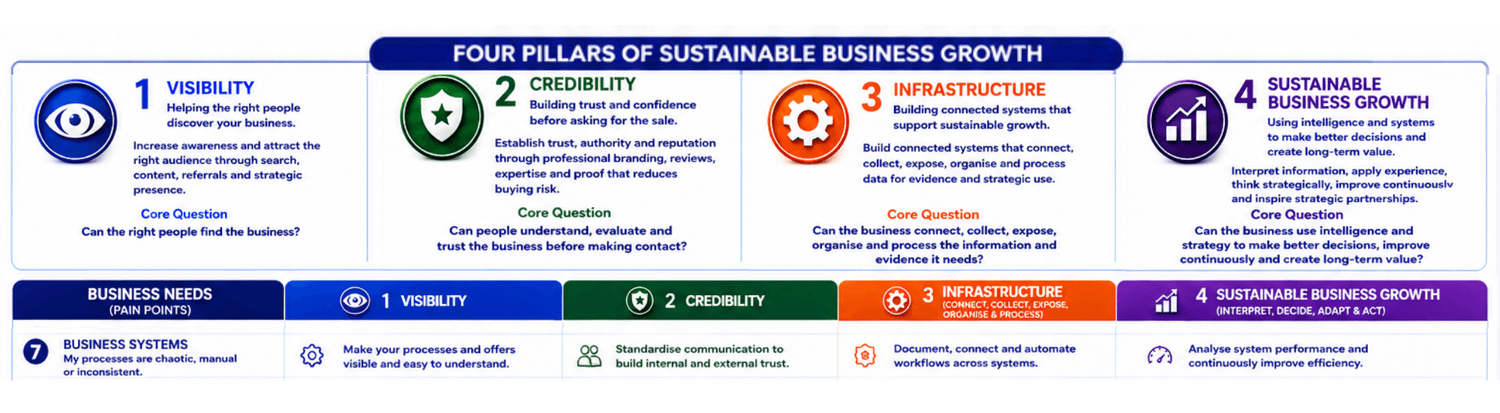
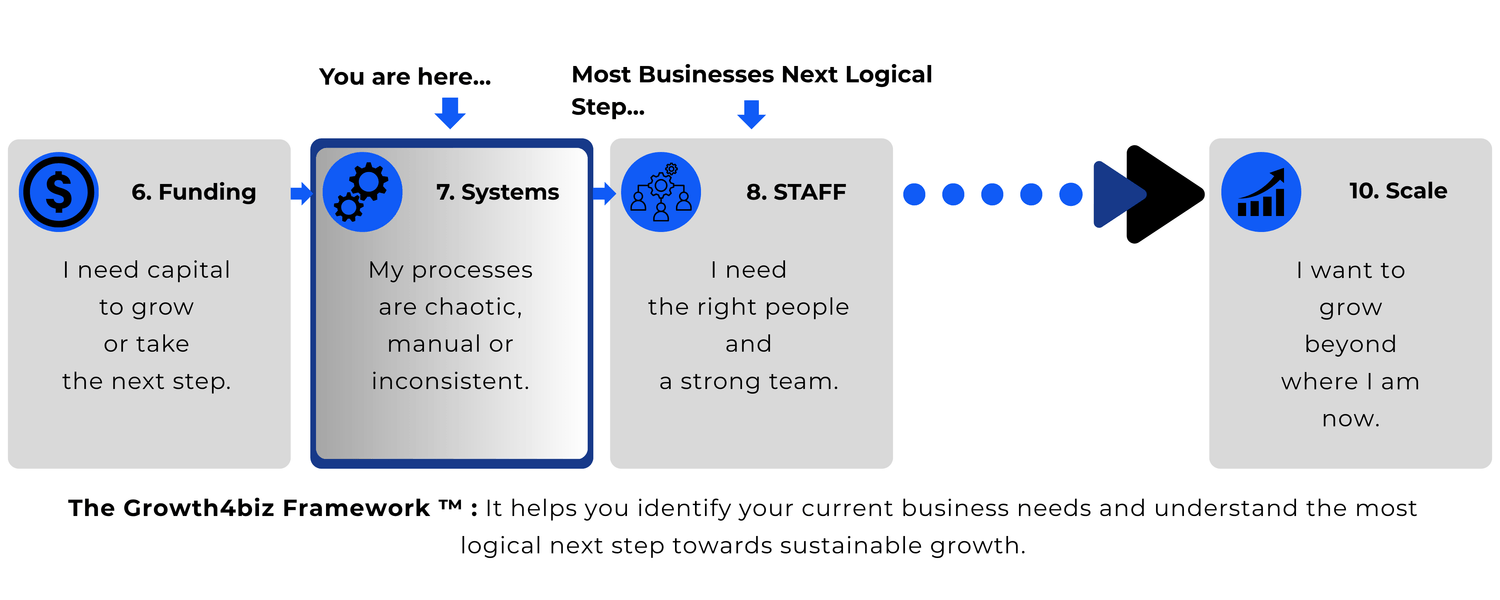

Primary Pillar — Infrastructure
What Connects, Collects, Supports, Organizes, Expose, Monitor, Sustains and Inspires Activity
Supporting Pillars:
Visibility
Credibility
Sustainable Business Growth
Primary Application Lens: Operational Lens
Business Need Hub: Business Systems
Why Business Systems Belong Within This Business Need
Businesses need systems to organise and manage the activities required to operate consistently.
These activities may involve attracting customers, recording enquiries, managing relationships, processing transactions, delivering products or services, organising information and monitoring business performance.
As business activity increases, these responsibilities become more difficult to manage through individual effort and memory alone.
Business Systems therefore represent a practical business requirement: establishing the processes, arrangements and repeatable ways of working needed to perform important activities consistently.
Why Infrastructure Is the Primary Pillar
Within the Growth4biz Framework™, Infrastructure refers to the people, systems, data, relationships, capabilities and structures that connect, collect, expose, organise, monitor, support and inspire business activity.
Business systems form part of this broader infrastructure.
However, the two concepts are not interchangeable.
This article examines the particular systems a business needs, while also explaining the broader infrastructure that enables those systems to operate, connect and develop.
How the Supporting Pillars Contribute
Visibility involves the decisions a business makes about what it wants to present, communicate and how it intends to be perceived. The resulting activity creates interactions and opportunities that may require appropriate business systems.
Credibility concerns how audiences interpret the business's presentation, activities and available evidence, whether they consider it credible or worthy of trust, and how they respond. Those responses can generate enquiries, relationships, transactions and other activities that need to be managed.
Sustainable Business Growth involves interpreting information and experience made available through business activity and supporting infrastructure, then using that understanding to guide strategic decisions, action, adaptation and further development.
Business systems help make important activities more organised and repeatable, while the broader Infrastructure pillar provides the foundation needed to support connected and developing business activity.
1. What Are Business Systems?
Business systems are the particular processes, arrangements and repeatable ways of working a business needs to perform important activities consistently.
They establish how important tasks are carried out, how information is handled, who is responsible and how activities move from one stage to another.
Instead of relying entirely on individual memory, informal arrangements or people figuring things out as they go, a business uses established ways of working to manage recurring activities.
For example, consider a business that regularly receives enquiries from potential customers.
Without an established system, the owner may:
Receive enquiries through WhatsApp, email and telephone calls.
Write customer details in a notebook.
Respond whenever time allows.
Try to remember which customers need follow-ups.
Prepare quotations individually.
Forget to record whether an enquiry resulted in a sale.
A business system provides a more organised arrangement.
It may establish that:
Every enquiry must be recorded.
Customer information must be stored in an organised location.
Every enquiry must receive an appropriate response.
Follow-ups must be scheduled.
Each opportunity must have a recorded status.
The outcome must be documented.
The business now has a repeatable way of managing enquiries.
The process can be followed by the owner, an employee or an appropriately appointed external service provider.
The important difference is that the activity no longer depends entirely on someone remembering what to do next.
What Makes Something a Business System?
A business system generally brings together several elements:
A defined purpose: What activity is the system intended to manage?
A process: What steps need to happen?
An arrangement: How are the activities, responsibilities and resources organised?
Information: What information needs to be collected, recorded or used?
Responsibilities: Who performs or oversees the activities?
Consistency: How does the business ensure the process can be repeated?
Monitoring: How does the business know whether the system is functioning as intended?
Not every system requires sophisticated software, extensive documentation or a large team.
A small business may begin with a simple written procedure, a spreadsheet and a calendar.
Another business may require specialised software, several employees and automated workflows.
The appropriate arrangement depends on the activity, the business's requirements and the resources available.
A Business System Is More Than a Checklist
A checklist can form part of a business system, but it does not necessarily constitute the entire system.
For example, a checklist may remind an employee to inspect a product before delivery.
However, the broader quality-control system may also establish:
What must be inspected.
Who performs the inspection.
When it must happen.
What standards must be met.
How defects are recorded.
Who approves the final product.
What happens when the product fails inspection.
The checklist supports the system by making an important part of the process easier to follow.
The system is the organised arrangement that makes the activity repeatable, not simply the individual document or tool used to perform it.
2. How Do Business Systems Work?
Business systems work by organising recurring activities into processes that can be understood, performed, monitored and improved.
They help businesses move away from relying on isolated actions and towards coordinated ways of working.
A typical business system may follow this general structure:
Activity → Process → Organisation → Execution → Monitoring → Improvement
Each stage contributes to the overall functioning of the system.
1. Activity: Identify What Needs to Be Done
Every business system begins with an activity or business requirement.
For example:
Managing customer enquiries.
Preparing quotations.
Processing orders.
Delivering services.
Scheduling appointments.
Recording financial transactions.
Publishing marketing content.
The business first identifies what needs to happen and why the activity matters.
2. Process: Establish How the Activity Should Be Performed
Once the activity has been identified, the business establishes the steps required to complete it.
For example, a customer onboarding process may include:
Receiving confirmation that a customer has accepted a proposal.
Recording the customer's details.
Confirming the agreed services.
Collecting the required information.
Scheduling the initial activity.
Communicating the next steps.
The process provides a repeatable way of completing the activity.
3. Organisation: Arrange the Necessary Resources and Responsibilities
The business determines what is needed to make the process work.
This may involve:
People.
Information.
Responsibilities.
Documents.
Equipment.
Software.
Communication channels.
External service providers.
The objective is to ensure that the necessary resources and responsibilities are appropriately arranged.
4. Execution: Perform the Activity
The process is then carried out.
Depending on the business, this may happen manually, digitally, automatically or through a combination of approaches.
For example, an employee may manually inspect an order while the system automatically records the order status and sends the customer a notification.
5. Monitoring: Check Whether the System Is Working
A business should be able to establish whether its systems are functioning as intended.
Monitoring may involve checking:
Whether tasks are completed on time.
Whether enquiries receive responses.
Whether information is recorded accurately.
Whether customers experience unnecessary delays.
Whether errors occur repeatedly.
Whether responsibilities are being fulfilled.
Monitoring helps identify problems before they become larger operational challenges.
6. Improvement: Strengthen the Way the System Works
Business systems should not remain unchanged when business requirements develop.
The business may discover that a particular process is taking too long, that customers are experiencing unnecessary delays or that an existing arrangement no longer supports the volume of activity.
The business can then adjust its processes, responsibilities, resources or technology.
This creates an opportunity for continuous improvement.
Related Read:
Website Improvements and Maintenance: Why a Business Website Can't Be Free or a Once-Off Purchase [Coming Soon]
A Practical Example: Managing Customer Enquiries
Imagine a professional services business that receives enquiries through its website.
Its customer enquiry system might operate as follows:
Stage
What happens
1. Enquiry
1. A potential customer submits a website form.
2. Recording
2. Customer information is stored in a CRM.
3. Confirmation
3. The customer receives an acknowledgement.
4. Assignment
4. The enquiry is assigned to the appropriate person.
5. Follow-up
5. A reminder is created for further communication.
6. Progress
6. The opportunity is updated as it moves through the sales process.
7. Outcome
7. The business records whether the enquiry became a customer.
Each stage contributes to a repeatable way of managing enquiries.
The software may help automate some activities, but the system also depends on the business's processes, information, responsibilities and people.
Why This Matters
A business does not need to automate every activity to have an effective system.
It needs to establish how important activities should be performed and ensure that the necessary arrangements are in place to support them.
Automation can then improve the execution of suitable parts of the process.
The objective is consistency, not complexity.
3. Business Systems vs Business Infrastructure
Business Systems and Business Infrastructure are closely related, but they do not mean the same thing.
Understanding the distinction is essential when considering what a business needs to establish, strengthen or develop.
Business Systems refer to the particular processes, arrangements and repeatable ways of working a business needs to perform important activities consistently.
Business Infrastructure refers to the broader foundation of people, systems, data, relationships, capabilities and structures that connect, collect, expose, organise, monitor, support and inspire business activity.
The difference is primarily one of scope and perspective.
Business systems focus on particular ways of working.
Infrastructure considers the broader environment that enables those ways of working, alongside other business activities, to function and develop.
Understanding the Difference
Business Systems
Business Infrastructure
1. Particular processes and arrangements.
1. The broader enabling foundation.
2. Establish repeatable ways of working.
2. Connects and supports business activity.
3. Focuses on how important activities are performed.
3. Includes the people, systems, data, relationships, capabilities and structures supporting those activities.
4. Addresses specific operational requirements.
4. Addresses broader organisational and operational capabilities.
5. May involve one or several processes.
5. May support multiple systems and activities.
6. Can be established or improved as a specific business requirement.
6. Develops as the wider foundation supporting the business.
An Example: Customer Relationship Management
Consider a business that introduces a Customer Relationship Management (CRM) system.
When discussing Business Systems, we examine how the CRM supports a repeatable customer management process.
For example:
Recording enquiries.
Storing customer information.
Tracking communication.
Scheduling follow-ups.
Monitoring sales opportunities.
The focus is on the system and the activities it helps the business perform consistently.
When examining Infrastructure, however, the CRM becomes one component of a much broader arrangement.
We also consider:
The people responsible for managing customer relationships.
The quality and organisation of customer information.
The procedures supporting customer communication.
The relationship between the CRM and other business systems.
The capabilities required to manage customer activity.
External relationships or partnerships that support customer service.
The ability to monitor, interpret and use customer information.
The CRM has not stopped being a business system.
It is simply being considered within the wider infrastructure that supports it.
Business Systems Are Part of Infrastructure, NOT an Alternative to It
This distinction is particularly important.
A business can have individual systems without having all the infrastructure needed to support them effectively.
For example:
A company may have a well-designed customer management process but lack sufficient people to respond to enquiries.
It may have documented procedures but lack the capabilities required to perform them.
It may have several software applications but no appropriate arrangements for connecting or managing the information they contain.
In these situations, the business may have established systems, but its broader infrastructure may still require attention.
The opposite can also happen.
A business may have employees, equipment, software and other resources but lack clear processes for using them consistently.
Having infrastructure does not automatically mean that effective business systems exist.
Business systems form part of infrastructure, but infrastructure extends beyond business systems.
Why the Distinction Matters to Business Owners
When a business identifies a problem, it should understand whether it needs to improve a particular system or strengthen the broader infrastructure supporting its activities.
For example:
If enquiries are not being followed up, the business may need a better customer management system.
If nobody is available to manage the enquiries, it may need additional people or external support.
If customer information is scattered across disconnected platforms, it may need stronger data organisation and system integration.
If the business lacks the expertise to manage a particular activity, it may need to develop that capability internally or establish an appropriate partnership.
These are related challenges, but they do not necessarily require the same solution.
The distinction helps business owners avoid treating every operational problem as a software problem or assuming that purchasing a new application will resolve a broader infrastructure gap.
4. Business Systems as a Business Need vs Infrastructure as a Growth4biz Framework™ Pillar
The distinction above also needs to be understood within the Growth4biz Business Knowledge System.
Growth4biz uses Business Needs to organise the practical challenges and requirements businesses encounter.
The Growth4biz Framework™, on the other hand, provides four interconnected pillars through which business activity and development can be understood.
These are two different ways of examining business requirements.
Business Systems as a Business Need
When a business owner visits the Business Systems Hub, the focus is on a practical question:
What systems does my business need to establish, improve or organise to perform important activities consistently?
The discussion may involve:
Customer management systems.
Sales systems.
Marketing systems.
Operations systems.
Financial systems.
Communication systems.
Document management systems.
Appointment management systems.
These are examples of specific systems a business may need.
The objective is to help business owners understand the requirements, identify gaps and establish appropriate arrangements.
Infrastructure as a Growth4biz Framework™ Pillar
When Infrastructure is examined as a Growth4biz Framework™ pillar, the question becomes broader:
What people, systems, data, relationships, capabilities and structures connect, collect, expose, organise, monitor, support and inspire business activity?
This perspective extends beyond the individual processes being examined under the Business Systems need.
It considers the broader foundation that makes business activity possible and supports its development.
For example, a business may need:
Employees or appropriately appointed external service providers.
Digital systems and physical resources.
Organised information and data.
Documented procedures.
Professional relationships.
Strategic partnerships.
Operational capabilities.
Structures for monitoring and supporting activity.
The Difference in One Practical Example
Imagine a small business that needs to improve how it delivers services.
From the Business Systems perspective, it may need a service delivery process that establishes how customer requests are received, assigned, completed and reviewed.
From the Infrastructure perspective, it may need to examine whether it has:
People with the necessary skills.
Suitable equipment and resources.
Access to supporting technology.
Appropriate service delivery relationships.
Partnerships that extend its capacity.
Information and structures for monitoring service quality.
The first examination concentrates on the particular system.
The second examines the wider foundation required to support it.
A Useful Way to Remember the Difference
Business Need: What does the business need to establish or improve?
Growth4biz Framework™ Infrastructure pillar: What broader foundation enables the business and its systems to function, connect, develop and support activity?
The same business issue can therefore be examined from both perspectives without confusing the two.
5. How Visibility and Credibility Reveal the Need for Business Systems
Business systems do not exist independently of the rest of a business.
Their importance often becomes apparent when we examine what a business presents to its audience and how that audience responds.
The Visibility and Credibility pillars of the Growth4biz Framework™ help explain this relationship.
Visibility: The Business Makes Deliberate Decisions About What to Present
Within the Growth4biz Framework™, Visibility begins with decisions.
A business decides:
What it wants to present.
What it wants to communicate.
Which products or services to highlight.
How it wants to present itself.
Which channels it wants to use.
Which audiences it wants to reach.
How it intends to be perceived.
These decisions shape the business's subsequent presentation, activities and interactions.
For example:
A professional services business may decide to establish a website, publish educational articles, create a Google Business Profile and communicate its services through social media.
These are deliberate decisions that shape how the business presents itself.
Visibility therefore involves more than simply being seen.
It concerns what the business deliberately chooses to communicate and how it expresses those decisions through its activities and presentation.
Credibility: Audiences Interpret and Respond
Once the business presents itself, audiences interpret what they encounter.
They may consider:
Whether the business appears professional.
Whether its services are clearly explained.
Whether available information is consistent.
Whether there is evidence of relevant experience.
Whether its communication appears reliable.
Whether they have sufficient confidence to engage.
The audience may then respond in different ways.
For example, someone who discovers a business through Google may:
Visit its website.
Read its articles.
Examine its services.
Contact the business.
Request a quotation.
Schedule an appointment.
Make a purchase.
Decide not to proceed.
These responses form part of the observable activity generated through the audience's interaction with the business.
Importantly, visibility does not guarantee credibility, and credibility does not guarantee a sale.
Different audiences may interpret the same presentation differently and respond in different ways.
However, the information and activity generated through these interactions can help a business understand what is happening.
How These Activities Reveal the Need for Business Systems
Consider a business that previously received only a few enquiries each month.
The owner could manage them personally through WhatsApp and telephone calls.
After improving its website, publishing useful content and strengthening its online presentation, the business begins receiving more enquiries.
Its visibility has increased.
More people are discovering the business, interpreting its presentation and deciding whether to engage.
However, the increased activity creates new requirements.
The business now needs a reliable way to:
Capture enquiries.
Record customer information.
Respond consistently.
Manage quotations.
Schedule follow-ups.
Monitor opportunities.
Organise customer relationships.
The business has discovered a Business Systems need.
The need did not necessarily arise because the business had poor systems before.
It may have risen because its activities and requirements have changed.
Visibility and Credibility Can Reveal What Infrastructure Is Needed
The relationship extends beyond the need for individual systems.
The activity generated through Visibility and the responses arising from audience interpretation under Credibility can provide information about what the business needs to support.
For example:
Increased enquiries may reveal a need for stronger customer management processes.
More appointments may reveal a need for better scheduling arrangements.
Growing customer demand may reveal a need for additional service delivery capacity.
More complex customer requirements may reveal a need for specialised skills.
Increased communication may reveal a need for additional people or external support.
The business can use this information to consider what infrastructure needs to be established or strengthened.
This may involve technology, people, data, relationships, capabilities, structures or strategic partnerships.
Understanding the Relationship Between the Four Pillars
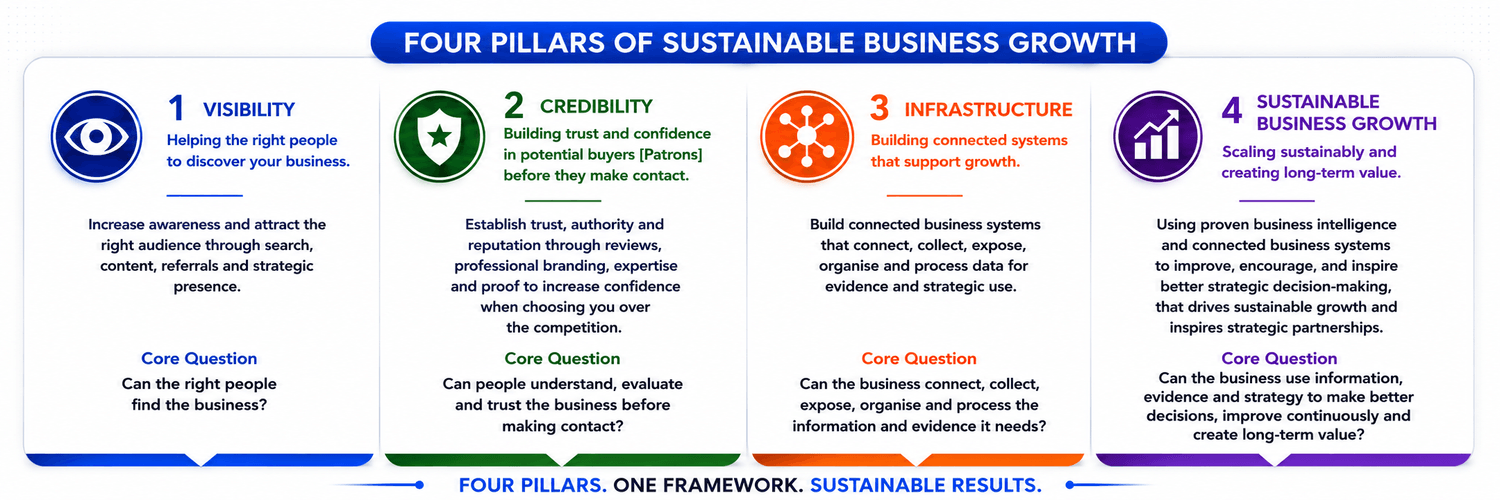
The following illustration shows one way to understand the relationship between the 4 Pillars:
Visibility — Deliberate Decisions and Presentation
The business makes decisions about what it wants to communicate and presents itself through relevant activities and channels.
↓
Credibility — Audience Interpretation and Response
Audiences interpret what they encounter and may respond through enquiries, interactions, engagement, transactions or other activities.
↓
Infrastructure — Connecting, Collecting, Organising, Exposing, Monitoring, Supporting and Inspiring
The business uses relevant information and experience to establish and strengthen the broader foundation needed to support its activities, including its business systems.
↓
Sustainable Business Growth — Interpretation and Strategic Decision-Making
The business interprets information and experience made available through its activities and supporting infrastructure, using that understanding to guide decisions, action, adaptation and further development.
This relationship highlights two important dimensions.
The first two pillars help us understand what the business deliberately puts forward and how audiences interpret and respond to it.
The latter two help us understand the supporting foundation and how the business interprets the information and experience available to guide its development.
This is an analytical way of understanding the interconnected pillars, not a rigid sequence that every business must follow.
Why This Matters
A business should not simply increase its visibility without considering its ability to manage the resulting activity.
Likewise, it should not assume that every increase in customer interaction automatically requires more software or employees.
The business needs to interpret what is happening, identify the actual requirements and establish appropriate systems and infrastructure.
This is where the four Growth4biz Framework™ pillars contribute to a broader understanding of Business Systems.
6. How Business Systems Contribute to Stronger Infrastructure
Business systems are part of infrastructure, but establishing individual systems is only one aspect of developing the broader foundation that supports a business.
A system may require people, information, technology, relationships and capabilities to function effectively.
These elements need to work together.
People and Responsibilities
Business systems require people to establish, operate, supervise or improve them.
A customer management system, for example, may require someone to:
Review incoming enquiries.
Respond to customers.
Update information.
Follow up on opportunities.
Resolve problems.
Monitor customer activity.
Automation may reduce repetitive work, but people remain important where judgement, communication, relationships and decision-making are required.
Automation Doesn't Replace People
Business systems often depend on accurate and accessible information.
A customer management system needs reliable customer records.
A financial system needs accurate transaction information.
A project management system needs clear task information and progress updates.
Without organised information, even a well-designed process may produce unreliable results.
Relationships and Strategic Partnerships
Not every business needs to employ a full internal team to perform every activity.
In some circumstances, relationships and strategic partnerships can provide access to capabilities that would otherwise be expensive or difficult to establish internally.
For example, a small business may:
Work with an external accountant.
Partner with a specialist marketing provider.
Outsource selected administrative activities.
Use an independent logistics provider.
Work with a technology specialist.
Collaborate with another business to deliver a service.
These arrangements can help a business extend its capacity without immediately taking on the cost and responsibilities of employing additional staff.
However, partnerships must be appropriately structured.
Responsibilities, expectations, communication, accountability and service requirements should be clear.
A partnership is not automatically effective simply because two businesses agree to work together.
It must contribute meaningfully to the capabilities and activities being supported.
Capabilities and Structures
Infrastructure also involves the capabilities and structures needed to perform business activities.
A business may have a documented process but lack the expertise to execute it.
It may have software but lack the capability to manage it.
It may have several external partners but lack a structure for coordinating their contributions.
These situations reveal why infrastructure must be understood more broadly than technology or individual business systems.
Business Systems and Infrastructure Work Together
Consider a business that establishes a project management system.
The system may organise tasks, deadlines, responsibilities and project progress.
However, its effectiveness may depend on:
People with the necessary skills.
Clear responsibilities.
Accurate project information.
Appropriate communication arrangements.
Access to necessary resources.
Relationships with external specialists.
Management structures for monitoring progress.
The business system provides an organised way of managing projects.
The broader infrastructure supports the people and resources involved in delivering them.
Business systems organise important activities.
Infrastructure provides the broader foundation that enables those activities and systems to function, connect and develop.
7. Business Systems vs Software and Technology
Business systems and software are often discussed as though they mean the same thing.
They do not.
A business system is an organised arrangement of processes, responsibilities, information and repeatable activities.
Software and technology are tools that can support, automate or improve parts of that arrangement.
A business can have an effective system without specialised software.
Likewise, a business can purchase several software applications and still have poorly organised processes.
Understanding the Difference
Business Systems
Software and Technology
1. Establish how activities should be performed.
1. Provide tools for performing or supporting activities.
2. Include processes and arrangements.
2. Include applications, platforms and technological resources.
3. Can exist without specialised software.
3. May support manual or automated processes.
4. Establish responsibilities and procedures.
4. Can help assign, record or automate tasks.
5. Focus on consistent business activity.
5. Focus on providing particular technological capabilities.
Example: A Customer Follow-Up System
A business may establish a customer follow-up system using:
A spreadsheet.
A calendar.
A written procedure.
A designated person responsible for follow-ups.
This is a basic system.
The business could later introduce a CRM that records customer information, tracks communication and creates reminders.
The software improves the way the system operates, but the underlying business requirement remains the same.
The business still needs to know:
Who should be followed up?
When should the follow-up happen?
Who is responsible?
What information should be communicated?
How should the outcome be recorded?
The software does not automatically answer these questions.
Examples of Software That Can Support Business Systems
The following products illustrate different ways technology can support business activity. They are examples of available tools, not a universal recommendation or an endorsement by Growth4biz Media.
1. HubSpot CRM — Customer Management
HubSpot provides customer relationship management capabilities that include contact management, deal tracking, activity records and pipeline management.
It can support a customer management system by helping businesses organise information and monitor interactions with potential and existing customers.
2. OneStream Live — Content Distribution and Marketing Activity
OneStream Live allows users to schedule pre-recorded videos to be broadcast as live streams on supported destinations.
For example, a business may record educational videos in advance and schedule their distribution across selected platforms.
This can support a content distribution process by helping the business organise when and where content is published without requiring someone to be physically present for every broadcast.
OneStream Live is particularly useful as an example of how a specialised tool can support a repeatable marketing activity.
It does not, by itself, establish the business's complete marketing system. The business still needs a content strategy, suitable material, scheduling decisions, audience understanding and a way to monitor the results.
3. Calendly — Appointment Scheduling
Calendly helps businesses arrange appointments and meetings through online scheduling.
It can support an appointment management system by allowing customers or prospects to select suitable meeting times according to the business's availability.
4. Trello — Project and Task Management
Trello provides boards, lists and cards that can be used to organise tasks and track work through different stages.
It can support project management and internal workflow systems.
5. Xero — Financial Management
Xero provides accounting capabilities that can support activities such as invoicing, expense management, bank reconciliation and financial record-keeping.
It can form part of a business's financial management system.
What These Examples Demonstrate
These tools serve different purposes.
Some support customer relationships, others support marketing activities, appointment scheduling, project management or financial administration.
A business may use one tool, several tools or a broader integrated platform.
The important consideration is not how many applications the business owns.
It is whether the technology supports the processes and arrangements the business actually needs.
Before investing in software, establish the business requirement first.
Then identify the appropriate tools.
8. Signs Your Business Needs Better Systems
A business may need better systems when important activities are becoming difficult to manage consistently.
These signs do not automatically mean that the entire Infrastructure pillar is inadequate.
In this section, we are specifically examining the Business Systems need: the processes, arrangements and repeatable ways of working required to manage important activities.
Some of the same symptoms may also reveal broader infrastructure requirements, but that should be examined separately.
1. You Frequently Forget Important Tasks
You may regularly forget to respond to enquiries, send quotations, follow up with customers or complete administrative activities.
This often happens when the business relies on memory rather than established processes.
A task management or follow-up system can help make responsibilities and deadlines more visible.
2. Customer Information Is Scattered
Customer details may be stored across notebooks, WhatsApp messages, email accounts, spreadsheets and individual devices.
This makes it difficult to retrieve information and maintain consistent communication.
A customer information management system can help organise records in a more accessible location.
3. The Same Activities Are Repeated Differently
One employee may follow one process while another uses a completely different approach.
Customers may receive inconsistent communication or experience different service standards.
Documented processes and clearer responsibilities can help establish greater consistency.
4. You Depend Too Much on Memory
The owner may be the only person who knows which tasks need to be completed, where important documents are stored or how particular activities should be performed.
This creates unnecessary dependence on one individual.
A more organised system can make important information and procedures accessible to the appropriate people.
5. You Struggle to Track Business Progress
You may find it difficult to establish:
How many enquiries are being received.
Which quotations are outstanding.
Which projects are delayed.
Which customers require attention.
Which invoices remain unpaid.
A system that records and organises relevant information can make these activities easier to monitor.
6. Business Growth Creates More Administrative Work
As the number of customers, orders or projects increases, the owner spends more time coordinating activities.
The business may need better processes to manage the increased workload.
7. Employees Frequently Ask the Same Questions
When procedures are unclear or undocumented, employees may repeatedly ask how to perform routine tasks.
Clearer processes and accessible documentation can reduce unnecessary interruptions.
8. Customers Experience Inconsistent Service
Customers may receive delayed responses, incomplete information or different levels of service depending on who handles their requests.
A more structured customer management and service delivery system can help establish consistent standards.
9. You Spend Too Much Time Solving the Same Problems
Repeatedly correcting the same mistakes may indicate that the underlying process needs attention.
Rather than solving every incident individually, examine the process responsible for producing the problem.
10. You Feel Busy but Cannot Easily Measure Progress
A business can be extremely active without having a clear understanding of what has been accomplished.
Systems that record activities, responsibilities and outcomes help business owners evaluate whether their efforts are producing the intended results.
Important Clarification: A Systems Problem Is Not Always an Infrastructure Problem
These signs primarily help identify weaknesses in particular business systems.
However, further investigation may reveal that the underlying issue involves insufficient people, skills, resources, relationships or capabilities.
For example:
Delayed customer responses may result from an ineffective follow-up process.
But they may also result from having insufficient people available to handle customer communication.
The first requires attention to the business system.
The second may require strengthening the broader infrastructure.
Sometimes both are necessary.
9. How to Begin Building Business Systems
Establishing business systems does not have to involve expensive software, complicated procedures or a large team.
The best approach is to start with important activities that need to be performed consistently.
Step 1: Identify Repeated Business Activities
Look at the activities your business performs regularly.
These may include:
Receiving enquiries.
Preparing quotations.
Following up with customers.
Processing orders.
Delivering services.
Managing appointments.
Recording financial transactions.
Publishing content.
Identify which activities are important and which ones currently create unnecessary problems.
Step 2: Understand How the Activity Currently Works
Before changing anything, examine the existing process.
Ask:
What happens first?
What happens next?
Who is responsible?
What information is required?
Where are records stored?
What usually causes delays?
Where do mistakes occur?
This helps establish what actually needs improvement.
Step 3: Establish a Clear Process
Determine how the activity should be performed.
Keep the process practical.
For example, a simple quotation process could establish:
Receive the customer request.
Record the customer's information.
Confirm the required products or services.
Prepare the quotation.
Review the quotation.
Send it to the customer.
Record the response.
Schedule an appropriate follow-up.
Step 4: Assign Responsibilities
Decide who is responsible for each part of the process.
In a small business, one person may perform several responsibilities.
As the business grows, responsibilities may be distributed among employees or external service providers.
What matters is that accountability is clear.
Step 5: Organise the Required Information
Determine what information must be collected, stored and accessed.
For example, a customer management process may require:
Customer name.
Contact information.
Enquiry details.
Requested service.
Communication history.
Quotation status.
Follow-up date.
Final outcome.
Establish where this information should be stored and who should have access to it.
Step 6: Introduce Appropriate Tools
Once the process is understood, identify tools that could make it easier to perform.
Depending on the requirement, these might include:
Spreadsheets.
Calendars.
CRM software.
Accounting platforms.
Project management applications.
Appointment scheduling tools.
Document management systems.
Workflow automation platforms.
Do not introduce technology simply because it is available.
Choose tools according to the business's actual requirements.
Step 7: Document Important Procedures
Create simple instructions for activities that need to be performed consistently.
These may become Standard Operating Procedures (SOPs).
Documentation is particularly useful when:
Several people perform the same activity.
Tasks must be completed in a specific order.
The activity has important quality requirements.
Training is required.
The business needs continuity when responsibilities change.
Step 8: Monitor and Improve
Observe how the system performs.
Check whether:
Activities are completed correctly.
Responsibilities are understood.
Information is accessible.
Delays are decreasing.
Customers are receiving consistent service.
The process remains suitable as activity increases.
Make improvements where necessary.
Start With What Matters Most
You do not need to systemise every activity simultaneously.
Start with the activities that have the greatest effect on customers, business operations, financial management or the owner's workload.
Build gradually.
A simple system that is consistently used is often more valuable than a sophisticated system that nobody understands or follows.
10. How Business Systems Contribute to Sustainable Business Growth
Business systems contribute to sustainable business growth by making important activities more organised, repeatable and manageable.
However, their contribution extends beyond saving time.
They can help businesses establish more reliable ways of working and create conditions that support further development.
They Reduce Unnecessary Dependence on Individual Memory
When important activities are organised into repeatable processes, the business becomes less dependent on one person remembering every detail.
This can improve continuity and make responsibilities easier to share.
They Improve Consistency
Customers benefit when businesses establish reliable processes for communication, service delivery and administration.
Employees also benefit from understanding what is expected of them.
They Make Business Activity Easier to Monitor
When information is collected and organised, business owners can examine what is happening.
They can identify delays, recurring problems, opportunities and areas requiring attention.
They Support Better Use of Resources
Organised processes can help businesses identify unnecessary duplication, inefficient activities and opportunities to use their available resources more effectively.
They Help Businesses Prepare for Increased Activity
A business that has established appropriate systems may find it easier to manage increasing enquiries, customers, orders or projects.
This does not mean that systems automatically eliminate the need for additional people or resources.
It means the business has a more organised foundation from which to evaluate and manage its requirements.
They Create Opportunities for Strategic Development
Information and experience generated through business activity can help business owners interpret what is working, what needs attention and where further development may be appropriate.
This connects Business Systems to the Sustainable Business Growth pillar.
The systems help organise activity and make relevant information available.
The business then needs to interpret that information and use it to guide decisions, adaptation and further development.
11. The Benefits of Effective Business Systems
Effective business systems can contribute to several important business outcomes.
Improved Productivity
Repeatable processes reduce unnecessary uncertainty about what needs to happen next.
Employees and business owners can spend less time figuring out routine activities and more time completing meaningful work.
Better Customer Experience
Organised customer management and service delivery processes can improve response times, communication and consistency.
Fewer Repeated Mistakes
Clear procedures and defined responsibilities help reduce avoidable errors.
They also make it easier to identify where problems originate.
Better Team Coordination
When responsibilities and processes are understood, people can coordinate their activities more effectively.
Easier Training and Onboarding
Documented procedures help new employees understand how important activities are performed.
They also reduce the need for existing employees to explain the same routine tasks repeatedly.
Better Information Management
Business systems help establish how information should be recorded, organised and accessed.
This can improve continuity and reduce unnecessary information loss.
Greater Operational Visibility
When activities and outcomes are recorded, management can better understand the status of important business processes.
More Manageable Growth
As business activity increases, appropriate systems help create more organised ways of managing the resulting workload.
They do not eliminate operational complexity, but they can make it easier to manage.
12. Common Mistakes Businesses Make When Establishing Systems
1. Buying Software Before Understanding the Process
Why it happens: Business owners assume that purchasing an application will automatically solve an operational problem.
Why it causes problems: The business may end up with software that does not match its actual requirements.
How to avoid it: Establish the process first. Identify what needs to happen, then select technology that supports it.
2. Assuming Every Activity Needs Automation
Why it happens: Automation is often presented as the ultimate solution to administrative work.
Why it causes problems: Some activities require human judgement, communication, relationships or approval.
How to avoid it: Automate suitable repetitive activities while retaining human involvement where it adds value.
3. Creating Too Many Disconnected Systems
Why it happens: Businesses introduce different applications whenever a new problem appears.
Why it causes problems: Information becomes scattered, employees must switch between platforms and processes become difficult to coordinate.
How to avoid it: Evaluate whether new tools can work with existing systems before introducing additional applications.
4. Failing to Document Important Processes
Why it happens: Business owners assume everyone understands how routine activities should be performed.
Why it causes problems: Knowledge remains with individuals, and processes become inconsistent when responsibilities change.
How to avoid it: Document important procedures in a practical and accessible format.
5. Ignoring the People Using the Systems
Why it happens: Businesses focus on the technology rather than the people expected to use it.
Why it causes problems: Employees may not understand the system or may continue using old arrangements.
How to avoid it: Involve relevant people in implementation, provide training and make responsibilities clear.
6. Automating Ineffective Processes
Why it happens: Businesses want to reduce manual work as quickly as possible.
Why it causes problems: Automation can make an ineffective process happen faster without correcting the underlying problem.
How to avoid it: Review and improve the process before automating it.
7. Failing to Monitor Performance
Why it happens: Once a system is established, the business assumes it will continue working effectively.
Why it causes problems: Errors, delays and changing requirements may go unnoticed.
How to avoid it: Establish appropriate monitoring and review arrangements.
8. Trying to Build Everything at Once
Why it happens: Business owners want to create a complete, sophisticated operating environment immediately.
Why it causes problems: Implementation becomes expensive, complicated and difficult to manage.
How to avoid it: Introduce systems gradually, prioritising the most important business requirements.
13. Practical Tips and Best Practices
The following practices can help businesses establish systems without introducing unnecessary complexity.
Start with recurring activities. Identify tasks that happen frequently and have an important effect on business operations.
Prioritise customer-facing processes. Enquiry management, communication and service delivery are often good starting points.
Keep processes understandable. Employees should be able to understand what needs to happen without navigating unnecessarily complicated instructions.
Assign clear responsibilities. Every important activity should have an appropriate person responsible for completing or overseeing it.
Organise business information. Establish consistent arrangements for storing and accessing important records.
Use technology selectively. Choose software according to the processes it needs to support.
Document essential procedures. Make important instructions accessible to the people who need them.
Consider external capabilities. Where internal resources are insufficient, investigate whether an appropriate service provider or strategic partnership could help.
Monitor important activities. Track information that helps the business understand whether its systems are working.
Review systems as the business develops. Processes that worked when the business was small may need to change as requirements increase.
Avoid unnecessary complexity. The objective is to improve consistency, not to introduce more administration.
Keep people involved. Systems should support people in performing their responsibilities, not remove human judgement where it is needed.
Frequently Asked Questions
Business systems are the processes, arrangements and repeatable ways of working a business uses to perform important activities consistently. They help organise tasks, responsibilities and information so that the business does not have to rely entirely on memory or informal arrangements.
Examples include customer management systems, sales systems, marketing systems, operations systems, financial management systems, appointment scheduling systems and project management systems. Each helps organise a particular area of business activity.
Business systems are particular processes, arrangements and repeatable ways of working. Business infrastructure is the broader foundation of people, systems, data, relationships, capabilities and structures that supports and connects business activity. Business systems form part of infrastructure, but infrastructure extends beyond them.
No. A business system establishes how an activity should be performed. Software provides tools that can support, automate or improve parts of that activity. A business can have effective systems using simple manual arrangements, while purchasing software does not automatically create an effective business system.
Yes. Every business performs activities that need to be managed consistently. However, the complexity of the systems required will depend on the business's size, activities, customers and operating requirements. A small business may need only simple processes and basic tools to begin with.
A business should begin establishing systems as soon as important activities become recurring and need to be managed consistently. It is particularly valuable to strengthen systems before increasing business activity creates unnecessary administrative pressure and operational bottlenecks.
Some activities can be managed through technology and automation, but business systems still require appropriate oversight, judgement and accountability. Depending on the business, these responsibilities may be handled by the owner, employees, independent service providers or strategic partners.
Business systems help businesses manage recurring activities more consistently, improve coordination, organise information and reduce unnecessary administrative work. They can also make it easier to monitor performance and prepare for increased activity. Their contribution to sustainable growth depends on how effectively the business uses the information and experience they help make available.
There is no universal starting point. However, customer enquiry and management processes are often useful starting points because they help businesses record, respond to and manage customer interactions. The most appropriate starting point depends on where the business experiences its greatest operational difficulty.
No. Automation is optional and should be introduced where it improves an established process. A clearly documented manual process can be an effective business system. The objective is consistent performance, not maximum automation.
Final Thoughts
Businesses do not become organised simply because they acquire more software, employ more people or introduce additional procedures.
They become more organised when important activities are supported by appropriate processes, arrangements and repeatable ways of working.
That is what business systems are intended to establish.
They help business owners move away from constantly remembering, improvising and correcting the same activities towards more consistent and manageable ways of operating.
However, business systems should never be viewed in isolation.
They form part of the broader Infrastructure pillar of the Growth4biz Framework™.
The people, data, relationships, capabilities and structures surrounding those systems determine how effectively they can operate, connect and develop.
The relationship with the other pillars is equally important.
Visibility begins with deliberate decisions about what a business presents and communicates. Credibility concerns how audiences interpret that presentation and respond. The resulting business activity can reveal requirements that need to be supported through appropriate systems and broader infrastructure.
Information and experience made available through these activities and supporting infrastructure can then be interpreted to guide strategic decisions, action, adaptation and further development.
This is how Business Systems contribute to a broader understanding of sustainable business growth.
At Growth4biz Media, we believe that building a business should involve more than simply increasing activity.
It should involve establishing the appropriate systems, capabilities and supporting infrastructure to manage that activity effectively.
Build systems that support your business.
Strengthen infrastructure that supports those systems.
Use what you learn to make better decisions and develop sustainably.
Because growing a business is not simply about doing more.
It is about becoming better equipped to do what matters consistently.
Continue Your Growth Journey
Related Articles
What Are Business Systems? Understanding How They Work and Why Businesses Need Them — This guide.
Website Improvements and Maintenance: Why a Business Website Can't Be Free or a Once-Off Purchase — [Coming Soon]
The Five Core Business Systems Every Growing Business Should Understand — [Coming Soon]
Customer Relationship Management (CRM): How Businesses Organise and Manage Customer Relationships — [Coming Soon].
Related Downloads
Business Systems Assessment Guide — Coming Soon.
Business Systems Planning Guide — Coming Soon.
Related Checklists
Business Systems Readiness Checklist — Coming Soon.
Business Process Review Checklist — Coming Soon.
Related Worksheets
Business Process Mapping Worksheet — Coming Soon.
Business Systems Planning Worksheet — Coming Soon.
Business Need Hub
Explore the Business Systems Hub for additional guidance on understanding, selecting, establishing and improving the systems that support your business activities.
Primary Pillar
Supporting Pillars
Visibility
Credibility
Sustainable Business Growth
Next Guide
The Five Core Business Systems Every Growing Business Should Understand
Explore the five important categories of business systems and understand how they contribute to managing customer relationships, sales, marketing, operations and financial activities.
Book a Consultation
As business activity increases, managing everything through memory and manual processes can become increasingly difficult.
Growth4biz Media helps businesses establish and strengthen their digital business infrastructure through appropriate online systems, business processes and connected digital solutions.
Whether you need to organise customer enquiries, improve your online presence, establish better workflows or strengthen the way your business operates, we can help you identify practical opportunities for improvement.
Let's discuss how appropriate business systems can help your business operate more effectively and prepare for sustainable growth.
Sources and Further Reading
The following official sources provide additional information about the software examples discussed in this article. They illustrate how different technology platforms can support particular business activities. Their inclusion does not constitute a recommendation or endorsement.
HubSpot — CRM Software. Provides information about customer contact management, deal tracking, activity records and sales pipeline management.
OneStream Live — Pre-Recorded Streaming. Explains how businesses and content creators can schedule previously recorded videos for broadcast as live streams.
OneStream Live Help Centre — What Are the Ways to Go Live with OneStream Live?. Explains the platform's different streaming methods, including scheduled pre-recorded broadcasts.
Calendly — Scheduling. Provides information about online appointment scheduling, availability management and meeting coordination.
Trello — How to Create a Trello Project. Explains how boards, lists and cards can be used to organise tasks and establish workflows.
Xero South Africa — Accounting Software. Provides information about accounting tools, invoicing, expense management, financial records and bank feeds.
Software features, availability, subscription conditions and pricing may change. Consult the providers' current official information before selecting or purchasing a product.
SHARE




ABOUT
Growth4biz Media is a Digital Business Infrastructure Agency helping businesses establish, strengthen and evolve the digital capabilities that support how they operate, communicate, connect with people and grow.
We do more than keep websites alive or help people monetise their intellectual property or expertise. We are helping businesses keep their digital capabilities relevant and useful as their operating environments change.
Copyright 2026 • Growth4biz Media (Pty) Ltd.