
What Is a Business Foundation? A Complete Guide to Building a Strong Foundation
Introduction
A business can have customers, generate revenue and maintain an active social media presence while still lacking the foundation it needs to develop further.
Perhaps the business owner handles every enquiry personally, stores important information across several devices, struggles to explain what makes the business different, or relies on a social media account to maintain contact with customers. Business may be moving forward, but the underlying arrangements have not necessarily developed at the same pace.
These situations are not unusual. Many business owners concentrate on the immediate demands of running a business: finding customers, delivering services, collecting payments and keeping operations moving. Foundational decisions can seem less urgent when there is work to do and income to generate.
However, the consequences often become more apparent as the business develops. Information becomes harder to manage, customer experiences become inconsistent, opportunities are missed, and the owner may find it increasingly difficult to delegate responsibilities or respond to new demand.
This is why a business foundation should not be understood as something that is established once and then forgotten.
A business foundation is the combination of fundamental decisions, assets, structures, relationships and capabilities that supports the existence, operation and development of a business.
Some of these elements are established when a business is first created. Others become necessary as its activities, responsibilities and ambitions change.
A new business may need to clarify what it offers and establish the essential arrangements for operating professionally. An established business may need to organise its information, strengthen its processes or address gaps that have emerged through years of operation. A business being rebuilt may need to reconsider which existing elements remain useful and which require replacement.
At Growth4biz Media, we examine business foundations within a broader understanding of business development. A foundation is not separate from visibility, credibility, infrastructure and sustainable growth. It provides the underlying conditions through which these dimensions can be developed and connected.
This guide explains what a business foundation involves, why it matters, how its essential elements fit together and what business owners can do to strengthen theirs.
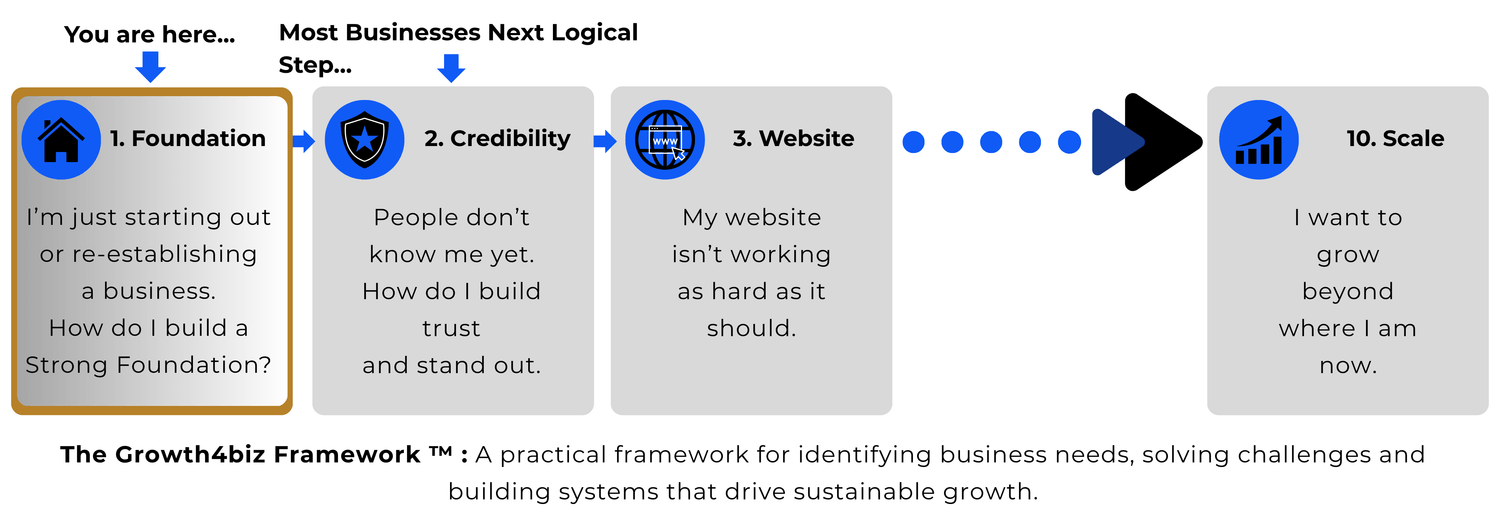
Your Position in the Growth4biz Framework™
Need — Business Foundation
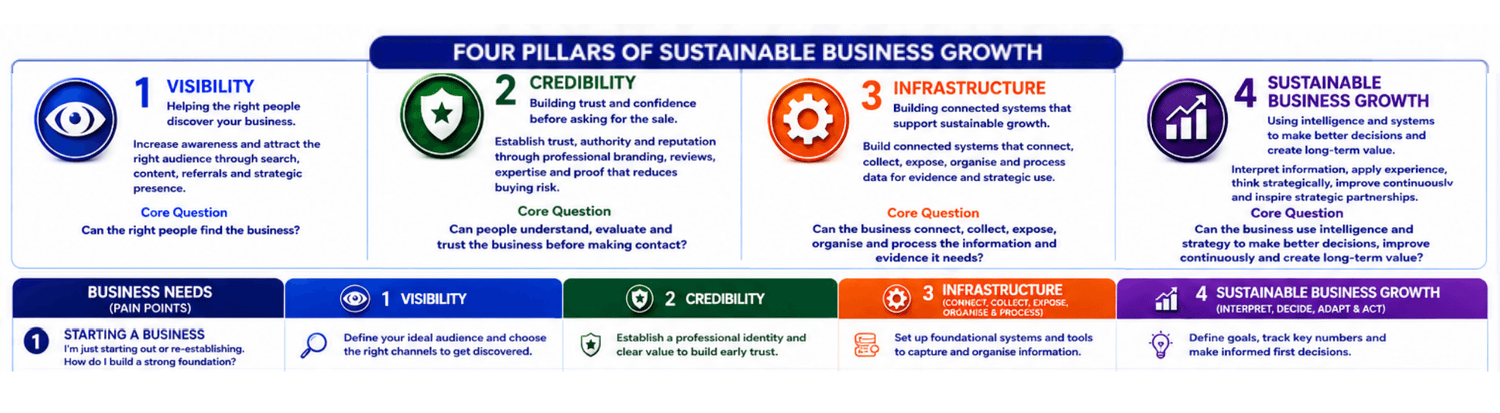

Primary Pillat — Infrastructure
Building connected systems that support growth.
The Business Foundation Need addresses the fundamental conditions that allow a business to establish itself, operate, communicate its value and develop over time.
Infrastructure is the primary pillar for this article because a business foundation includes the people, systems, processes, assets, relationships and capabilities that support its activities.
Supporting Article: Visibility, Credibility, Sustainable Growth
Application Lens: Analytical
However, infrastructure alone does not explain the entire foundation.
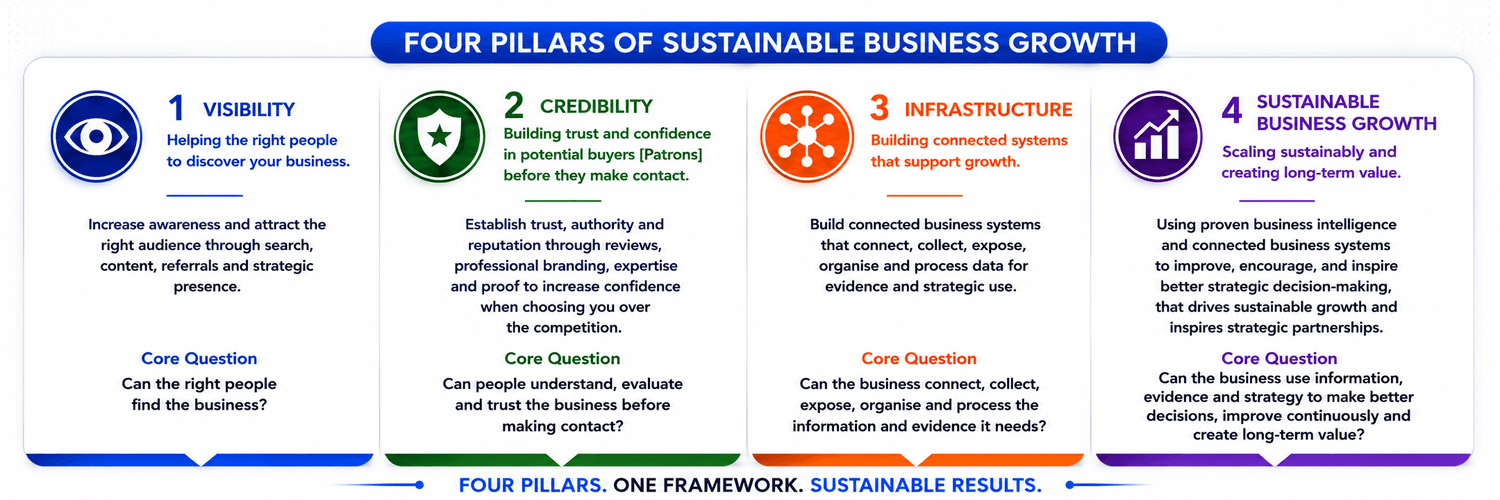
Visibility concerns what the business deliberately presents about its identity, purpose, positioning and activities.
Credibility concerns the information audiences can observe and evaluate when forming their perceptions of the business.
Sustainable Growth concerns how the business interprets information and experience, makes decisions, develops capability and adapts.
These pillars are interconnected, but they are not interchangeable.
The Business Foundation Need therefore provides a useful starting point for examining how the fundamental elements of a business fit together.
This article primarily uses the Analytical Lens to explain observable business conditions and the relationships between foundational elements. Its practical recommendations offer general educational guidance rather than a diagnosis of any particular business.
A strong foundation can help prepare a business for subsequent Business Needs, including Credibility, Website, Visibility, Leads and Systems. It does not guarantee success, but it can make future development more coherent and manageable.
1. What Is a Business Foundation?
A business foundation is the underlying combination of elements that allows a business to exist, function and develop.
It includes more than the legal act of registering a company or choosing a business name. It also includes the decisions, resources and arrangements that shape how the business operates and how others encounter it.
Depending on the nature of the business, its foundation may include:
A clearly defined business purpose and direction.
A suitable business structure and the necessary legal or regulatory arrangements.
A clear understanding of the customers it serves.
Defined products, services and value propositions.
A recognisable business identity and professional presentation.
Appropriate financial and administrative arrangements.
Business assets, records and documentation.
The people, processes and relationships needed to deliver its offering.
Suitable communication channels and digital assets.
The basic systems required to organise activity and information.
The capacity to review performance and make informed decisions.
Not every business requires the same arrangements. A freelance professional, a local retailer, a church-related service provider and a growing company may have different operational, legal and administrative requirements.
The objective is not to create the largest possible structure. It is to establish the elements appropriate to the business's current activities, responsibilities and intended direction.
Why it matters:
When the fundamental elements of a business are unclear or disconnected, the owner may have to compensate through personal effort.
For example:
Service provider might remember every customer's requirements, prepare quotations from scratch, search through old messages for previous agreements and manually follow up on every enquiry.
This arrangement may be manageable with a small number of customers. As activity increases, however, the same approach can become difficult to maintain.
The issue is not necessarily that the business lacks technology or sophisticated management practices. It may simply lack a suitable foundation for the level of activity it is trying to support.
A useful foundation makes the business less dependent on improvisation and more capable of handling its responsibilities consistently.
2. A Business Foundation Is More Than Starting a Business
The phrase business foundation is often associated with starting a new company. Establishing a business is certainly one important stage, but foundational development continues throughout the life of the business.
A business that has operated for ten years may still have foundational weaknesses. Equally, a new business may establish sound practices early without investing in complicated systems.
The relevant question is not simply how old the business is. It is whether its fundamental elements remain appropriate for what it is trying to do.
Consider three situations:
A new business
A newly established service business needs to clarify its offering, understand its intended customers, organise its administration and establish a way for customers to contact it. These decisions create the starting conditions for future activity.
An established business
A business with existing customers may need to formalise how enquiries are managed, improve its records, clarify responsibilities or establish more consistent ways of delivering its services.
A business rebuilding its foundation
A business may have changed direction, lost important assets, outgrown its original arrangements or discovered that earlier decisions no longer support its needs. Rebuilding involves evaluating what exists, retaining what remains useful and addressing what no longer works.
What these situations have in common:
Each business is working with a different starting point, but all three need to consider the relationship between what they want to achieve and what currently supports their activities.
The foundation is therefore not a once-off checklist. It is something that can be established, evaluated, strengthened and adapted as the business develops.
3. The Essential Elements of a Strong Business Foundation
There is no universal checklist that fits every business. Nevertheless, several fundamental areas deserve attention in most small and medium-sized businesses.
3.1 Define the Business Clearly
Before investing heavily in marketing, technology or equipment, establish what the business is intended to do and whom it serves.
A business owner should be able to explain:
What does the business offer?
Who is the intended customer?
What problem does the offering address?
What value does the customer receive?
How does the business deliver that value?
What makes the offering relevant to its intended market?
These questions help distinguish the actual business offering from the owner's broader ambitions.
For example:
A business owner may describe a company as a provider of general business services. That description may be accurate, but it might not help a potential customer understand whether the company can solve a particular problem.
A more clearly defined offering gives the business a stronger basis for making decisions about its services, communication, resources and future development.
Why this matters:
Decisions made at this stage influence what the business presents through Visibility, what audiences can evaluate through Credibility and what must exist within Infrastructure to deliver the promised value.
3.2 Establish the Appropriate Business and Administrative Arrangements
A business needs appropriate arrangements for its legal status, financial administration and other responsibilities.
Depending on the business and its jurisdiction, these may include:
Selecting an appropriate business structure.
Completing applicable registration requirements.
Understanding tax obligations.
Maintaining financial records.
Establishing invoicing and payment procedures.
Meeting relevant industry, licensing or regulatory requirements.
Keeping important agreements and business documents organised.
In South Africa, requirements differ according to the type of business, its legal structure, its activities and its circumstances. Business owners should verify applicable requirements with the relevant authorities or qualified professionals rather than assuming that every business has identical obligations.
Registering a business does not automatically mean that every other administrative requirement has been satisfied. Similarly, an unincorporated business may still have legal, tax, contractual or other obligations.
Why this matters: Appropriate administrative arrangements help the owner understand the responsibilities attached to operating the business and provide a more reliable basis for managing its affairs.
3.3 Develop a Clear Business Identity
A business needs a recognisable identity through which it can present itself to customers, suppliers, partners and other audiences.
This may include:
Business name.
Logo and visual identity.
Colours and typography.
Description of the business.
Service descriptions.
Communication style.
Professional presentation.
A logo is one expression of a business identity, not the entire identity itself.
The identity should reflect the business that actually exists and the value it intends to provide. It should also be expressed consistently enough that audiences can recognise the business across its communication channels.
For example:
A business that presents itself as a professional service provider on its website but uses conflicting business names, outdated contact details and inconsistent descriptions elsewhere may create unnecessary uncertainty.
Consistency does not mean every platform must look identical. It means that the underlying identity remains recognisable and the information presented is not unnecessarily contradictory.
Why this matters: Identity contributes to Visibility, while the way that identity is expressed and the evidence available to audiences influence how they evaluate the business.
3.4 Secure the Appropriate Business Assets
A business foundation also includes the assets needed to operate, communicate and protect the business's interests.
These may be physical, digital, financial or informational.
Examples include:
Equipment and tools.
Business documents and records.
Customer and supplier information.
Domain names and professional email accounts.
Website files and digital content.
Social media accounts.
Software accounts and business subscriptions.
Intellectual property and relevant agreements.
The appropriate assets depend on what the business does. A construction business may depend heavily on equipment, transport and safety documentation. A consulting business may depend more on professional knowledge, client records, communication tools and documented methods of delivery.
Digital assets deserve particular attention because businesses sometimes establish accounts and online properties without clearly documenting who controls them.
Where practical, the business should know who owns or administers its important accounts, how access can be recovered and where essential records are kept.
Why this matters: Assets provide resources the business can use, but their value depends partly on whether they are accessible, appropriately managed and suitable for the activities they support.
3.5 Establish a Professional Customer Experience
A foundation should support the way customers encounter and interact with the business.
Consider what happens when someone first makes contact.
Can they understand the offering?
Do they receive a clear response?
Can they obtain a quotation, understand the terms and determine the next step?
A professional customer experience may require:
Clear service descriptions.
Accessible contact information.
A consistent enquiry-handling process.
Clear quotations and terms.
Reliable communication.
Appropriate records of customer agreements.
A consistent approach to delivering the service.
A suitable process for handling questions or complaints.
These arrangements do not have to be complicated. A small service provider may initially manage enquiries through a dedicated email address, a structured quotation template and a simple tracking sheet.
The important consideration is whether the arrangement supports reliable service delivery.
Why this matters: The business's presentation creates expectations, but customers also evaluate what happens when they interact with it. A suitable foundation helps connect what the business communicates with what it can actually deliver.
3.6 Put Basic Financial Management in Place
Revenue is important, but revenue alone does not provide a complete picture of the business's financial position.
A business needs appropriate ways to record income, expenses, payments, outstanding amounts and financial commitments.
Depending on its circumstances, it may also need to monitor cash flow, maintain reserves, plan for tax obligations and understand the costs associated with delivering its products or services.
Basic financial arrangements may include:
Recording business income and expenses.
Issuing and tracking invoices.
Monitoring outstanding customer payments.
Keeping relevant supporting documents.
Understanding operating costs.
Reviewing cash flow.
Separating business and personal transactions where appropriate.
Planning for recurring expenses and future commitments.
For example:
A business may secure several large projects but still experience financial pressure if payments arrive later than expected while suppliers and other expenses must be paid immediately.
Understanding this situation requires more than counting sales. It requires information that helps the owner interpret the business's financial position.
Why this matters:
Financial records contribute to the information available for decisions about pricing, expenditure, capacity and future development.
3.7 Develop the People, Processes and Capabilities Needed
Not every business needs employees from the beginning. However, every business depends on some combination of human effort, knowledge, skills, relationships and processes.
Initially, the owner may perform nearly every task. Over time, certain activities may require specialist support, delegation, documented procedures or additional capacity.
Consider a business that receives more service requests than the owner can handle. The immediate response might be to work longer hours. Another possibility is to examine the activities involved, identify bottlenecks and determine whether improved processes, additional skills or appropriate support would help.
Relevant foundational elements may include:
Clearly understood responsibilities.
Essential working procedures.
Supplier and partner relationships.
Training and skills development.
Documented knowledge.
Appropriate delegation.
Quality-control practices.
Arrangements for continuity when someone is unavailable.
The objective is not to eliminate the owner's involvement. It is to develop the capability required to support the business's activities without relying unnecessarily on one person's memory or availability.
Why this matters: Activity creates requirements for capability, while developed capability enables additional activity. A foundation becomes less suitable when the demands placed on the business consistently exceed what its people and processes can support.
3.8 Establish Appropriate Digital Foundations
Digital infrastructure is now relevant to many businesses, even when their main activities take place offline.
A business does not have to manage every aspect of administration, compliance, and funding readiness manually. Digital platforms such as Flexi Africa may help businesses organise key functions, manage administrative requirements, and explore funding opportunities through a more structured approach.
For small businesses, these tools can provide a useful starting point for building better systems and preparing for future growth.
However, businesses should assess any platform, verify the services it actually provides, and understand costs and limitations before relying on it. Using a business management platform doesn't automatically make a business compliant nor guarantee it will qualify for funding.
Depending on the business, digital foundations may include:
A suitable domain name.
Professional email.
A business website.
Relevant business listings.
Appropriate communication platforms.
Secure storage for important records.
Systems for organising enquiries and customer information.
Access controls and account-recovery arrangements.
Company compliance.
Not every business needs every tool immediately. The appropriate starting point depends on customer expectations, operational requirements, available resources and the business's direction.
A business may initially need only a professional email address, a simple website and a structured way to track enquiries. Another may require more advanced systems because of its transaction volume, regulatory environment or operational complexity.
The principle is to select tools that support actual business requirements rather than collecting technology for its own sake.
Why this matters:
Digital infrastructure can help connect the business with audiences, organise information and support its activities. Its usefulness depends on how well it fits the wider business foundation.
For a deeper examination of website requirements, continue with Does Your Business Need a Website? Everything You Need to Know.
4. How the Growth4biz Framework™ Helps Explain a Business Foundation
The Growth4biz Framework™ examines business development through four interconnected pillars: Visibility, Credibility, Infrastructure and Sustainable Growth.
The pillars provide different perspectives on how a business presents itself, how audiences evaluate what they encounter, what supports its activities and how it learns and develops.
Visibility: What Is the Business Deliberately Presenting?
Visibility begins with decisions about how the business wants to present its identity, purpose, positioning, services and activities.
For a business establishing its foundation, this may involve defining its offering, selecting appropriate communication channels and deciding what information potential customers should be able to find.
Visibility is not limited to being seen. It concerns what the business deliberately puts forward for others to encounter.
For example:
A local service provider may decide to communicate its service area, explain its offering and publish clear contact information. Those decisions create a more understandable public presentation.
However, visibility alone does not establish that the business can deliver everything it presents.
Credibility: What Can Audiences Evaluate?
Credibility concerns what audiences can understand, assess and potentially trust based on the business's presentation and observable evidence.
Evidence may include demonstrated experience, customer reviews, documented results, relevant qualifications, professional communication and consistent delivery.
The distinction is important: a business can claim to be experienced, reliable or professional, but those claims do not automatically establish how an audience will evaluate it.
For example:
A business may present a professional website and clear service descriptions. These elements help audiences understand the offering, but customers may also consider previous experience, recommendations, the quality of communication and the business's ability to meet its commitments.
Credibility is therefore not something a business can guarantee simply by making the right presentation.
Learn more in How to Build Business Credibility: Earn Trust Before You Sell.
Infrastructure: What Supports the Business's Activities?
Infrastructure includes the people, systems, processes, assets, relationships and capabilities that connect and support the business's activities.
It can be physical or digital. It can also include arrangements that are not technology-based, such as documented procedures, supplier relationships, staff responsibilities and the organisation of business records.
For example:
A business may decide to increase its online visibility. That decision may create requirements for enquiry management, customer communication, service capacity and record-keeping.
The visible activity and the infrastructure supporting it are related, but they are not the same thing.
Infrastructure helps the business organise what happens behind its presentation and day-to-day operations.
Sustainable Growth: How Does the Business Learn and Develop?
Sustainable Growth concerns how a business uses information and experience to make decisions, take action, improve capability and adapt.
This includes determining what should be continued, improved, reduced, replaced, expanded or developed.
For example:
A business may notice that many enquiries arrive through one communication channel but that several are not followed up. By recording enquiries and reviewing the information, the owner may identify a recurring issue and introduce a more suitable follow-up process.
The value lies not simply in collecting information, but in interpreting it and using it to guide decisions.
The resulting changes may then influence what the business chooses to present in the future, creating a continuing relationship between the four pillars.
How the pillars work together
Consider a small business that wants to attract more customers.
It begins by clarifying what it offers and how it wants to present itself. It develops accessible information that helps potential customers understand its services. It establishes appropriate arrangements for handling enquiries and delivering the work. It then reviews the information available to determine whether its approach needs to change.
The four pillars help explain different dimensions of that process.
They are interconnected rather than a rigid sequence that every business must follow in exactly the same way.
5. How Business Foundations Develop Over Time
A business foundation is not necessarily built in a single phase. Its elements develop as the business encounters new requirements.
An owner may initially manage everything personally. As customer numbers increase, the business may require more structured record-keeping, clearer procedures or additional support. If the business expands into new markets, it may need to reconsider its presentation, relationships and operational arrangements.
This can be understood through three related patterns.
Identity, Expression and Evidence
A business establishes an identity through the way it defines and presents itself.
That identity is expressed through its messages, services, activities, relationships and public presence.
Audiences can then encounter evidence associated with that expression and evaluate what it means.
The relationship can be represented as:
Identity → Expression → Evidence
For example:
A business may identify itself as a specialist service provider. Its services and communication express that positioning. Information about relevant experience, work completed and demonstrated capability gives audiences material they can evaluate.
The framework does not automatically determine the resulting credibility judgment. That remains with the audience.
Activity and Capability
A business's activities create requirements for capability. At the same time, developing capability enables the business to undertake additional activities.
Activity ↔ Capability
A business that increases its workload may need additional skills, equipment, people, processes or systems. If these requirements are not addressed, increasing activity can create pressure rather than improving the business's ability to deliver.
Conversely, strengthening capability may allow the business to take on more complex work or serve customers more consistently.
The important question is whether the business's capacity is developing appropriately alongside its activities.
Information, Decisions and Action
Business activity produces information and experience. When that information is captured and interpreted, it can inform decisions.
Information → Interpretation → Decision → Action → New Information
For example:
A customer feedback may reveal recurring questions about a service. The owner can interpret that information, improve the service description and observe whether the change helps customers understand the offering.
The new activity produces further information that can be reviewed.
This is one way a foundation develops over time: not only by adding more resources, but also by improving the business's ability to learn from what happens.
6. A Practical Example: Strengthening a Small Service Business
Consider a fictional business owner who provides maintenance services while balancing other responsibilities.
The business has regular customers and receives occasional enquiries through social media. However, service information is inconsistent, quotations are prepared manually, and customer details are spread across messages and personal records.
The business is operating, but some of its foundational arrangements are becoming difficult to manage.
Understanding the situation
Through the Analytical Lens, the owner can examine what is observable:
The business receives enquiries through particular channels.
Service information is presented inconsistently.
Customer records are stored in several places.
Quotations require repeated manual work.
The owner performs most administrative tasks personally.
These observations describe the current arrangements. They do not, by themselves, establish every underlying cause or prove that a particular solution is necessary.
Identifying what requires attention
With more context, the owner can assess which issues matter most. Perhaps the main difficulty is not a lack of visibility, but the amount of time spent handling enquiries and preparing quotations.
This is where a Diagnostic application becomes useful: it helps distinguish the most important constraints from symptoms that may be less significant.
Taking practical action
The owner could then consider operational changes such as:
Clarifying the services offered.
Creating a consistent quotation template.
Establishing a central record of customer enquiries.
Organising essential business documents.
Improving the presentation of contact information.
Introducing an appropriate process for following up on enquiries.
The business does not necessarily need an expensive system or a large team. It needs arrangements proportionate to its requirements.
Infrastructure: What Supports the Business's Activities?
Each business is working with a different starting point, but all three need to consider the relationship between what they want to achieve and what currently supports their activities.
The foundation is therefore not a once-off checklist. It is something that can be established, evaluated, strengthened and adapted as the business develops.
Reviewing what changes
After implementing the changes, the owner can examine what has been produced or enabled.
Are customer records easier to access?
Is preparing quotations more consistent?
Are enquiries being followed up more reliably?
Has the owner gained a clearer understanding of where time is being spent?
These are questions for the Outcomes Lens.
The answers provide new information that can inform further decisions.
This example illustrates how the Growth4biz Framework™ can be applied without treating the pillars as an inflexible sequence. The starting point depends on the business's circumstances, and subsequent decisions depend on what the available information reveals.
7. Protecting and Maintaining Your Business Foundation
Establishing a business asset or process is only part of the task. It is also important to maintain it and protect it against avoidable disruption.
This applies to physical assets, digital accounts, important documents, business knowledge and relationships.
Protect important digital assets
Where a business uses domains, websites, email accounts or online platforms, it should understand who controls those assets and how access can be maintained.
Practical measures may include:
Keeping account ownership and administrator details documented.
Using strong, unique passwords and multifactor authentication where available.
Maintaining current recovery information.
Limiting access to people who need it.
Reviewing access when responsibilities change.
Keeping appropriate backups of important business information.
Understanding renewal dates and recurring account costs.
A business should also understand the difference between using a third-party platform and controlling an asset directly.
For example:
A social media account can provide access to an audience, but it does not remove the risks associated with relying exclusively on a platform the business does not control.
Preserve essential business knowledge
Important business information should not exist only in the owner's memory or in isolated conversations.
Depending on the business, useful records may include customer agreements, supplier details, service procedures, financial records and instructions for recurring tasks.
Documentation should be proportionate. A small business does not need a manual for every minor activity, but it should identify information that would be difficult or costly to reconstruct if it were lost.
Review the foundation as the business changes
A foundation that supported a small operation may become inadequate when the business expands.
Reviewing it periodically can help identify outdated information, unused subscriptions, unclear responsibilities, weak processes and emerging capacity requirements.
The objective is not to replace everything whenever the business changes. It is to understand which arrangements remain suitable and which need to develop.
8. Benefits of Building a Strong Business Foundation
A strong foundation does not eliminate uncertainty or guarantee commercial success. It can, however, create more favourable conditions for running and developing the business.
Clearer business direction:
A clearly defined offering helps the owner make more coherent decisions about services, customers, communication and resource allocation.
It also makes it easier to explain the business to potential customers and partners.
More consistent customer experiences:
Clear service information, reliable communication and suitable processes help reduce unnecessary confusion.
Customers can better understand what the business offers, what to expect and how to proceed.
Better organisation of information:
Appropriate records and processes reduce the need to reconstruct information from memory or search through disconnected sources.
This can make day-to-day administration more manageable and support more informed decisions.
Greater readiness for opportunities:
New customers, projects or partnerships can create additional demands. A suitable foundation helps the business assess those demands and determine what resources or changes may be required.
Readiness does not mean accepting every opportunity. It means being better positioned to evaluate and respond to opportunities appropriately.
More deliberate use of resources:
Understanding the business's activities, costs and capacity can help the owner decide where investment is most useful.
Instead of purchasing tools simply because they are popular, the owner can evaluate whether a particular resource addresses a real requirement.
Better conditions for sustainable growth:
As the business develops, it needs to learn from experience, adjust its arrangements and strengthen its capabilities.
A sound foundation makes it easier to build on what is working, address weaknesses and adapt without unnecessarily disrupting the entire operation.
9. Common Business Foundation Mistakes
Mistake 1: Treating registration as the entire foundation
Why it happens: Registration is a visible milestone that can make a new business feel officially established.
Why it causes problems: The business may still lack clear service descriptions, appropriate records, customer communication arrangements or the processes needed to operate consistently.
How to avoid it: Treat registration as one component of establishing the business, alongside the other legal, administrative, operational and commercial requirements relevant to its circumstances.
Mistake 2: Investing in presentation before clarifying the offering
Why it happens: Logos, websites and promotional materials are tangible, visible assets.
Why it causes problems: The business may invest in presenting an offering that remains unclear or difficult to deliver consistently.
How to avoid it: Clarify the business's purpose, intended customers, services and value proposition before making substantial investments in presentation.
Presentation still matters; it simply needs a clear underlying direction.
Mistake 3: Relying entirely on social media
Why it happens: Social platforms can provide convenient ways to reach people without building a complete digital presence.
Why it causes problems: Important business information, customer conversations and access to audiences may become heavily dependent on a third-party platform.
How to avoid it: Use suitable platforms for reach while developing appropriate business-controlled assets, records and communication channels. The right combination depends on the business, but exclusive dependence on one channel creates avoidable exposure.
Mistake 4: Buying systems before understanding the problem
Why it happens: New software can appear to offer an immediate solution to disorganisation or limited capacity.
Why it causes problems: The business may acquire costs, complexity and unused features without addressing the actual cause of the difficulty.
How to avoid it: Identify the task or problem first. Then determine whether a simple procedure, spreadsheet, existing tool or more advanced system is appropriate.
Mistake 5: Keeping everything in the owner's head
Why it happens: Remembering details and handling tasks personally can seem faster when the business is small.
Why it causes problems: Information becomes difficult to share, recurring tasks consume attention, and the business may struggle when the owner is unavailable.
How to avoid it: Document important information and recurring activities in proportion to their importance. Begin with tasks that are frequent, consequential or difficult to reconstruct.
Mistake 6: Pursuing more activity without assessing capacity
Why it happens: More enquiries, customers and projects are often treated as signs of progress.
Why it causes problems: Activity may increase faster than the business's ability to deliver, communicate and maintain quality.
How to avoid it: Review the people, processes, equipment, time and other resources required to support additional activity. Develop capacity where necessary before making commitments the business cannot reliably fulfil.
Mistake 7: Treating the foundation as a once-off project
Why it happens: Business owners may assume that foundational decisions made at launch will remain suitable indefinitely.
Why it causes problems: Systems, records, responsibilities and assets can become outdated as the business changes.
How to avoid it: Review the foundation periodically and whenever a significant change creates new requirements.
10. Practical Tips for Strengthening Your Business Foundation
You do not need to improve every area simultaneously. A structured review can help you identify where to begin.
Step 1: Clarify what the business does
Write a short description of the business, its intended customers, its offering and the value it provides.
Identify any areas where the description remains vague or inconsistent.
Step 2: Review the essential administrative arrangements
Check whether the business's legal, financial and regulatory responsibilities are understood and appropriately managed.
Seek qualified advice where requirements are unclear or the consequences of an incorrect decision could be significant.
Step 3: Check the business's identity and presentation
Review the business name, service descriptions, contact details and other information audiences encounter.
Look for inconsistencies that could make the business difficult to understand or contact.
Step 4: Inventory important assets and accounts
Identify the physical assets, documents, digital accounts, records and other resources the business depends on.
Confirm that essential assets are accessible, appropriately controlled and protected.
Step 5: Map the main business activities
Write down the key activities required to receive an enquiry, provide a quotation, deliver the service, collect payment and maintain the customer relationship.
Identify where information is lost, work is repeated or responsibilities are unclear.
Step 6: Establish the minimum useful systems
Choose simple, appropriate ways to manage the activities that matter most.
For example, a structured enquiry register may be sufficient before a business needs a dedicated customer relationship management system.
Step 7: Review capacity
Consider whether the current people, skills, time, equipment and processes are sufficient for the business's activities.
If demand increases, determine what would need to change before committing to a larger workload.
Step 8: Review information and make decisions
Identify what information would help you understand the business's performance and recurring difficulties.
Use that information to decide what should be improved, continued, reduced or developed.
Step 9: Prioritise the most important gaps
Not every weakness requires immediate attention.
Prioritise issues that create significant operational, financial, customer or continuity risks, followed by improvements that support the business's next realistic stage of development.
Step 10: Schedule a foundation review
Choose a suitable interval for reviewing important arrangements and revisit them when the business undergoes a significant change.
The purpose is to maintain a foundation that remains appropriate, rather than continually rebuilding it without a clear reason.
Frequently Asked Questions
A business foundation is the combination of fundamental decisions, assets, structures, relationships and capabilities that supports a business's existence, operation and development. It may include the business's direction, administrative arrangements, identity, financial records, people, processes and digital assets.
A strong foundation can help a business operate more consistently, organise information, manage responsibilities and prepare for changing demands. It also provides a basis for developing visibility, credibility, infrastructure and sustainable growth.
The main elements depend on the business, but commonly include a clear offering, appropriate legal and administrative arrangements, a recognisable identity, suitable assets, financial management, customer processes, people and capabilities, and appropriate digital infrastructure.
No. New businesses need to establish their foundations, while established businesses may need to strengthen or adapt them. A business that changes direction, expands its activities or encounters operational difficulties may also need to rebuild particular foundational elements.
A business foundation is the broader set of fundamental elements that supports the business. Infrastructure is one important part of that foundation, encompassing the people, systems, processes, assets, relationships and capabilities that connect and support its activities.
Not every business has identical website requirements, and the appropriate approach depends on its customers, services and operating model. A website can provide a business-controlled place to explain services, present information and support customer enquiries.
Read Does Your Business Need a Website? Everything You Need to Know for a more detailed discussion.
There is no universal cost. Some foundational improvements involve decisions, documentation and better organisation, while others require registration fees, professional advice, equipment, software or specialist services. Costs depend on the business's circumstances and the requirements being addressed.
Yes. You can begin by clarifying your offering, organising existing records, reviewing responsibilities, documenting important procedures and identifying gaps. Some improvements may require investment, but not every foundational improvement requires new software, equipment or professional services.
Review it when starting a business, when significant changes occur and whenever the existing arrangements appear unable to support current activities. Periodic reviews can also help identify outdated information, emerging risks and opportunities to improve how the business operates.
The Growth4biz Framework™ examines business development through Visibility, Credibility, Infrastructure and Sustainable Growth. The Business Foundation Need addresses the fundamental conditions that support these dimensions and their development. Infrastructure is the primary pillar for this article, while the other pillars help explain how a business presents itself, how audiences evaluate it and how it learns and develops.
Final Thoughts
A business foundation is not defined by how much money has been invested, how many tools have been purchased or how professionally the business appears from the outside.
Its strength depends on whether the fundamental elements of the business are appropriate for what it is trying to achieve.
A new business may need to establish its identity and essential arrangements. An established business may need to organise its information, improve its processes or strengthen its capacity. A business entering a new stage of development may need to reconsider whether its existing foundation can support what comes next.
The important principle is to understand the relationship between what the business wants to present, what it can demonstrate, what supports its activities and how it uses experience to make decisions.
Within the Growth4biz Framework™, these relationships are examined through Visibility, Credibility, Infrastructure and Sustainable Growth.
The Business Foundation Need provides a starting point for understanding the underlying conditions that support business development. It does not require every business to build the same structure. It requires business owners to establish and strengthen the elements appropriate to their circumstances and direction.
Build the foundation your business needs today, and keep developing it as the business evolves.
Continue Your Growth Journey
Your business foundation provides a starting point. The next step is to strengthen the specific elements that help customers understand your business, evaluate what you offer and engage with you.
Explore the following guides to continue developing your business.
Related Articles:
How to Build Business Credibility: Earn Trust Before You Sell
Does Your Business Need a Website? Everything You Need to Know
How Better Business Systems Save Time, Reduce Chaos and Increase Profit
Related Downloads:
Business Foundation Review Worksheet — Coming Soon
Business Foundation Planning Guide — Coming Soon
Related Checklists:
Business Foundation Readiness Checklist — Coming Soon
Essential Business Assets Checklist — Coming Soon
Related Worksheets:
Business Foundation Self-Assessment Worksheet — Coming Soon
Business Direction and Priorities Worksheet — Coming Soon
Need — Business Foundation
The Business Foundation Need addresses the fundamental elements that support a business's existence, operation and development.
Primary Pillar
Infrastructure
Supporting Pillars
Visibility
Credibility
Sustainable Growth
Next Guide
How to Build Business Credibility: Earn Trust Before You Sell
Book a Consultation
A business foundation that no longer supports your activities can make it harder to organise operations, present your services consistently and prepare for growth.
Growth4biz Media helps businesses assess their digital business infrastructure and identify practical opportunities to strengthen their online presence, business systems and supporting arrangements.
Book a consultation with Growth4biz Media to discuss your business's current needs, identify areas that may require attention and explore practical next steps for developing a stronger foundation.
SHARE




Copyright 2026 • Growth4biz Media (Pty) Ltd.