
Professional Business Email Guide: Why Every Business Needs a Professional Email Address
Introduction
When starting a business, many entrepreneurs use their personal email address for business communication.
After all, it's free, familiar, and already set up.
While this may seem convenient initially, using a personal email address can unintentionally undermine your professionalism, weaken your brand, and create challenges as your business grows.
Imagine receiving a quotation from:
versus
Which business immediately appears more established?
A professional business email is much more than an email address.
It becomes part of your business identity, strengthens credibility, improves customer confidence, and supports your long-term digital infrastructure.
However, there's another important consideration that many business owners overlook.
A professional business email and a dedicated business Gmail account serve different purposes.
One is for communicating with customers.
The other is for protecting and managing your digital business assets.
Understanding the difference can save significant problems later.
At Growth4biz Media, we believe establishing both correctly from the beginning creates a stronger, more resilient business foundation.
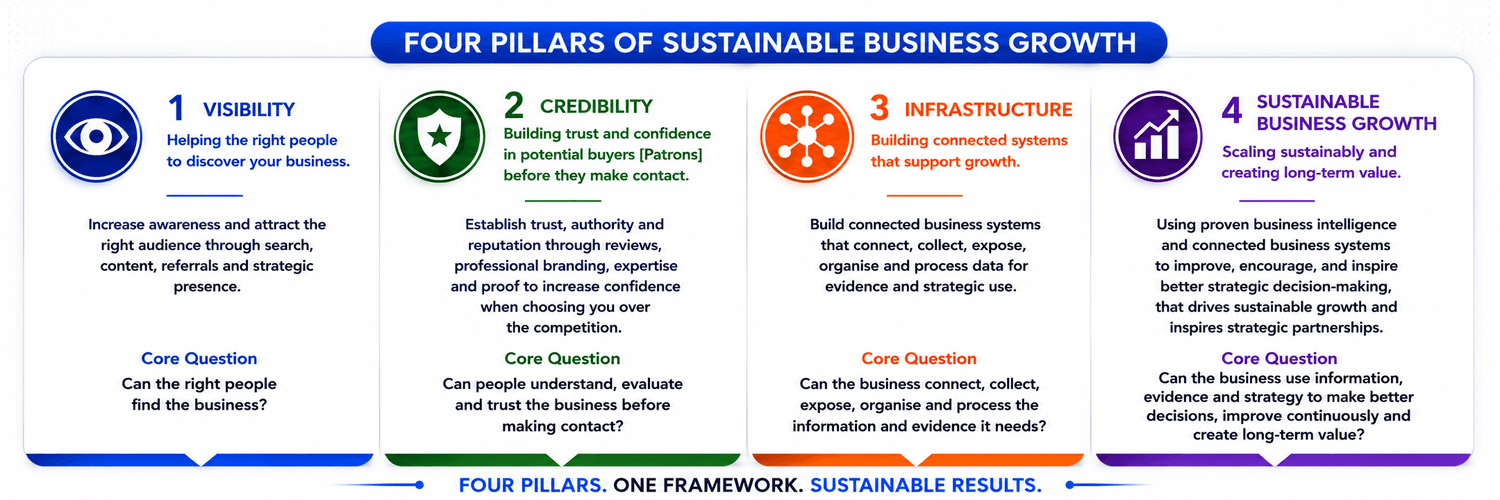
Your Position in the Growth4biz Framework™
Need — Business Foundation
Primary Pillar

Infrastructure
Creating systems that generate enquiries and improve efficiency.
Professional email forms part of your digital foundation. It improves customer confidence while helping you organise, secure and protect your business as it grows. This works well into strengthening Infrastructure.
Supporting Pillars: Credibility • Visibility
What Is a Professional Business Email?
A professional business email uses your own domain name rather than a free email service.
Examples include:
info@yourbusiness.co.za
sales@yourbusiness.co.za
support@yourbusiness.co.za
admin@yourbusiness.co.za
Unlike Gmail, Yahoo or Outlook personal accounts, a professional email reinforces your business brand every time you communicate.
It tells customers that your business has invested in establishing a professional presence.
Related Read:
Business Name vs Domain Name: What's the Difference and Why It Matters?
Why Does a Professional Business Email Matter?
Every interaction shapes customer perception.
Your email address is often one of the first things customers notice.
A professional email helps:
Build trust
Reinforce your brand
Improve professionalism
Create consistency
Support future business growth
Small details influence purchasing decisions.
Professional email is one of those details.
Why You Should Still Have a Separate Business Gmail Account
This is one of the most overlooked parts of building a digital business.
Many people assume:
"I have a professional email and that's enough."
Well, it isn't.
A professional email and a dedicated business Gmail account serve different purposes.
Professional Email
Business Gmail
1. Customer communication
1. Digital ownership
2. Sales
2. Google services
3. Quotes
3. Account recovery
4. Support
4. Administration
5. Daily operations
5. Platform ownership
Your customers should rarely see your business Gmail address.
Instead, it becomes the master account that owns many of your digital assets.
Examples include:
YouTube
Google Business Profile
Google Analytics
Google Search Console
Google Drive
Google Ads
Google Maps
Chrome Profiles
Android devices
Think of your business Gmail account as the administrator.
Think of your professional email as the public-facing communication channel.
Why You Should Never Use Your Personal Gmail for Business
Many business owners make this mistake.
They create:
Facebook Pages
YouTube Channels
Google Business Profiles
Analytics Accounts
using their personal Gmail.
At first, it seems harmless.
Over time, however, your personal and business digital lives become intertwined.
Google begins recommending business content alongside personal interests.
Your Chrome profile becomes cluttered.
Business notifications become mixed with family emails.
Password management becomes more complicated.
Instead of seeing helpful business related videos...
You're seeing dancing cats.Instead of strategic resources...
You're seeing holiday destinations.
It may sounds funny on a more serious note…
If someone else needs to manage your business later, your personal Google account becomes a barrier.
Keeping business and personal accounts separate creates cleaner administration, stronger security and easier delegation.
What Happens If Your Domain Expires?
This is another issue that businesses rarely consider.
Suppose your professional email is:
info@yourbusiness.co.za
Everything works perfectly.
Then...
Your domain expires.
Suddenly:
Your website goes offline.
Your email stops working.
Password reset emails never arrive.
Microsoft 365 or Google Workspace may stop functioning.
Customers cannot contact you.
If every online account is tied exclusively to your professional email, recovering access becomes significantly more difficult.
This is why maintaining a secure business Gmail account as your recovery account is considered good practice.
It provides an additional layer of protection for your most important business systems.
Personal Email vs Professional Email
Personal Email
Professional Email
1. Gmail, Yahoo, Outlook
1. Your own domain
2. Personal use
2. Business communication
3. Limited branding
3. Reinforces your brand
4. Less professional
4. Builds credibility
5. Doesn't promote your website
5. Promotes your business with every email
A Simple Email Strategy for Small Businesses
Growth4biz recommends using both.
Business Gmail
Used for:
Google Business Profile
YouTube
Analytics
Search Console
Google Ads
Recovery emails
Administrator accounts
Professional Business Email
Used for:
Customer communication
Sales
Invoices
Quotations
Support
Daily business operations
This simple separation makes administration much easier as your business grows.
Common Business Email Addresses
Role-based email addresses help businesses appear organised and professional.
Examples include:
info@
hello@
sales@
support@
admin@
accounts@
enquiries@
Unlike personal addresses, these continue working even if staff members change.
Choosing the Right Business Email Provider
Popular providers include:
Google Workspace
Microsoft 365
Zoho Mail
Your hosting provider
The specific provider is less important than establishing a professional email system that supports your business.
Common Mistakes to Avoid
Many businesses delay setting up professional email or implement it poorly.
Common mistakes include:
Using personal Gmail for customer communication
Using personal Gmail to create business platforms
Registering a domain but never creating business email
Forgetting to renew domains
Sharing one email account between multiple employees
Creating confusing email addresses
Most of these problems are easy to avoid with proper planning.
Best Practices
To maximise professionalism:
Register your domain early.
Create professional email addresses immediately.
Maintain a separate business Gmail account.
Use role-based email addresses where appropriate.
Enable multi-factor authentication.
Keep recovery details updated.
Renew your domain before it expires.
These simple practices create a much stronger digital foundation.
Frequently Asked Questions
No.
You only need to own your domain.
Yes.
Google Workspace allows you to use Gmail with your professional business domain.
Because it provides ownership and recovery for your Google business services without mixing business and personal accounts.
Your website, professional email and potentially access to linked services may stop working until the domain is renewed.
Most professional email services are affordable and offer excellent value considering the credibility and security they provide.
Final Thoughts
Professional email is no longer optional for businesses that want to build credibility.
It strengthens your brand.
Improves customer confidence.
Creates consistency.
But perhaps more importantly...
Separating ownership from communication creates a much stronger digital foundation.
Your professional email communicates with customers.
Your business Gmail protects your business.
Together, they create an infrastructure that supports long-term business growth.
Building a business isn't simply about appearing professional.
It's about protecting everything you're working hard to build.
Continue Your Growth Journey
Related Articles
Business Name vs Domain Name: What's the Difference and Why It Matters?
Google Business Profile vs Website: Which One Does Your Business Need?
Business Website Checklist (Coming Soon)
Related Downloads
Business Email Setup Checklist (Coming Soon)
Digital Business Infrastructure Checklist (Coming Soon)
Related Checklists
Professional Email Checklist (Coming Soon)
Google Account Setup Checklist (Coming Soon)
Related Worksheets
Digital Identity Planning Worksheet (Coming Soon)
Business Infrastructure Worksheet (Coming Soon)
Business Need
Need – Business Foundation
Growth4biz Framework™ Coordinate
Need → Business Foundation
Framework Pillars
Primary
Infrastructure
Supporting
Credibility
Visibility
Previous Guide
Business Name vs Domain Name: What's the Difference and Why It Matters?
Next Guide
Book a Consultation
Building a professional business starts with more than registering a domain—it requires creating the right digital infrastructure from the beginning.
If you need help registering your domain, setting up professional business email, configuring your Google Business Profile, or building a secure digital foundation, Growth4biz Media can help.
Book a consultation and let's build a business infrastructure designed for long-term growth.
SHARE




Copyright 2026 • Growth4biz Media (Pty) Ltd.