
How to Build Trust Online: A Practical Guide for Small Businesses
Introduction
A business can have a professional website, a Google Business Profile, social media accounts and a good-looking logo — and still struggle to make potential customers trust it.
The problem is often not visibility.
People may already be finding the business.
The problem is what happens after they find it.
A potential customer might see the business online and immediately start asking:
"Is this business legitimate?"
"Can they actually do what they say they can do?"
"Have other people trusted them?"
"Will they communicate properly?"
"Will they deliver what I am paying for?"
These questions are particularly important for small and growing businesses because potential customers often have limited information to work with.
A customer cannot see everything happening behind the scenes.
They cannot immediately see the owner's intentions, the quality of the internal processes, the experience of the team or the effort that goes into delivering a service.
Instead, they experience the business through signals.
They see the website.
They read the wording.
They look at reviews.
They see how quickly the business responds.
They notice whether information is consistent.
They observe how enquiries are handled.
They compare what the business promises with what other customers say.
Over time, these experiences form a perception of the business.
That perception becomes increasingly important.
Trust is therefore not something a business can simply add to a website.
It is something a business builds through repeated, consistent evidence.
This is an important Growth4biz principle:
Trust grows when the reality of the business consistently supports what the business communicates.
That means building trust online is not simply about looking professional.
It is about creating a business that can make credible promises, consistently deliver on them, communicate clearly and allow genuine evidence of the customer experience to accumulate over time.
That is where online trust becomes connected to sustainable business growth.
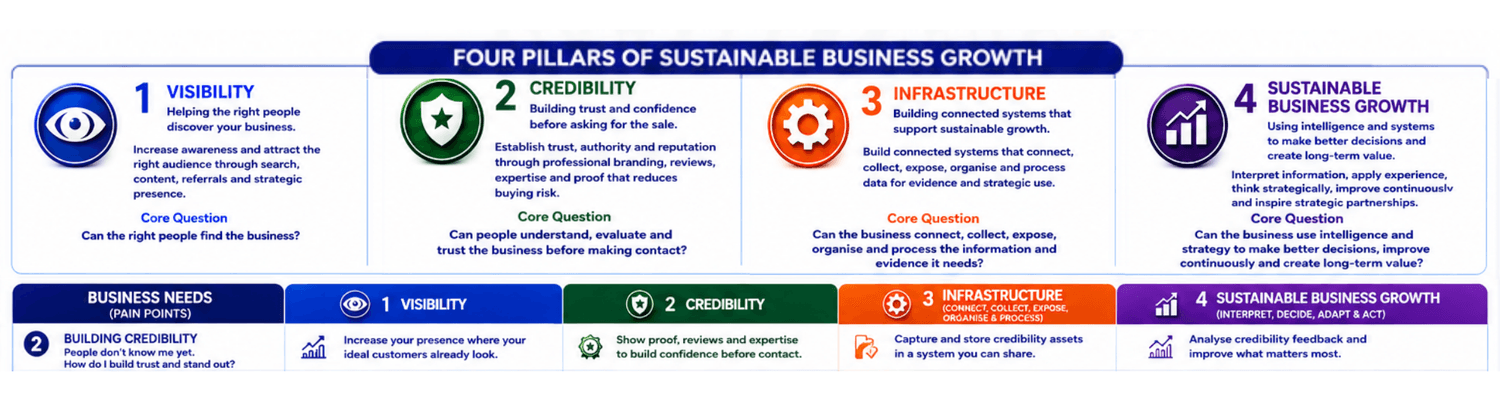
Your Position in the Growth4biz Framework™
Need — Business Credibility
Primary Pillar

Credibility
Building confidence before customers make contact.
Trust belongs within the Credibility Business Need because businesses eventually reach a point where simply being visible is no longer enough and realize credibility is what needs strengthening.
Supporting Pillars: Visibility • Infrastructure •
A business can be discovered through Google, social media, referrals, advertising or its website.
But discovery does not automatically create confidence.
Once potential customers become aware of a business, they begin evaluating whether they should trust it.
This is where credibility becomes important.
Trust is strengthened when a business presents itself consistently, provides genuine evidence, communicates professionally and delivers experiences that match its promises.
Infrastructure also becomes important because a business cannot maintain trust through communication alone.
The systems behind the business need to support the promises being made.
A business that promises fast responses but has no enquiry management system may struggle to deliver.
A business that promises professional service but has inconsistent processes may struggle to deliver.
A business that promises expertise but repeatedly produces poor customer experiences will eventually create a gap between perception and reality.
That gap is dangerous.
The objective is therefore not simply to look trustworthy.
The objective is to build a business that deserves to be trusted.
Solving this challenge prepares the business for later stages of the Growth4biz Business Growth Journey because stronger credibility improves customer confidence, customer fit, conversion and the foundation for sustainable growth.
What Does Trust Mean in Business?
Trust is the confidence that another person will behave in a way that is reasonably consistent with what they have communicated or promised.
In business, customers often trust a company when they believe:
The business is legitimate.
The business understands their problem.
The business can deliver what it promises.
The business will communicate honestly.
The business will handle problems professionally.
The business will treat them fairly.
The business's public claims are supported by reality.
Trust therefore involves more than appearance.
A professional website may create an initial impression.
A strong visual presentation may create familiarity.
A review may provide evidence.
A professional conversation may strengthen confidence.
But the customer's actual experience ultimately tests the promise.
This creates a simple relationship:
Promise → Experience → Evidence → Trust
If the experience consistently supports the promise, trust can strengthen.
If the experience repeatedly contradicts the promise, trust can weaken.
How the Growth4biz Framework™ Connects to Trust
Trust can be understood from the perspective of the business through four distinct relationships within the Growth4biz Framework™.
These relationships should not be treated as a fixed sequence.
One does not automatically cause the next.
Instead, each relationship describes how a particular business activity can strengthen one of the Framework's four pillars.
1. Promises Strengthen Visibility
A business makes promises about what it does, who it serves and what customers can expect.
For example, a business may communicate:
The services it provides.
The problems it solves.
The type of customers it helps.
The topics it understands.
The results it aims to provide.
The experience it wants customers to expect.
These promises become part of what the business makes visible to the market.
A business launching a YouTube channel, for example, may decide to consistently publish content about a particular subject.
It is communicating:
"This is what we do. This is what we know about. This is the type of customer we want to attract."
The promise itself does not guarantee that an audience will respond.
It simply gives the business a clearer position to communicate.
In the Growth4biz Framework:
Promises strengthen Visibility.
2. Audience Experience Strengthens Credibility
Once people interact with a business, they form their own experiences.
That experience may come from:
Watching content.
Visiting a website.
Speaking with the business.
Purchasing a product.
Using a service.
Communicating with employees.
Receiving customer support.
Going through the broader customer journey.
The experience may strengthen credibility when it supports what the business has communicated.
For example, if a business presents itself as professional and customers consistently experience clear communication, organised processes and reliable service, that experience can strengthen credibility.
The important distinction is that the business does not control this outcome completely.
The business creates the environment and the experience.
The customer decides what that experience means to them.
In the Growth4biz Framework:
Audience Experience strengthens Credibility.
3. Evidence Strengthens Infrastructure
Evidence can come from more than one perspective.
The audience may produce evidence through:
Reviews.
Testimonials.
Feedback.
Questions.
Responses.
Engagement.
Buying behaviour.
Repeat purchases.
Referrals.
The business can also produce and collect evidence through:
Enquiry data.
Customer records.
Conversion data.
Content performance.
Sales data.
Customer behaviour.
Follow-up results.
Service performance.
Operational information.
This evidence gives the business information about what is actually happening.
It can reveal:
Which promises attract attention.
Which audiences respond.
Which services generate interest.
Which experiences create problems.
Where customers drop off.
What customers repeatedly request.
Which processes are working.
Which processes need improvement.
That information can then be used to strengthen the business's infrastructure.
Infrastructure may include:
Systems.
Processes.
People.
Technology.
Documentation.
Data management.
Customer management.
Automation.
Follow-up systems.
The evidence does not automatically improve the infrastructure.
The business has to interpret the evidence and decide what needs to change.
But when evidence is used effectively, it gives the business a stronger basis for improving how it operates.
In the Growth4biz Framework:
Evidence strengthens Infrastructure.
4. Trust Strengthens Sustainable Growth
Trust develops through repeated interactions between the business and the people it serves.
A business may communicate promises.
Customers may experience the business.
Evidence may reveal what is working and what needs improvement.
The business can then use that information to sharpen its promises, improve its customer experience and strengthen its infrastructure.
Over time, greater consistency can create stronger reasons for customers to trust the business.
Trust can then support outcomes such as:
Repeat business.
Customer retention.
Referrals.
Recommendations.
Stronger relationships.
Greater confidence in purchasing.
Increased willingness to consider additional services.
This is where trust connects with the fourth pillar.
In the Growth4biz Framework:
Trust strengthens Sustainable Growth.
The Four Growth4biz Trust Relationships
The four relationships can therefore be stated simply:
Promises strengthen Visibility.
Audience Experience strengthens Credibility.
Evidence strengthens Infrastructure.
Trust strengthens Sustainable Growth.
These are relationships, not a fixed sequence.
There is deliberately no arrow connecting one relationship directly to the next.
A business may have strong visibility without receiving meaningful audience engagement.
A business may receive audience engagement without immediately building strong credibility.
A business may collect evidence without acting on it.
And a business may have trust in one part of its customer base while still needing to strengthen trust elsewhere.
The value of the Framework is therefore not in presenting a guaranteed chain of events.
It is in helping the business identify what is happening within each pillar and understand how those areas can be strengthened.
How the Four Relationships Work Together
Although the four relationships are not a fixed sequence, they can reinforce one another over time.
A business may use evidence from its audience and internal operations to improve its infrastructure.
Improved infrastructure may help the business deliver a better experience.
A better experience may strengthen credibility.
Greater credibility may help the business communicate stronger and more relevant promises.
Those promises may improve visibility among the right audience.
And when the business repeatedly delivers what it communicates, trust can strengthen.
Trust can then contribute to sustainable growth.
The relationship is therefore better understood as a reinforcing business system rather than a straight line.
The business continuously learns, improves and adjusts.
That is what makes the Growth4biz Framework™ relevant to sustainable business growth.
The four pillars do not exist in isolation, and they do not have to occur in a predetermined order. They strengthen different parts of the business while continuously influencing how the business develops.
Trust Is Not the Same as Looking Professional
One of the most common mistakes businesses make is confusing professionalism with trust.
Professional presentation matters.
But presentation is only one part of the equation.
A beautifully designed website cannot compensate indefinitely for poor service.
A sophisticated logo cannot compensate for unanswered enquiries.
A large collection of marketing claims cannot compensate for inconsistent delivery.
A business can therefore create a strong first impression while still failing to build genuine trust.
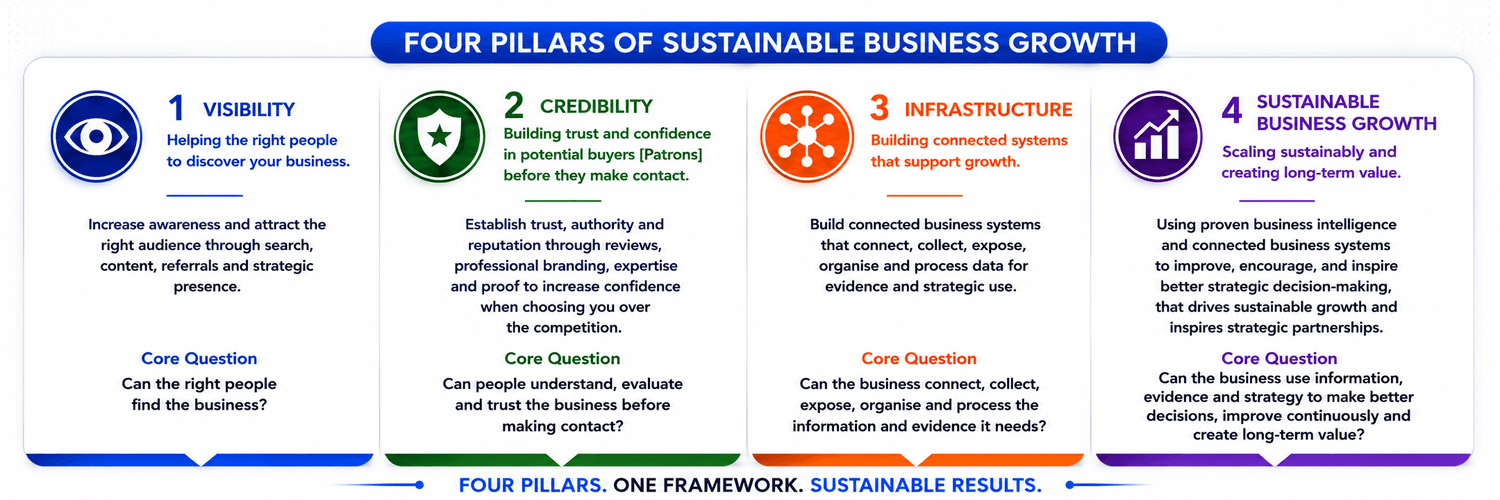
This is why Growth4biz separates visibility, credibility, infrastructure and sustainable growth.
Visibility helps people discover the business.
Credibility helps them believe the business.
Infrastructure helps the business consistently deliver what it promises.
Sustainable Growth helps the business consistently predict income and plan for future business endeavors for growth.
All four need to work together.
The Trust Gap
Many businesses experience what can be described as a trust gap.
The business communicates one thing.
The customer's experience suggests something else.
For example:
A website says:
"We respond quickly to every enquiry."
But potential customers wait several days for a response.
The business says:
"We provide a professional customer experience."
But customers receive inconsistent communication.
The business presents itself as highly experienced.
But its processes are disorganised.
The business promises personalised service.
But customers are passed between different people without clear communication.
Each individual problem may appear small.
Collectively, however, they create a different perception.
The trust gap grows.
The solution is not necessarily better marketing.
The solution may be improving the reality behind the marketing [Infrastructure, Processes, Systems, etc.].
Trust Begins With What the Business Actually Is
A business cannot sustainably communicate a reality that does not exist.
This is particularly important for new businesses.
A new business may not yet have:
Hundreds of reviews.
Years of customer history.
A large portfolio.
A large team.
Extensive case studies.
Significant market recognition.
That is okay.
Being new is not the same as being untrustworthy.
The problem begins when a business tries to disguise its current stage by manufacturing evidence.
Instead, the business should communicate honestly while continuing to build capability.
A business can say:
"We are a growing business focused on helping customers solve this problem."
It does not need to pretend:
"We are the market leader."
if it cannot support that claim.
Trust is strengthened when the business's communication reflects reality.
Consistency Is One of the Foundations of Trust
Consistency is one of the most important principles in building trust.
Customers notice patterns.
They notice whether:
The website says the same thing as the sales conversation.
The business communicates consistently.
Pricing information is clear.
The visual presentation is recognisable.
Staff provide consistent information.
Customer service follows a reliable process.
Promises are followed by action.
Problems are handled in a consistent manner.
Consistency reduces uncertainty.
And uncertainty is one of the things that makes customers hesitant.
A customer may not know exactly what will happen when they engage with a business.
But consistent signals give them a clearer expectation.
That is valuable.
Branding, Consistency and Trust
This principle connects directly to the Growth4biz perspective on branding.
Many businesses use the word branding when they are actually referring to visual design.
They may mean:
A logo.
Colours.
Fonts.
Business cards.
Letterheads.
Posters.
Website design.
These can all be useful business assets.
But they are not the entire brand.
Visual presentation is closer to the clothing of the business.
It is what the business chooses to present externally.
The deeper identity of a business is communicated through its repeated actions.
How it communicates.
How it makes decisions.
How it treats customers.
How it handles problems.
How it delivers its service.
How consistently it keeps its promises.
The business therefore creates its brand knowingly or unknowingly.
The audience does not simply "create" the brand.
The business continuously communicates signals through its actions, systems and presentation.
The audience then interprets those signals and develops a perception of the business.
This gives us a useful distinction:
The business shapes the brand. The audience forms a perception of it.
That perception is influenced by what the business consistently does.
This is why consistency matters so much.
A business cannot sustainably present one character visually while repeatedly demonstrating another character through its actions.
Eventually, the reality becomes more convincing than the presentation.
Trust Is Built Through Evidence
Customers rarely trust a business simply because the business says:
"Trust us."
They look for evidence.
That evidence can come from:
Customer reviews.
Testimonials.
Case studies.
Portfolio examples.
Professional communication.
Transparent information.
Consistent customer experiences.
Demonstrated expertise.
Clear processes.
Reliable follow-through.
This is why genuine customer feedback is so valuable.
As discussed in "Customer Reviews vs Testimonials: What's the Difference and Why Both Matter" article, reviews and testimonials can provide different forms of credibility.
Reviews can provide independent social proof.
Testimonials can provide more targeted customer experiences.
Both can become evidence that supports the claims a business makes.
BUT the evidence needs to be genuine.
Manufactured evidence may create the appearance of trust while actually weakening the foundations underneath it.
Why Manufactured Trust Fails
A business might be tempted to manufacture:
Testimonials.
Customer results.
Reviews.
Case studies.
Portfolio examples.
Claims of experience.
Claims of expertise.
The temptation is understandable.
A new business may feel that it needs to "look established" before customers will trust it.
But this creates a dangerous cycle:
Manufactured credibility → False expectations → Wrong customers → Delivery pressure → Customer dissatisfaction → Negative feedback → Reputation damage
The problem becomes larger than the original attempt to look more credible.
The business may also lose something more valuable:
Real customer data.
A genuine customer experience can tell the business:
What customers value.
Why they chose the business.
What confused them.
What they liked.
What disappointed them.
What outcome mattered most.
What could be improved.
A manufactured testimonial cannot provide that information.
This means dishonest credibility can actually prevent the business from learning how to become better.
Real Customer Feedback Builds Trust and Capability
Customer feedback should not only be viewed as marketing material.
It can become business intelligence.
Imagine ten customers repeatedly mention that communication was excellent.
That tells the business something.
Imagine several customers mention that onboarding was confusing.
That tells the business something too.
The feedback can therefore create a loop:
Real Customers → Real Experiences → Real Feedback → Better Decisions → Better Business → Stronger Credibility
This is much more powerful than simply collecting five-star reviews.
The business is learning while it is building its reputation.
That is sustainable credibility.
Trust Is Created Across the Entire Customer Journey
Trust does not begin when someone reads a testimonial.
It starts earlier.
A customer's journey might look like this:
Discovery → Verification → Evaluation → Contact → Delivery → Follow-up
At each stage, the customer receives signals.
Discovery
The customer finds the business.
Verification
The customer checks whether the business appears legitimate.
Evaluation
The customer compares the business with alternatives.
Contact
The customer experiences the business directly.
Delivery
The business must fulfil its promise.
Follow-up
The business demonstrates whether the relationship continues to matter after the transaction.
Every stage can strengthen or weaken trust.
This means trust cannot be delegated entirely to the marketing department.
It is a business-wide responsibility.
Where Trust Can Be Lost
Trust can disappear surprisingly quickly.
A business might spend years building a reputation and then damage it through:
Misleading advertising.
Poor communication.
Hidden costs.
Missed promises.
Inconsistent service.
Ignoring complaints.
Fake reviews.
Fake testimonials.
Poor data handling.
Unprofessional behaviour.
Overpromising.
Failing to acknowledge mistakes.
The lesson is important:
Trust is easier to damage than to build.
That does not mean businesses should fear mistakes.
Mistakes happen.
What matters is how the business responds.
A professional response to a mistake can sometimes strengthen trust because it demonstrates accountability, professionalism or even expertise.
Transparency Can Strengthen Trust
Customers do not expect every business to be perfect.
They often expect businesses to be honest.
For example, a business can communicate:
"We are currently experiencing a delay and expect to complete your order by Friday."
That is generally more trustworthy than saying nothing and hoping the customer does not notice.
Similarly:
"This service is outside our current area of expertise, but we can recommend someone who specialises in it."
may create more credibility than pretending to be capable of everything.
Transparency reduces uncertainty.
It also helps attract customers whose expectations are aligned with the actual business.
Trust and Customer Fit
Trust is not only about getting more customers.
It is also about getting the right customers.
If a business exaggerates its capabilities, it may attract customers who expect services or results the business cannot reliably provide.
That creates pressure.
The business then spends more time managing expectations and solving preventable problems.
Honest positioning can produce a different outcome.
The business attracts customers whose needs are better aligned with what it actually does.
That creates better customer experiences.
Better customer experiences create stronger feedback.
Stronger feedback creates better credibility.
The cycle continues.
Trust and Infrastructure
Trust may appear to be a marketing concept.
In reality, it is also an infrastructure issue.
Consider a business that promises:
"We respond to every enquiry within one business day."
To deliver that promise consistently, the business may need:
An enquiry management system.
Notifications.
Assigned responsibilities.
Follow-up processes.
Customer records.
Standard communication templates.
Performance monitoring.
The promise creates an operational requirement.
This is where credibility and infrastructure meet.
A business should therefore ask:
"What systems do we need behind the promise we are making?"
That question can prevent a significant number of trust problems.
Trust and Digital Presence
A business's digital presence often provides the first opportunity to establish credibility.
Potential customers may encounter:
Website.
Google Business Profile.
Social media profiles.
Business directories.
Email communication.
Online reviews.
Digital advertisements.
Search results.
These assets should not contradict one another.
For example, if a website says the business operates Monday to Friday but another profile says Monday to Saturday, the inconsistency creates uncertainty.
If the website describes one service while social media promotes another, customers may become confused.
If the business uses different contact details across platforms, potential customers may question whether the information is current.
Consistency across digital assets therefore becomes part of the trust-building process.
Trust Does Not Mean Hiding Imperfections
A trustworthy business does not need to look perfect.
In fact, excessive perfection can sometimes create suspicion.
Customers understand that businesses encounter:
Delays.
Mistakes.
Difficult customers.
Operational problems.
Learning curves.
What matters is whether the business handles those situations responsibly.
A business can build trust by saying:
"We made a mistake."
"Here is what happened."
"Here is what we are doing to fix it."
"Here is what we are changing so it does not happen again."
That demonstrates something a polished marketing statement cannot:
accountability.
The Difference Between Perception and Reality
Trust becomes strongest when perception and reality are closely aligned.
Consider three situations.
Reality Better Than Perception
The business is capable, but communicates poorly.
Customers may underestimate it.
This is an opportunity to improve visibility and communication.
Perception Better Than Reality
The business presents itself as more capable than it actually is.
This creates risk.
Customer expectations may exceed delivery capability.
Perception Aligned With Reality
The business communicates honestly and consistently delivers what it promises.
This is the strongest foundation.
The objective should therefore not be to manipulate perception.
It should be to improve the business while communicating its genuine strengths more effectively.
A Simple Trust Model
Trust can be thought of as the relationship between:
What You Say + What You Do + What Customers Experience + What Evidence Exists
When these elements support one another, credibility strengthens.
When they contradict one another, credibility weakens.
This gives businesses a practical question to ask:
"If a potential customer investigated everything we say about ourselves, would the evidence support it?"
If the answer is yes, the business has a strong foundation.
If the answer is no, the solution may not be better marketing.
It may be better capability.
Benefits of Building Genuine Online Trust
Building genuine trust can create several long-term benefits.
Greater Customer Confidence
Customers are more comfortable engaging with businesses when uncertainty is reduced.
Better Conversion
A visible business with credible evidence gives potential customers more reasons to take the next step.
Stronger Customer Relationships
Trust creates a stronger foundation for ongoing relationships.
Better Customer Fit
Honest positioning helps attract customers whose expectations match the business.
Stronger Reputation
Consistent experiences can accumulate into a durable reputation.
Better Customer Feedback
Customers are more likely to provide meaningful feedback when the business has a genuine relationship with them.
Better Business Decisions
Real feedback can reveal opportunities for improving services, systems and customer experience.
Sustainable Credibility
The business gradually builds evidence that supports its claims.
The long-term benefit is therefore larger than simply "getting more trust."
It is creating a business where trust, learning, capability and growth reinforce one another.
Common Mistakes
Treating Professional Design as Proof of Trust
Why it happens:
Businesses assume a polished appearance automatically creates credibility.Why it causes problems:
Customers eventually evaluate the experience behind the presentation.How to avoid it:
Use professional design to support the business's actual identity and capabilities.
Example: A beautiful website with unanswered enquiries may create a strong first impression but a poor second one.
Claiming More Experience Than You Have
Why it happens:
New businesses may feel pressure to compete with established companies.Why it causes problems:
Customers may arrive with expectations the business cannot consistently meet.How to avoid it:
Communicate honestly about your current capabilities while building experience.
Manufacturing Reviews or Testimonials
Why it happens:
Businesses want social proof quickly.Why it causes problems:
It creates false evidence and removes valuable customer feedback from the business.How to avoid it:
Collect genuine feedback from real customers.
Inconsistent Information
Why it happens:
Different digital platforms are often updated at different times.Why it causes problems:
Contradictory information creates uncertainty.How to avoid it:
Regularly review your website, Google Business Profile, social media and other business listings.
Overpromising
Why it happens:
Businesses want to make their services sound attractive.Why it causes problems:
Expectations become difficult to meet.How to avoid it: Make promises that your systems and capabilities can reliably support.
Ignoring Negative Feedback
Why it happens:
Negative feedback feels threatening.Why it causes problems:
It can hide genuine operational problems.How to avoid it:
Investigate recurring complaints and use legitimate criticism as business intelligence.
Trying to Look Bigger Than You Are
Why it happens:
Businesses believe customers only trust established companies.Why it causes problems:
The presentation can create expectations beyond current capability.How to avoid it:
Present the business professionally without pretending it is something it is not.
Treating Trust as a Marketing Department Responsibility
Why it happens:
Reviews, websites and social media are often managed by marketing teams.Why it causes problems:
The customer experience may contradict the marketing message.How to avoid it:
Make trust a business-wide responsibility involving leadership, marketing, sales, operations and customer service.
Practical Tips / Best Practices
Make sure your public information is accurate.
Keep your website and business profiles consistent.
Make realistic promises.
Build systems that support the promises you make.
Collect genuine customer reviews and testimonials.
Ask customers specific questions about their experiences.
Use customer feedback as business intelligence.
Respond professionally to negative feedback.
Acknowledge mistakes instead of hiding them.
Avoid exaggerating experience, results or capabilities.
Make sure your marketing reflects the reality of the business.
Review the customer journey for points where trust can be lost.
Use professional design to support your business rather than disguise weaknesses.
Build consistency across communication, service delivery and customer experience.
Allow credibility to grow alongside actual capability.
A useful test is simple:
If your marketing disappeared tomorrow, would your business still behave in a way that creates trust?
If the answer is yes, the business is building something much stronger than marketing.
It is building credibility into the business itself.
Frequently Asked Questions:
Start with accurate information, professional communication, realistic promises and genuine customer experiences. You do not need to pretend to be established. You need to demonstrate that your business is legitimate, capable and reliable.
Be transparent about your current stage, provide useful information, communicate professionally, demonstrate your expertise and begin collecting genuine customer feedback as meaningful experiences occur.
A professional website can support credibility, but it does not create trust by itself. Trust depends on whether the business's actions and customer experiences support what the website communicates.
Yes. Genuine reviews can provide independent evidence that other customers have experienced the business. They are particularly useful during the verification stage of the customer journey.
Yes. Detailed testimonials can help potential customers understand specific experiences, problems and outcomes. They work particularly well when the customer's situation is relevant to the potential customer's own needs.
AI can help edit, organise or format genuine customer feedback. It should not invent customer experiences and present them as genuine testimonials.
Acknowledge the mistake, communicate clearly, take responsibility where appropriate and explain what is being done to resolve the issue. Consistent accountability can strengthen trust over time.
They should not be treated as competing concepts. The business's presentation communicates expectations, while customer experience demonstrates whether those expectations are supported by reality. Strong branding and strong customer experience should reinforce one another.
Visual identity includes elements such as logos, colours, typography and design. Branding is broader and concerns the character a business consistently communicates through its actions, communication, systems and customer experiences.
Yes, although professional presentation can help establish an initial level of credibility. Trust ultimately depends on whether the business consistently behaves in a reliable, honest and capable manner.
There is no fixed timeframe. Trust generally develops through repeated experiences and evidence over time. A business can strengthen trust through every interaction, while a single serious contradiction can damage it quickly.
Yes. Consistency reduces uncertainty. When a business communicates, behaves and delivers in ways that support the same expectations, customers have a clearer understanding of what they can expect.
Final Thoughts
Trust is not something a business can simply place on a website nor is a brand.
It cannot be created by a logo.
It cannot be manufactured through fictional testimonials.
It cannot be guaranteed by saying:
"We are trustworthy."
Trust grows when the business consistently behaves in a way that supports the expectations it creates.
That means credibility begins inside the business.
It is reflected through communication.
It is supported by infrastructure.
It is demonstrated through customer experience.
It is reinforced by genuine evidence.
And....
It becomes part of the perception customers form over time.
This is why branding and credibility are closely connected.
A business creates signals through what it says and does.
Customers interpret those signals.
Over time, they develop a perception of the business.
The business therefore has a responsibility to make sure that perception is supported by reality.
This leads to a deeper Growth4biz principle:
A business does not build trust by appearing more capable than it is. It builds trust by becoming more capable and consistently communicating that reality.
Within the Growth4biz Framework™, this is what makes credibility sustainable.
Visibility gets the business noticed.
Consistency gives customers a clearer expectation.
Customer experience tests the promise.
Feedback reveals what is working and what needs improvement.
Infrastructure helps the business deliver consistently.
And over time, these elements reinforce one another.
Real capability → Consistent action → Customer experience → Evidence → Credibility → Trust → Growth
The goal is not to create the appearance of a trustworthy business.
The goal is to build a business whose reality makes trust possible.
Continue Your Growth Journey
Related Articles
Google Business Profile vs Website: Which One Does Your Business Need?
Business Name vs Domain Name: What's the Difference and Why It Matters?
Google Business Profile for Small Businesses: How to Set It Up Correctly and Why It Matters
GKA-0017 — Customer Reviews vs Testimonials: What's the Difference and Why Both Matter
GKA-0019 — How to Create a Professional Business Brand
Related Downloads
Online Trust Audit Checklist (Coming Soon)
Business Credibility Assessment Checklist (Coming Soon)
Related Checklists
Online Trust Checklist (Coming Soon)
Customer Trust Touchpoint Checklist (Coming Soon)
Related Worksheets
Trust Gap Analysis Worksheet (Coming Soon)
Customer Trust Journey Worksheet (Coming Soon)
Business Need: Credibility
Primary Pillar
Credibility
Supporting Pillars
Visibility
Infrastructure
Book a Consultation
Building trust is not simply about making your business look professional online.
It is about creating a business whose communication, customer experience, systems and actual capabilities consistently support the expectations it creates.
Growth4biz Media can help you strengthen the foundations behind your credibility—from improving your digital presence and customer trust signals to developing the systems and processes that help your business consistently deliver what it promises.
Book a consultation and let's build a business that earns the trust it needs to grow with confidence.
SHARE




Copyright 2026 • Growth4biz Media (Pty) Ltd.