
How to Create a Professional Business Brand: A Practical Guide for Small Businesses
Introduction
A business can have a logo, a website, social media pages and professionally printed business cards — and still not have a professional brand.
This is a common problem for small businesses.
A business owner may spend money on a logo, choose a few colours and create a social media profile, believing the branding work is finished.
But then the business starts growing.
The website looks one way.
The social media pages look another.
The business cards use different colours.
The wording changes from one platform to another.
The sales conversation communicates something different from the website.
The business may even look more established online than the actual customer experience suggests.
The result is not necessarily a bad-looking business.
The result is an inconsistent business.
And inconsistency creates uncertainty.
Potential customers want to understand:
What does this business actually do?
Who is it for?
What does it stand for?
Why should I choose it?
What can I expect from it?
Is the business professional?
Can I trust what it is telling me?
A professional brand helps a business answer these questions consistently.
But there is an important distinction between creating a brand and controlling how that brand is perceived.
A business owner can create the name, messaging, visual identity, positioning and standards that make up the brand. Those are business decisions the owner can control and change.
What the owner cannot completely control is how every customer interprets those signals.
Customers form their own opinions based on what they see, hear and experience.
That means a professional brand has two sides:
What the business intentionally creates, and what customers ultimately experience and perceive.
The goal of professional branding is therefore not to control people's minds or manufacture a particular perception.
The goal is to create clear, consistent and credible signals that accurately represent the business and give customers a better basis for understanding and evaluating it.
This distinction is important because a business can own its brand assets while still recognising that customer perception develops through experience.
This is where branding becomes connected to business growth.
A strong brand can improve recognition, support credibility, clarify positioning and give marketing a stronger foundation.
But the brand also needs to reflect reality.
A business cannot sustainably build credibility by presenting itself as something it cannot consistently deliver.
This leads to an important Growth4biz principle:
A professional brand should make the real strengths of a business easier to recognise — not create expectations that the business cannot support.
A business is allowed to position itself, differentiate itself and present itself professionally.
It is also allowed to evolve its brand as the business changes.
The important boundary is credibility.
If the brand consistently communicates promises that the business cannot deliver, the problem is no longer simply a branding problem. It becomes a business-performance problem.
The strongest brands are therefore not necessarily the brands that make the biggest claims.
They are the brands where the identity, positioning, communication and actual customer experience make sense together.
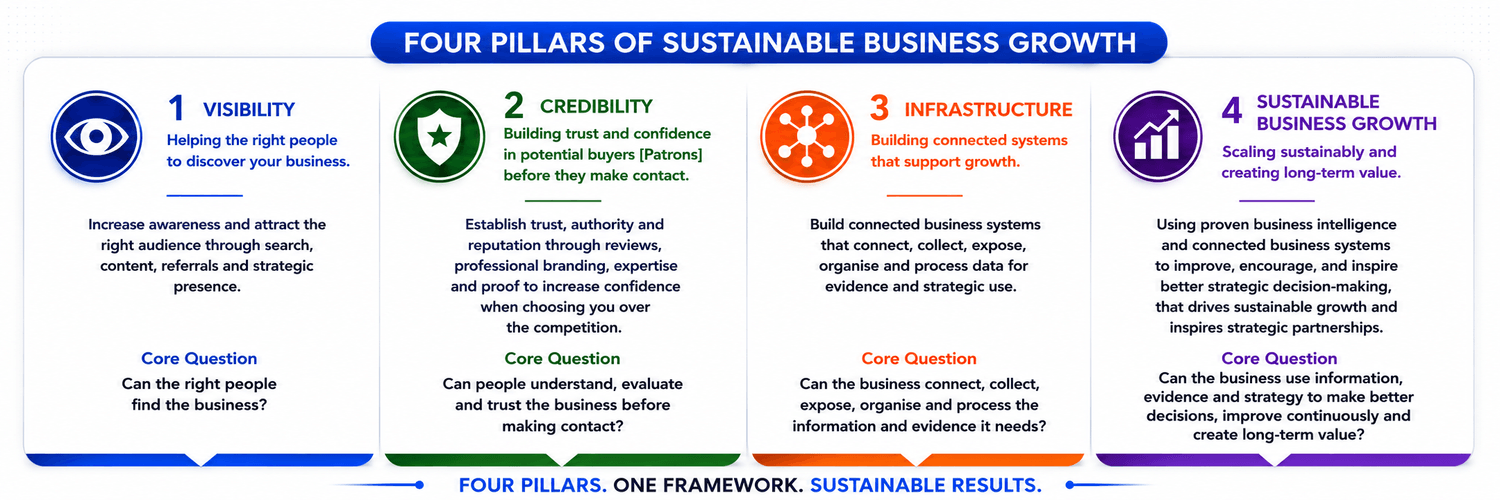
Your Position in the Growth4biz Framework™
People don't know me yet, I need to improve my interpreted value. How do I build trust and stand out?
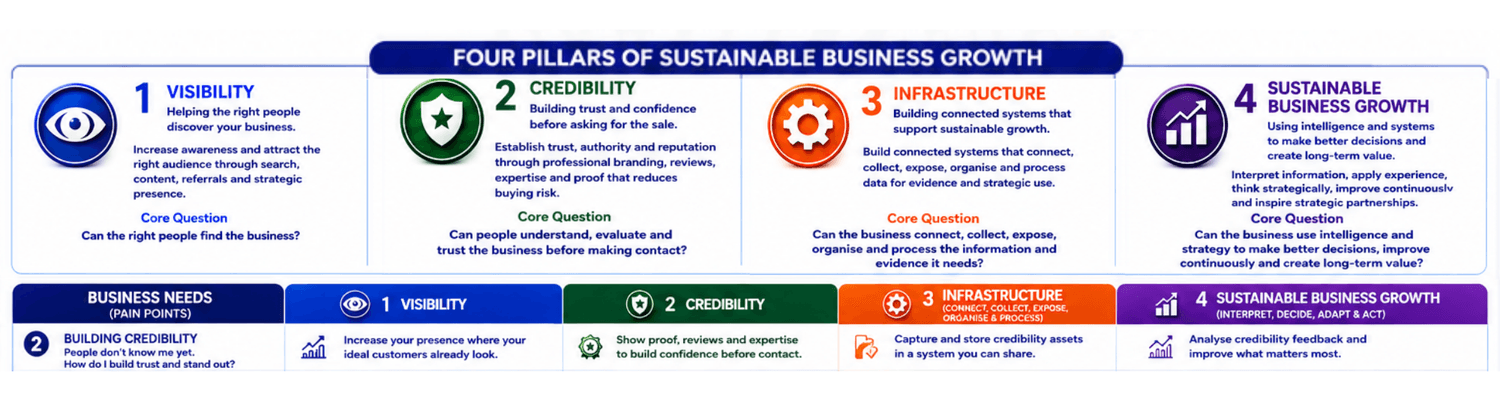

Primary Pillar - Credibility
What the Audience Understands, Evaluates, and Potentially Trusts
Branding belongs within the Credibility Business Need because businesses eventually reach a point where simply being visible is no longer enough and strengthening credibility is the logical next step.
Supporting Pillars: Visibility • Infrastructure
Customers may discover a business through Google, social media, referrals, advertising or its website.
But discovery creates another question:
"What should I think about this business?"
A professional brand helps a business communicate a clearer answer.
It gives the business a consistent way to present its identity, positioning, values, services and expectations.
Visibility helps people discover the business.
Branding helps customers recognise, understand and evaluate the business.
Credibility develops when the signals communicated by the business are supported by evidence and experience.
Infrastructure helps the business deliver consistently enough to support the expectations created by the brand.
This creates an important progression:
Visibility → Brand Expression → Customers Understanding → Customers Experience → Evidence → Credibility
The brand does not create credibility by itself.
It creates a framework for communicating what the business is and what customers can expect. The business then has to support those expectations through its actions, systems and customer experience.
This means branding is not an isolated design exercise.
It becomes part of the system through which a business communicates with the market.
When a business has a clear brand, it becomes easier to create consistent websites, marketing materials, social media content, emails, proposals and customer communications.
More importantly, the brand can become a reference point for how the business behaves.
That prepares the business for later stages of growth, where consistency becomes increasingly important.
What Is a Professional Business Brand?
A business brand is the broader identity a business communicates through its positioning, messaging, visual identity, behaviour and customer experience.
It is bigger than a logo.
It is also bigger than colours and fonts.
A professional brand helps communicate:
Who the business is.
Who the business serves.
What problem it solves.
What makes it different.
What customers can expect.
How the business communicates.
How the business presents itself.
How consistently the business delivers its promises.
A useful way to think about the process is:
Identity → Positioning → Communication → Experience → Perception
The business defines its identity.
It decides how it wants to position itself.
It communicates that positioning.
Customers experience the business.
Over time, customers form a perception.
The business owns and controls many of the assets that make up its brand.
It can choose its name, positioning, messaging, visual identity, tone of voice, design standards and the way those elements are applied.
It can also change those elements when the business evolves.
What it cannot completely control is how every customer interprets them.
A customer may see a professional website and interpret the business as trustworthy. Another customer may see the same website and want more evidence before making a decision.
The business therefore controls the inputs to the brand experience more than it controls the final interpretation.
This is why professional branding should focus on clarity and consistency rather than trying to manufacture a specific reaction.
You can create the brand. You can manage the signals. You can influence the experience. But the customer ultimately forms their own perception.
A strong brand accepts that reality rather than trying to eliminate it.
Brand, Visual Identity and Logo Are Not the Same Thing
These terms are often used interchangeably, but they describe different things.
Brand
Visual Identity
Logo
1. Broader business identity
1. Visual system representing the business
1. Identifiable visual mark
2. Includes positioning and messaging
2. Includes colours, typography and imagery
2. One component of the identity
3. Influenced by behaviour and experience
3. Creates visual consistency
3. Helps recognition
4. Shapes expectations
4. Supports recognition
4. Does not define the entire brand
A logo is therefore important, but it is only one part of a professional brand.
Imagine a local accounting firm with a modern logo.
The logo might help customers recognise the company.
But the brand is communicated through much more:
The firm's website.
Its tone of voice.
Its proposals.
The way staff answer enquiries.
The way reports are presented.
The professionalism of its communication.
The clarity of its pricing.
The experience customers receive.
The way problems are handled.
The logo identifies the business.
The broader brand represents the identity and positioning the business intentionally creates and communicates.
Customers then interpret that identity through their interactions with the business.
That means a business can legitimately say, “This is our brand,” because the business created and owns the brand assets and decisions behind it.
At the same time, it should recognise that customers may describe or perceive that brand differently based on their individual experiences.
Both statements can be true.
The business owns the brand it creates. The customer owns their perception of it.
Why a Professional Brand Matters
A professional brand can create several important business advantages.
Recognition
Consistent branding makes it easier for customers to recognise the business across different environments.
A customer may first see the business on Google, later encounter it on Facebook, receive an email and eventually visit the website.
When the same identity appears across those interactions, the business becomes easier to recognise.
Credibility
Consistency can reduce uncertainty because customers receive fewer conflicting signals.
Consider a potential customer who finds a business through Google, visits its website and then receives a quotation.
If the business name, visual identity, messaging, service descriptions and tone all feel connected, the customer receives a coherent picture of the business.
If each interaction feels different, the customer has to work harder to understand whether everything belongs to the same company and whether the business is as professional as it claims to be.
Professional branding does not remove the need for evidence.
It helps create a clearer environment in which evidence can be understood.
Reviews, testimonials, case studies, qualifications, experience and customer interactions can then reinforce the expectations established by the brand.
Differentiation
Customers often have several businesses to choose from.
A clear brand can help communicate why one business is different from another.
Differentiation does not always mean being unusual.
Sometimes it means being clearer.
Customer Fit
A professional brand can communicate who the business is designed to serve.
That helps potential customers determine whether the business is relevant to them.
Consistency
A defined brand gives the business a reference point for communication and presentation.
This becomes increasingly valuable as more people become involved in the business.
Growth
As a business grows, its marketing activity usually grows with it.
Without a clear brand, that growth can produce inconsistency.
A stronger brand foundation makes it easier to create additional marketing and customer-facing assets without constantly reinventing the business's identity.
The Difference Between a Logo and a Brand
This is one of the most important distinctions for small businesses.
A logo is an identifier.
A visual identity is a system.
A brand is the broader identity communicated by the business.
The customer experience is where that identity is tested.
For example, imagine a cleaning company with a polished logo and attractive website.
The website communicates reliability.
The logo looks professional.
The business promises fast responses.
But customers regularly wait three days for replies.
The logo is not the problem.
The deeper problem is the gap between the promise being communicated and the experience being delivered.
The business has created a signal of speed, but its internal processes do not support that signal.
This is where branding becomes a business issue rather than a design issue.
The solution may involve changing the promise, improving the response process, or both.
Simply redesigning the logo would not solve the underlying problem.
This is why branding needs to connect with the actual business.
A professional brand should create expectations that the business can realistically support.
Step 1: Define What Your Business Stands For
Before choosing colours, fonts or logo concepts, define the foundation of the business.
Ask:
What does the business do?
Who does it serve?
What problem does it solve?
What does it want to be known for?
What does it do particularly well?
What principles influence the way it operates?
What should customers expect when dealing with it?
These questions help prevent a common branding mistake: designing an attractive identity before understanding what the identity is supposed to communicate.
Start With Reality
Before defining what the brand should look like, define what the business is actually capable of being known for.
A brand should have something real underneath it.
If a business is exceptionally responsive, that may become part of its positioning.
If it has deep specialist knowledge, that may become part of its identity.
If it provides unusually personal service, that may become part of the customer promise.
But the business should be able to demonstrate the qualities it chooses to emphasise.
This creates a useful test:
What is genuinely true about this business that we want customers to recognise more clearly?
The answer is often more valuable than trying to invent an impressive-sounding brand personality.
A business selling premium professional services may need a different brand expression from a business built around speed, convenience and affordability.
The visual identity should support that difference.
The same applies to communication.
A business that wants to be known for straightforward advice should not communicate in a way that is unnecessarily complicated.
A business that promises personal service should not create an experience that feels completely automated.
The brand needs to make sense as a whole.
Step 2: Define Your Ideal Customer
A professional brand should not try to appeal to everyone.
When a business attempts to speak to everyone, its communication often becomes vague.
The customer needs to recognise:
"This business understands people like me."
Consider:
Who is the customer?
What problem are they trying to solve?
What are they worried about?
What do they value?
What influences their buying decision?
What alternatives are they considering?
What would make them feel confident choosing the business?
For example, a bookkeeping business serving established small companies may communicate very differently from a bookkeeping service aimed at first-time entrepreneurs.
The underlying service may be similar.
The customer context is different.
A professional brand makes that context clearer.
A professional brand does not need to appeal to everyone. It needs to communicate clearly to the right customers.
Step 3: Clarify Your Positioning
Positioning is about how you want your business to be understood in relation to the alternatives available to customers.
It answers a practical question:
"Why should this customer consider this business instead of another option?"
Positioning can include:
Your market category.
Your target customer.
The problem you solve.
Your key difference.
The value you provide.
The experience you want to create.
For example:
A generic statement might be:
"We provide quality business services."
It does not tell the customer much.
A clearer position might be:
"We help growing small businesses organise their financial records and reporting so owners can make better decisions."
The second statement gives the customer more information.
It identifies the audience.
It identifies the problem.
It communicates the purpose.
It creates a clearer expectation.
Good positioning does not require exaggerated claims.
Strong positioning often comes from identifying a specific combination of customer, problem, capability and experience that the business can genuinely support.
For example, “high-quality services” is difficult to own because almost every competitor can say the same thing.
A more useful position might identify the specific customer served, the problem solved and the particular way the business approaches that problem.
Positioning is therefore not simply about finding a clever sentence.
It is about making deliberate choices about where the business belongs in the customer's mind and why it should be considered.
Those choices then influence the rest of the brand.
Step 4: Develop Your Brand Personality
Every business communicates in a particular way, whether it has consciously defined that personality or not.
A business may come across as:
Professional.
Friendly.
Practical.
Authoritative.
Approachable.
Premium.
Straightforward.
Innovative.
Reliable.
Personal.
The important question is not:
"Which personality sounds best?"
The better question is:
"Which personality accurately represents how we want to communicate and operate?"
A business should avoid presenting itself as highly personal if customers rarely receive personal interaction.
It should be cautious about presenting itself as premium if its service delivery does not support premium expectations.
It should not claim to be highly innovative simply because the word sounds attractive.
The brand personality should be believable.
That makes it easier for the business to maintain consistently.
Personality Should Support Positioning
Brand personality works best when it reinforces the position the business has chosen.
A specialist professional service may want to communicate authority and clarity.
A family-oriented service business may emphasise warmth and accessibility.
A premium business may communicate attention to detail and confidence.
These choices are not about selecting personality traits from a menu.
They are about creating a communication style that makes sense for the business, its customers and the experience it intends to provide.
The more believable the personality, the easier it is to maintain consistently.
Step 5: Create Your Brand Messaging
Once the business understands its identity, customer and positioning, it can begin developing its messaging.
Messaging translates strategy into communication.
Core Message
What does the business fundamentally want customers to understand?
Value Proposition
Why should the customer care?
Key Messages
What important things should customers know about the business?
Supporting Messages
What information or evidence supports those claims?
Tone of Voice
How does the business communicate?
For example, a business might decide that its communication should be:
Clear, professional, practical and straightforward.
That decision can then influence:
Website copy.
Emails.
Social media.
Proposals.
Sales conversations.
Customer support.
Marketing campaigns.
This creates consistency.
It also connects directly to the principles discussed in How to Build Trust Online.
A useful way to test brand messaging is to ask:
What evidence would a customer need to believe this claim?
If a business says it is experienced, what demonstrates that experience?
If it says it is responsive, what does the customer experience?
If it says it provides premium service, what aspects of the service justify that expectation?
This creates a stronger relationship between messaging and credibility:
Claim → Evidence → Experience → Trust
The brand communicates the claim.
The business provides the evidence and experience.
The customer decides whether the claim is credible.
Step 6: Choose Your Business Name and Domain Carefully
Your business name is part of your brand foundation.
The name needs to work not only today, but also as the business develops.
Consider:
Is it memorable?
Is it easy to pronounce?
Is it easy to spell?
Does it make sense for the intended market?
Is it too restrictive?
Can the business grow beyond its current service?
Is the relevant domain available?
Does the name create unnecessary confusion?
A business should avoid choosing a name purely because the matching domain happens to be available.
The business name and domain need to support the broader identity.
For more detail on the relationship between these two assets, see Business Name vs Domain Name: What's the Difference and Why It Matters?
The goal is to make decisions that give the brand room to grow.
Step 7: Build Your Visual Identity
Once the strategic foundation is clear, the business can begin developing the visual identity.
Design Should Follow Strategy
Visual identity is where many businesses begin, but it should not be where the branding process begins.
The logo, colours, typography and imagery should communicate something that has already been decided strategically.
Otherwise, design decisions can become personal preferences rather than business decisions.
A business owner may prefer blue, another may prefer black, and another may prefer a particular font.
Those preferences are not necessarily wrong.
The better question is whether the choices support the identity, positioning, customer and experience the business is trying to communicate.
Good design does not replace brand strategy. It gives the strategy a visible form.
Logo
The logo should help identify the business.
It should be:
Recognisable.
Appropriate.
Legible.
Practical across different sizes and applications.
Flexible enough for digital and physical use.
A logo does not need to explain the entire business.
Its job is to provide a recognisable visual identifier.
Colours
Colours create visual consistency and can help customers recognise the business.
A small business does not need a complicated colour system.
A practical palette might include:
Primary colour.
Secondary colour.
Supporting colours.
Neutral colours.
The important thing is consistency.
Typography
Typography affects how information feels and how easily it can be read.
Choose fonts that:
Are readable.
Work across digital platforms.
Match the intended brand personality.
Can be used consistently.
Imagery
Photography, illustrations and other visual elements should support the identity.
A professional brand should avoid using completely unrelated visual styles across different platforms.
Layout and Graphic Elements
Spacing, shapes, icons, patterns and other design elements can create additional consistency.
The objective is not to make every asset identical.
The objective is to make different assets feel as though they belong to the same business.
Visual identity should reinforce the brand strategy, not replace it.
Step 8: Create Simple Brand Guidelines
Once the visual identity and messaging have been defined, document them.
This does not need to become a 100-page corporate brand manual.
For many small businesses, a practical brand guide is enough.
It could include:
Logo usage.
Colour palette.
Typography.
Imagery style.
Tone of voice.
Core messaging.
Key positioning statements.
Social media presentation.
Website application.
Email presentation.
Basic design principles.
The purpose is consistency and scalability.
Imagine hiring a new employee six months from now.
Until that point, the business owner may have personally controlled every website update, social media post, quotation, email and presentation.
That can create the illusion that the brand is naturally consistent.
Once other people become responsible for communication, that consistency can disappear quickly.
Brand guidelines turn personal preferences into documented business standards.
This is one reason branding eventually becomes connected to infrastructure.
A scalable brand cannot depend entirely on one person's memory.
Step 9: Apply the Brand Consistently
A brand becomes useful when it is applied consistently.
The business should consider how its identity appears across the entire customer journey.
Digital
Your brand may appear on:
Website.
Google Business Profile.
Social media.
Email.
Digital advertising.
Business directories.
These platforms do not need identical layouts.
But important information should remain consistent.
Physical
Branding may also appear on:
Business cards.
Signage.
Packaging.
Quotations.
Invoices.
Documents.
Vehicles.
Customer Experience
The brand also appears through:
Enquiry handling.
Sales conversations.
Onboarding.
Service delivery.
Follow-up.
Customer support.
This is where branding begins to connect strongly with infrastructure.
A business cannot maintain consistency as it grows through memory alone.
Processes and systems eventually become necessary.
The Customer Should Experience One Business
A customer may encounter a business many times before making a purchase.
They may see a Google Business Profile, visit the website, read a review, receive an email, speak to someone on the phone and then receive a quotation.
These interactions may happen on different platforms and through different people.
They should still feel connected.
The objective is not to make every interaction look identical.
The objective is to make the business recognisable and understandable across the entire journey.
Different touchpoints. One business. One underlying identity.
Step 10: Make Sure the Brand Matches the Customer Experience
This is one of the most important principles in professional branding.
A brand creates expectations.
Those expectations are then tested by the customer experience.
Consider a business that presents itself as:
Fast.
Customers will expect responsive communication.
A business that presents itself as:
Premium.
Customers will expect attention to detail.
A business that presents itself as:
Personal.
Customers will expect meaningful human interaction.
A business that presents itself as:
Professional.
Customers will expect reliable communication, organised processes and competent delivery.
This creates a simple relationship:
Brand Promise → Internal Systems → Customer Experience
The question every business should ask is:
Can we consistently deliver the experience our brand promises?
If the answer is no, the business should not simply hide the gap through better design.
It has two fundamental options:
Change the promise to reflect reality.
Or....
Improve the business so it can deliver the promise.
For example, if a company promises rapid responses but regularly takes three days to reply, changing the wording may solve the communication problem temporarily.
Improving the enquiry-management process solves the underlying business problem.
This is one of the reasons Growth4biz treats branding as more than visual presentation.
A strong brand can expose weaknesses that the business needs to address.
That is not a failure of branding.
It is one of its strategic benefits.
That is where credibility and infrastructure meet.
Professional Brand vs Weak Brand Foundation
Professional branding is not simply about spending more money on design.
A business can spend a significant amount on branding and still create a weak foundation.
The difference is often strategic.
Weak Brand Foundation
Strong Brand Foundation
1. Unclear positioning
1. Clear positioning
2. Inconsistent presentation
2. Consistent presentation
3. Generic messaging
3. Relevant messaging
4. Logo-focused
4. Identity-focused
5. Attempts to appeal to everyone
5. Clear customer focus
6. Unsupported claims
6. Evidence-backed claims
7. No standards
7. Documented standards
8. Design disconnected from reality
8. Brand aligned with experience
9. Constant changes
9. Consistent application
10. Presentation hides weaknesses
10. Presentation reflects genuine strengths
The difference is not simply how much money was spent on the brand.
A business can have a sophisticated visual identity and still have an unclear position, inconsistent communication or an experience that does not support its promises.
Likewise, a small business with a relatively simple visual identity can create a strong professional impression when its positioning is clear, its communication is consistent and its customer experience supports what it promises.
Professionalism comes from alignment, not decoration.
The goal is therefore not simply to make the business look expensive.
The goal is to make the business easier to understand and more credible.
A modest brand applied consistently can be more effective than an expensive identity that the business does not know how to use.
How Much Should a Small Business Invest in Branding?
There is no single correct branding budget for every business.
The appropriate investment depends on:
Business stage.
Industry.
Customer expectations.
Competitive environment.
Growth plans.
Existing brand assets.
Internal capability.
An early-stage business may not need an extensive corporate identity system.
It may first need what could be described as minimum viable professional branding.
This could include:
Clear business name.
Professional logo.
Defined colours.
Appropriate typography.
Basic messaging.
Consistent templates.
Professional website presentation.
Email signature.
Consistent social media presentation.
As the business grows, the brand system can become more sophisticated.
The important principle is:
Professional consistency before unnecessary complexity.
A small business does not need to look like a multinational corporation.
It needs to communicate clearly, present itself consistently and create expectations it can support.
The goal of early-stage branding is not to create a massive corporate identity system.
It is to establish enough clarity and consistency that customers, employees and partners can understand what the business represents.
As the business develops, the brand can develop with it.
This avoids two opposite mistakes:
Under-investing: creating a fragmented or unclear identity.
Over-investing: building a complex brand system before the business has the structure or scale to use it.
The right level of investment is the level that creates professional consistency for the stage the business is actually in.
Building a Brand That Can Grow With the Business
A brand should not trap the business in its current stage.
For example, a company that currently provides one narrow service may eventually expand.
A highly restrictive business name, slogan or visual identity can make that transition harder.
Before finalising the brand, ask:
Could the business add new services?
Could it serve new customer groups?
Could it expand geographically?
Could the business model change?
Could new employees eventually represent the brand?
Could the business operate in a larger market?
This does not mean trying to predict everything.
It means avoiding unnecessary limitations.
A good brand gives the business room to grow without requiring a complete identity change every time the business evolves.
Growth Does Not Mean Constant Rebranding
Allowing a brand to grow with the business does not mean changing the brand every time the business changes.
A strong foundation should provide enough flexibility for normal growth.
The business may add services, hire employees, enter new markets or refine its positioning without needing to start again from zero.
Major changes may eventually justify a rebrand.
Normal business development usually does not.
The goal is to build a brand with enough structure to remain recognisable and enough flexibility to remain relevant.
Benefits of a Professional Business Brand
A professional brand can provide several long-term benefits.
Greater recognition
Clearer positioning
Stronger credibility
Better customer fit
More consistent communication
Easier marketing execution
Stronger differentiation
Better customer expectations
More scalable business communication
A stronger foundation for growth
Greater Recognition
Consistent visual and verbal signals make the business easier to recognise.
Over time, recognition can reduce the amount of effort required for customers to identify the business.
Clearer Positioning
A defined brand forces the business to become clearer about who it serves and what it offers.
That clarity can improve marketing, sales and customer communication.
Stronger Credibility
Professional consistency can reduce uncertainty.
When the business's presentation, communication and experience reinforce one another, credibility becomes easier to establish.
Better Customer Fit
A clear brand can attract customers whose expectations and needs align with what the business actually provides.
That can reduce mismatched enquiries and unnecessary expectation management.
More Consistent Marketing
Once the business has defined its identity, creating marketing assets becomes easier.
Instead of deciding from scratch how every new piece of content should look and sound, the business has a framework to follow.
Stronger Differentiation
A professional brand can make the business easier to distinguish from competitors that communicate in generic ways.
More Scalable Communication
As more people become involved in the business, documented brand standards help maintain consistency.
The brand becomes less dependent on one person's memory or personal preferences.
Better Business Decision-Making
A defined brand can also become a decision-making reference point.
When considering a new service, marketing campaign, partnership, website design or communication channel, the business can ask:
Does this strengthen the identity and position we have chosen, or does it create confusion?
This makes the brand more than a marketing asset.
It can become a practical reference point for maintaining strategic consistency as the business grows.
Common Branding Mistakes
1. Designing Before Defining the Strategy
Businesses often begin with the logo because it feels tangible.
The problem is that design cannot solve an unclear business identity.
How to avoid it: Define the customer, positioning, messaging and personality before finalising the visual identity.
Example: A business spends money on a beautiful logo and later realises it does not appeal to the customers it wants to serve.
2. Focusing Entirely on the Logo
A logo is visible, so it is easy to assume it is the most important part of branding.
It is not.
How to avoid it: Treat the logo as one component of a wider brand system.
3. Copying Competitors
A business may copy the colours, language, website structure or visual style of a successful competitor.
The temptation is understandable.
If something appears to work for another business, copying it can feel safer than making an independent decision.
The problem is that the business may end up communicating someone else's positioning rather than its own.
It can also make the business harder to distinguish.
How to avoid it: Study competitors to understand the market and the expectations customers already have, but build your brand around your own customer, capabilities, positioning and business reality.
4. Letting Too Many People Define the Brand
Branding can become difficult when every person involved in the business has equal influence over every decision.
One person prefers blue.
Another prefers red.
One wants the business to sound formal.
Another wants it to sound casual.
One wants premium positioning.
Another wants affordability.
The result can be a brand that communicates several different ideas at once.
How to avoid it: Establish clear decision-making principles before making individual design or messaging decisions. The brand should serve the business strategy and customer, not every personal preference.
5. Trying to Appeal to Everyone
Broad messaging often becomes vague messaging.
How to avoid it: Define the customers the business is best positioned to serve.
6. Using Too Many Colours and Fonts
Adding more design elements does not automatically make a brand stronger.
It can make the business look inconsistent.
How to avoid it: Create a simple visual system that can be applied repeatedly.
7. Changing the Branding Constantly
Some businesses change colours, logos and messaging whenever they become bored with the existing identity.
Customers then have less opportunity to build recognition.
How to avoid it: Make deliberate changes when there is a strategic reason, not simply because the current design feels old.
8. Inconsistent Social Media
A business may have a professional website but completely different branding on social media.
How to avoid it: Apply the same core identity, messaging and visual principles across platforms.
9. Making the Brand Look More Established Than the Business Is
A business may feel pressure to appear larger, older or more experienced than it really is.
Why it causes problems: It can create expectations the business cannot support.
How to avoid it: Present the business professionally while communicating honestly about its actual capabilities.
10. Making Claims the Business Cannot Support
Words such as "best", "leading", "expert" and "number one" can sound attractive.
But unsupported claims can weaken credibility.
How to avoid it: Make claims that can be demonstrated through evidence and customer experience.
11. Ignoring Customer Experience
A business may invest heavily in visual branding while ignoring what customers actually experience.
How to avoid it: Regularly compare the brand promise with the real customer journey.
12. Treating Branding as a One-Time Project
Branding is sometimes treated as something that is completed when the logo and brand guide are delivered.
But the brand continues to be expressed every time the business communicates with a customer.
Why it causes problems: A strong brand can gradually become inconsistent if new employees, suppliers, agencies or business owners introduce their own interpretations.
How to avoid it: Treat the brand as an ongoing business standard. Review it periodically and update it when the business genuinely evolves.
13. Failing to Document Brand Standards
A business may have a consistent brand today because one person controls everything.
That can change quickly when employees, contractors or agencies become involved.
How to avoid it: Create simple guidelines that explain how the brand should be used.
Practical Tips for Building a Professional Brand
The easiest way to implement professional branding is to work from the inside out.
Start with what the business is and who it serves.
Then clarify positioning.
Then define messaging and personality.
Then create the visual identity.
Then document the standards.
Finally, apply the brand consistently across the customer journey.
This order matters because it prevents the visual identity from becoming disconnected from the underlying business strategy.
Define the business before designing the brand.
Identify the customers you want to serve.
Clarify your positioning.
Decide what you want the business to be known for.
Choose a brand personality that reflects reality.
Create clear core messaging.
Choose your business name with long-term growth in mind.
Check the relationship between your business name and domain.
Create a simple, consistent visual identity.
Document your basic brand standards.
Use consistent branding across your website and digital profiles.
Keep customer-facing information accurate and consistent.
Make sure your brand promises are supported by your systems.
Collect genuine customer feedback and evidence.
Review whether customer experience matches your brand promise.
Avoid exaggerating your experience or capabilities.
Give the brand time to build recognition.
Change the brand when there is a strategic reason, not simply because you are tired of it.
A useful test is:
If someone encountered your business in five different places, would they recognise that all five belonged to the same company?
If the answer is no, there may be an opportunity to strengthen brand consistency.
Brand Audit: Is Your Business Brand Professional?
A simple brand audit can reveal weaknesses that are difficult to notice when you are close to the business.
Ask:
Identity
Is it clear what our business stands for?
Is our business identity clearly defined?
Customer
Is our ideal customer clear?
Does our communication speak directly to that customer?
Positioning
Is it clear what makes us different?
Can customers understand why they should consider us?
Visual Identity
Is our logo used consistently?
Are our colours consistent?
Are our fonts consistent?
Do our images and design elements feel connected?
Communication
Does our website communicate the same core message as our social media?
Does our email communication sound like the same business?
Is our tone consistent?
Credibility
Are our claims supported by evidence?
Does our presentation accurately reflect our current capabilities?
Customer Experience
Does the customer experience match our brand promise?
Do our systems support the expectations we create?
Scalability
Could another employee apply our brand correctly?
Do we have basic brand guidelines?
A useful brand audit should not simply ask whether the business has a logo or colour palette.
It should test whether the entire brand system is aligned.
Look for three types of gaps:
Clarity gaps — Customers do not clearly understand the business.
Consistency gaps — Different touchpoints communicate different identities or messages.
Credibility gaps — The brand creates expectations that the business does not consistently support.
These gaps are particularly valuable to identify because they point toward different solutions.
A clarity gap may require better positioning.
A consistency gap may require brand guidelines or improved systems.
A credibility gap may require changes to the actual customer experience.
This makes a brand audit more useful than simply reviewing whether the design looks good.
Frequently Asked Questions:
A professional business brand is a clear and consistent expression of what a business is, who it serves, what it stands for and what customers can expect. It includes positioning, messaging, visual identity, communication and customer experience.
Visual identity is the visual system used to represent a business, including elements such as logos, colours, typography and imagery. Branding is broader and includes the identity, positioning, communication, behaviour and customer experience associated with the business.
A logo is useful for recognition, but a business can have a brand without having a sophisticated logo. A brand is much broader than a visual mark.
There is no single cost that applies to every business. The appropriate investment depends on the business stage, industry, customer expectations, competitive environment and growth plans. Early-stage businesses can often begin with a simple, professional and consistent identity before investing in more advanced brand systems.
Yes. A business owner can define the business identity, customer, positioning, messaging and basic visual identity. Professional assistance can become valuable when the business needs deeper strategic positioning, professional design or a scalable brand system.
At a minimum, a small business should consider its business identity, positioning, target customer, core messaging, logo, colours, typography, imagery, tone of voice and basic brand guidelines.
Choose colours that support the intended identity and can be applied consistently. Consider readability, customer expectations, industry context and how the colours will work across websites, social media, documents and physical materials.
Choose fonts that are readable, appropriate for the business and practical across the platforms where the brand will be used. A small business usually does not need a large collection of fonts.
It can reflect the personality of the business and its founders, but the brand should also consider customers and the experience the business wants to provide. Personal preference alone should not determine the entire brand.
There is no fixed schedule. A brand should change when there is a meaningful business reason, such as a major repositioning, market change or significant business evolution. Constant unnecessary changes can make recognition more difficult.
Yes, when it is connected to a clear business strategy and supported by the actual customer experience.
Branding can improve recognition, positioning, credibility, customer fit and marketing consistency.
It is not a substitute for a good product, reliable service, strong systems or customer satisfaction.
Its value comes from helping customers understand the business more clearly and giving the business a consistent way to communicate what it genuinely offers.
Absolutely. A new business does not need decades of history to present itself professionally. The important thing is to communicate honestly about what the business is, what it does and what customers can expect.
Basic guidelines can include logo usage, colours, typography, imagery, tone of voice, core messaging, positioning and examples of how the brand should appear across websites, social media, email and other customer-facing materials.
Branding influences the expectations customers form about a business.
A professional brand can communicate qualities such as reliability, expertise, responsiveness or premium service.
But those signals do not automatically create trust.
Trust becomes stronger when the business repeatedly provides experiences and evidence that support the expectations created by the brand.
In simple terms:
Branding can create the expectation. Experience and evidence determine whether that expectation is justified.
Marketing is the broader process of communicating with and attracting customers. Branding helps define the identity, positioning and consistent signals that those marketing activities communicate. Branding and marketing work best when they reinforce one another.
Final Thoughts
A professional business brand is not created by simply making a business look bigger than it is.
It begins with understanding what the business actually is.
Who it serves.
What problem it solves.
What it stands for.
What makes it different.
What customers should expect.
From there, the business can create messaging and a visual identity that communicate those things consistently.
But the process does not end with the logo.
The brand continues through the website.
The business email.
The Google Business Profile.
Social media.
Sales conversations.
Proposals.
Customer service.
Service delivery.
Follow-up.
Every one of these interactions can reinforce or weaken the identity the business is communicating.
That is why professional branding is closely connected to credibility.
A brand creates expectations.
The business experience tests those expectations.
Customer feedback provides evidence.
Infrastructure helps the business deliver consistently.
Over time, those elements can reinforce one another.
The Growth4biz model can therefore be expressed as:
Identity → Positioning → Communication → Experience → Evidence → Perception → Credibility → Growth
Identity defines what the business intentionally stands for.
Positioning determines how it wants to be understood.
Communication expresses that position.
Experience puts the promise into practice.
Evidence gives customers something tangible to evaluate.
Perception is the customer's interpretation of everything they encounter.
Credibility develops when the signals, experience and evidence consistently support one another.
And stronger credibility can create a stronger foundation for sustainable growth.
The objective is not to manufacture the appearance of professionalism.
The objective is to build a business with genuine strengths and make those strengths easier for customers to understand, recognise and evaluate.
That distinction sits at the centre of professional branding.
A business owner can create and control the brand assets.
The customer ultimately decides what those signals mean to them.
The strongest position is therefore not to promise an idealised version of the business.
It is to create a clear identity, communicate it consistently and then build the capability required to support it.
A strong brand should grow alongside the business.
As capability increases, the brand can communicate that capability more effectively.
As the customer base develops, the business can refine its positioning.
As systems improve, the business can deliver more consistently.
And as genuine customer experiences accumulate, credibility can become stronger.
That is how branding becomes more than design.
It becomes part of the foundation for sustainable business growth.
Continue Your Growth Journey
Related Articles:
Google Business Profile vs Website: Which One Does Your Business Need?
Business Name vs Domain Name: What's the Difference and Why It Matters?
GKA-0016 — Google Business Profile for Small Businesses: How to Set It Up Correctly and Why It Matters
GKA-0017 — Customer Reviews vs Testimonials: What's the Difference and Why Both Matter
GKA-0018 — How to Build Trust Online: A Practical Guide for Small Businesses
Related Downloads
Professional Brand Audit Checklist (Coming Soon)
Business Brand Foundation Checklist (Coming Soon)
Related Checklists
Professional Branding Checklist (Coming Soon)
Brand Consistency Checklist (Coming Soon)
Related Worksheets
Brand Positioning Worksheet (Coming Soon)
Brand Identity Planning Worksheet (Coming Soon)
Business Need: Credibility
Primary Pillar
Credibility
Supporting Pillars
Visibility
Infrastructure
Book a Consultation
Building a professional brand is not simply about creating a better-looking logo.
It is about defining what your business stands for, clarifying how you want customers to understand it, communicating that identity consistently and making sure the experience behind the brand supports the expectations you create.
Growth4biz Media can help you develop a stronger brand foundation — from positioning and messaging to visual identity, digital presentation and the systems that support consistent customer experiences.
Book a consultation and let's build a professional brand that reflects the business you are building and gives it a stronger foundation for growth.
SHARE




ABOUT
Growth4biz Media is a Digital Business Infrastructure Agency helping businesses establish, strengthen and evolve the digital capabilities that support how they operate, communicate, connect with people and grow.
We do more than keep websites alive or help people monetise their intellectual property or expertise. We are helping businesses keep their digital capabilities relevant and useful as their operating environments change.
Copyright 2026 • Growth4biz Media (Pty) Ltd.