
What Is Business Funding? The Complete Guide for Small Businesses
Introduction
A business can have a good product, customers who need it, and a clear opportunity to grow — yet still struggle to take the next step.
Perhaps the owner needs equipment to accept larger orders. Perhaps the business has secured a contract but lacks the working capital to deliver it. Another business may need employees, technology, additional stock, or access to a new market.
The owner begins looking for money.
They search for grants, investigate business loans, approach banks, and look for government funding programmes. They may hear about investment opportunities or organisations that help entrepreneurs establish and grow their businesses.
But the more options they discover, the more difficult it can become to determine which type of funding is appropriate, which organizations are relevant, and what the business needs to prepare before applying.
Business funding is not simply about finding someone willing to provide money.
It is about identifying the resources a business needs, understanding the available ways to obtain them, and determining which option fits the business's circumstances and objectives.
The wrong funding arrangement can create repayment pressure, reduce ownership, or leave a business with resources it cannot use effectively. The right arrangement, by contrast, may help a business develop new capabilities, meet demand, improve operations, or pursue a worthwhile growth opportunity.
This guide explains what business funding is, the different forms it can take, where South African businesses can investigate potential funding sources, and how to begin preparing for the process.
It also introduces a practical way to examine funding needs through the Growth4biz Framework™.
The objective is not to encourage every business to borrow money or pursue grants. It is to help business owners make better-informed decisions about whether funding is necessary, what it should accomplish, and how it fits into the wider development of the business.
What You Will Learn in This Guide
By the end of this guide, you should have a clearer understanding of:
What business funding means.
Why businesses seek funding.
The difference between grants, loans, investment, asset finance, and other forms of support.
Where South African businesses can investigate potential funding opportunities.
What funding providers may consider when assessing applications.
How to prepare for a funding application.
How to examine potential funding needs through the Growth4biz Framework™.
Common funding mistakes and how to avoid them.
What to do if your business does not qualify for a particular opportunity.
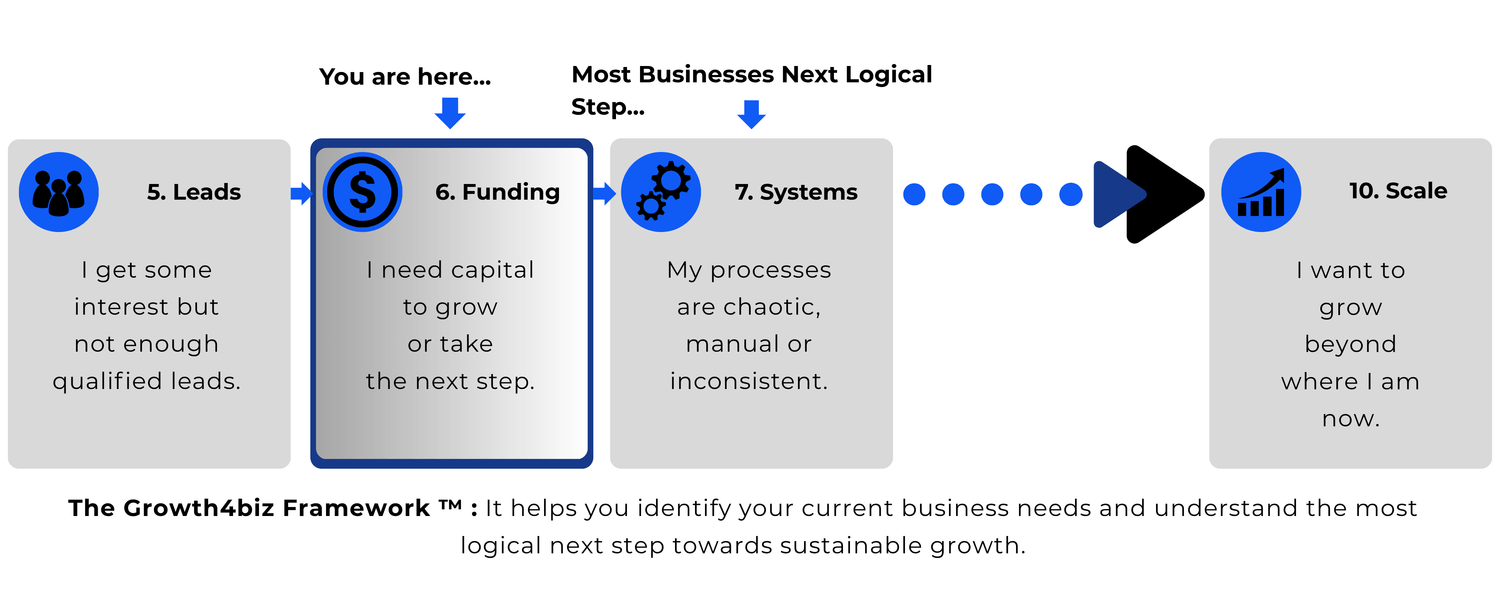
Your Position in the Growth4biz Framework™
I need capital to grow and or take the next step.

Primary Pillar — Sustainable Business Growth
Interpreting, Deciding, Acting, Adapting, and Developing Capacity
Business funding connects to the wider development of a business because obtaining resources is only one part of the process.
Supporting Pillars: Visibility, Credibility, Infrastructure
Primary Application Lens: Operational
The business must also understand what it is trying to accomplish, what evidence supports the proposed investment, and how the additional resources will be used.
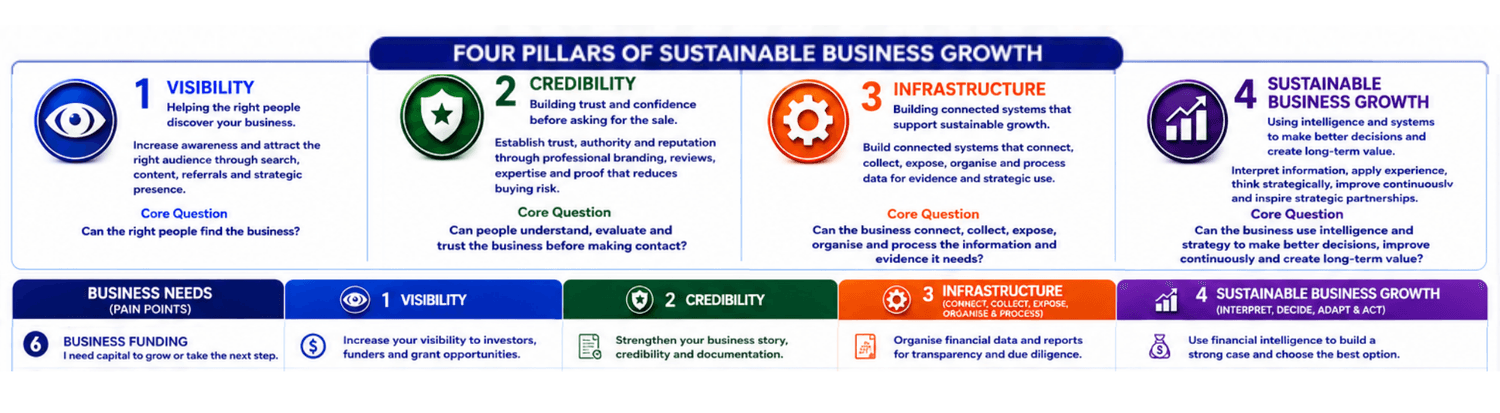
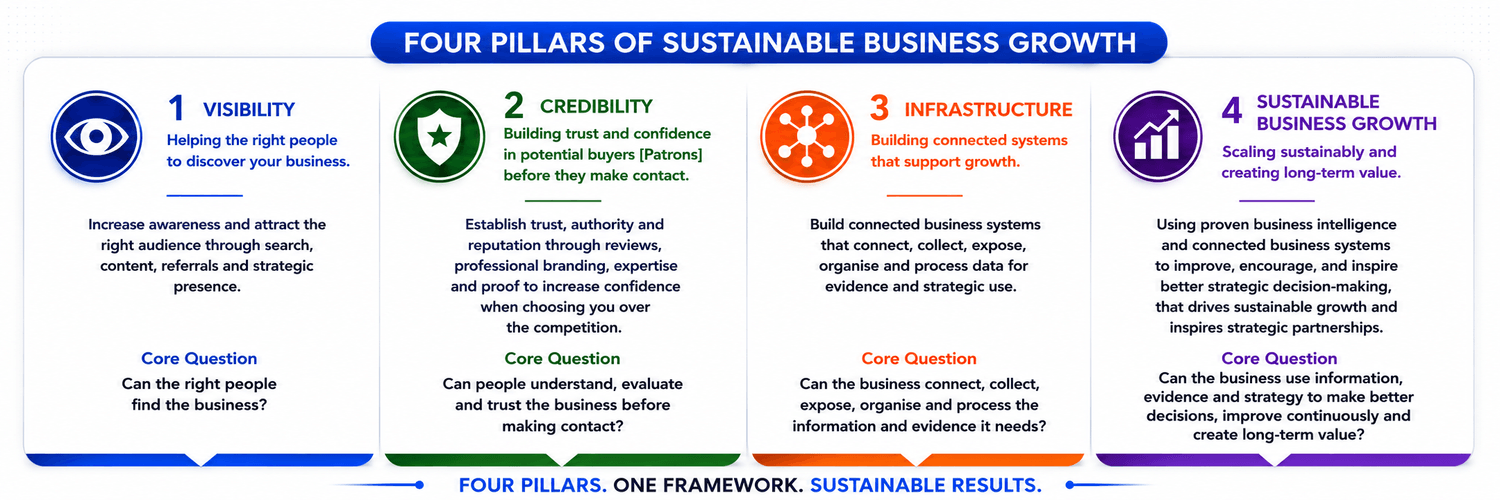
The Growth4biz Framework™ provides four connected perspectives for examining these relationships.
Visibility: Begins with the deliberate decisions that shape what a business presents, how it positions itself, and what activities it undertakes. These decisions influence how the business communicates its needs, capabilities, and opportunities.
Credibility: Begins with how an audience interprets the business's activity and the evidence available to it. A funding provider may evaluate the business's track record, financial information, experience, and ability to substantiate its proposal.
Infrastructure: Concerns the people, systems, data, relationships, capabilities, and structures that connect, collect, expose, organize, monitor and support business activity and evidence for operational and strategic use. Depending on the need, this infrastructure may be digital or physical.
Sustainable Business Growth: Concerns interpreting business intelligence, information, and experience to improve strategic decision-making, guide action, and develop the capacity for sustainable growth and strategic partnerships.
These pillars are not four exclusive categories into which every funding expense must fit. A single investment may relate to several of them.
The practical question is: What does the business need to accomplish, what capability or resource would help, and what evidence supports that decision?
1. What Is Business Funding?
Business funding refers to the money or financial resources a business obtains to establish, operate, develop, or expand its activities.
Depending on the arrangement, funding may come from a bank, government programme, development finance institution, investor, private financier, business partner, customer, supplier, or the business owner's own resources.
Funding may be used for purposes such as:
Starting a business.
Purchasing equipment or machinery.
Buying stock or raw materials.
Paying operating expenses.
Meeting working-capital requirements.
Hiring employees.
Developing products or technology.
Improving systems and infrastructure.
Expanding production or service capacity.
Entering new markets.
Fulfilling a contract.
Acquiring another business or commercial property.
Not every funding arrangement works in the same way.
Some funding must be repaid. Some requires the business to share ownership or future returns with an investor. Some programmes provide grants to eligible recipients for approved purposes. Other arrangements provide access to resources, contracts, equipment, or support without giving the business unrestricted cash.
This distinction matters because the amount of money available is only one consideration. The conditions attached to it may be just as important.
For example:
A business that needs a vehicle for regular commercial work might investigate asset finance. A business that needs to develop a new technology product may need a different type of funding. A business that has already secured a contract might investigate contract finance or negotiate payment terms with its customer.
The funding solution should match the actual requirement rather than being selected simply because it is available.
2. Why Do Businesses Need Funding?
Businesses seek funding for different reasons. Understanding the reason is an important first step because it helps determine which funding options are worth investigating.
2.1 Starting a business
A new business may need money for initial equipment, registration-related costs, stock, tools, premises, product development, or other essential resources.
However, a business idea does not automatically justify a funding application.
The owner should first determine what is required to test the idea, reach potential customers, and establish whether a viable business opportunity exists.
In some cases, a small pilot, customer-funded project, or partnership may be more appropriate than a large funding request.
2.2 Buying equipment and productive assets
A business may need machinery, computers, production equipment, tools, vehicles, sound equipment, or other assets to deliver its services or increase capacity.
The key question is whether the asset will help the business achieve a worthwhile objective.
For example:
Purchasing production equipment may allow a manufacturer to accept larger orders. Buying professional event equipment may allow an event-services business to deliver work it previously had to decline or outsource.
The owner should consider the purchase price, operating costs, maintenance, expected use, revenue potential, and whether the asset will generate enough value to justify its cost.
2.3 Managing working capital
Working capital helps a business manage the timing difference between money going out and money coming in.
A business may need to pay suppliers, employees, rent, transport, or other operating expenses before customers settle their invoices.
This is especially relevant when the business has secured work but must spend money before receiving payment.
A working-capital shortage does not necessarily mean the business is unprofitable. It may mean that the timing of its cash inflows and outflows is creating pressure.
Before seeking finance, the owner should understand the size of the shortfall, how long it is likely to last, and how the business will repay any borrowing.
2.4 Expanding an existing business
An established business may seek funding to open another location, hire additional staff, purchase more equipment, develop a new product, or increase its ability to serve customers.
Expansion funding should be connected to a clear plan.
The business should be able to explain what is changing, why the change is necessary, what resources are required, and how the investment is expected to contribute to the business.
2.5 Fulfilling a contract or purchase order
Winning a contract can create a funding requirement of its own.
A business may have an order but lack the money to purchase materials, pay workers, hire equipment, or cover delivery costs before payment arrives.
Depending on the circumstances, contract finance, working-capital finance, supplier terms, or a negotiated customer deposit may be worth investigating.
The existence of a contract does not automatically guarantee finance. Providers may still assess the contract, the customer, the delivery costs, the business's capacity, and the repayment arrangements.
2.6 Developing a new capability
Sometimes the business needs funding because it wants to become capable of doing something it cannot currently do reliably or at the required scale.
This might involve:
Establishing a content-production capability.
Introducing a customer-management system.
Training employees.
Improving production processes.
Developing a digital platform.
Building logistics capacity.
Improving reporting and financial controls.
This is a broader way to think about funding. Rather than simply listing the items the owner wants to purchase, the business identifies the capability it needs to develop and determines which resources are necessary to support it.
That distinction will become important when we examine the Growth4biz Framework™ later in this guide.
3. What Are the Main Types of Business Funding?
Different funding arrangements serve different purposes. The following options are not interchangeable, and some businesses may use a combination of them.
3.1 Grants
A grant is funding awarded under a particular programme or set of conditions. It generally does not require repayment when the recipient complies with the applicable terms, although the agreement may require reporting, approved expenditure, milestones, or repayment in certain circumstances.
Grants may support objectives such as:
Youth entrepreneurship.
Enterprise development.
Innovation.
Skills development.
Job creation.
Community or economic development.
Specific industries or strategic projects.
What to consider:
Grants are usually governed by defined eligibility rules and permitted uses. A business should verify who may apply, what expenses are allowed, whether matching contributions are required, what evidence must be submitted, and whether applications are currently being accepted.
A grant should not be treated as unrestricted money simply because it does not operate like a conventional loan.
3.2 Business loans
A business loan provides money that must be repaid under agreed terms.
Depending on the product, repayments may be made monthly or according to another agreed schedule. Interest, fees, security requirements, and repayment periods vary.
Loans may be suitable for purposes such as working capital, expansion, equipment purchases, or other investments where the business can reasonably support the repayment obligations.
What to consider:
Before borrowing, assess the total cost of finance, repayment schedule, cash-flow impact, security requirements, guarantees, and consequences of missing payments.
The important question is not merely whether the business can obtain a loan. It is whether the business can use the money productively while meeting the repayment obligations.
3.3 Equity investment
Equity investment involves an investor contributing capital in exchange for an ownership interest or another agreed investment arrangement.
This can be relevant to businesses with significant growth potential, scalable models, innovative products, or opportunities that require substantial investment before they generate sufficient cash flow.
Unlike a conventional loan, equity investment does not normally operate through fixed loan repayments. However, the business owner may give up some ownership, decision-making rights, or a share of future value.
What to consider:
Understand the valuation, ownership dilution, investor rights, governance arrangements, expected returns, and implications for future funding rounds.
Investment is not simply a loan without repayments. It can change the ownership and governance of the business.
3.4 Asset finance
Asset finance is designed to help a business acquire specified assets, depending on the product and provider.
Examples include vehicles, machinery, production equipment, and certain other business assets.
It can be useful when an asset has a clear operational purpose and the business would prefer not to pay the entire purchase price upfront.
What to consider:
Check the deposit, repayment terms, interest and fees, ownership arrangements, insurance requirements, maintenance costs, and what happens if the business cannot meet its obligations.
Asset finance may be more appropriate than a general-purpose loan for some purchases, but this depends on the terms and the business's circumstances.
3.5 Overdrafts and revolving credit
An overdraft or revolving credit facility can provide access to funds up to an agreed limit.
These arrangements may help a business manage short-term cash-flow fluctuations or recurring working-capital requirements.
They can be useful when money is needed temporarily and the business has a credible way to repay the amount used.
What to consider: Interest may be charged on the amount used, and facilities may be reviewed or withdrawn under their terms. Repeatedly using short-term credit to cover an ongoing structural loss can create further financial pressure.
3.6 Invoice and contract finance
Invoice finance may allow a business to obtain funding against qualifying unpaid invoices. Contract finance may help an eligible business finance the costs associated with fulfilling an awarded contract or purchase order.
The exact structure depends on the financier and the transaction.
These options can be relevant when the business has commercial activity but experiences a gap between incurring costs and receiving payment.
What to consider:
Check the eligible invoices or contracts, customer requirements, fees, repayment arrangements, recourse provisions, and whether the expected margin is sufficient to justify the finance.
3.7 Supplier credit and customer deposits
Not every funding solution involves receiving money from a bank or investor.
A supplier might agree to payment terms that allow the business to receive goods before paying for them. A customer might agree to a deposit or milestone-based payment schedule that helps cover the costs of delivering an order.
These arrangements can reduce the amount of external cash the business needs to find.
What to consider: Payment terms should be agreed clearly and documented. The business must be able to fulfil its obligations, and the arrangement should not create commitments it cannot meet.
3.8 Internal funding and reinvestment
A business may use retained profits, owner contributions, or other internal resources to finance its next stage of development.
Internal funding does not usually require an external application, although owner contributions and related transactions should still be recorded appropriately.
What to consider: Reinvesting profits can preserve ownership and avoid financing costs, but the business should retain enough cash for operating needs, emergencies, tax obligations, and other commitments.
Comparing the main options
Funding type
Potential advantage
Important consideration
1. Grant
1. May not require repayment if terms are met
1. Eligibility, approved use, and reporting requirements
2. Business loan
2. Provides capital under an agreed repayment arrangement
2. Repayment capacity, interest, fees, and security
3. Equity investment
3. Can provide capital without conventional loan repayments
3. Ownership dilution, investor rights, and governance
4. Asset finance
4. Connects finance to a specific asset purchase
4. Asset costs, ownership terms, and repayment obligations
5. Overdraft or revolving credit
5. Flexible access to funds within an approved limit
5. Cost of use and risk of ongoing dependence
6. Invoice or contract finance
6. May help fund delivery before customer payment
6. Contract terms, fees, and repayment conditions
7. Supplier credit or customer deposits
7. May reduce immediate cash requirements
7. Commercial terms and delivery obligations
8. Internal reinvestment
8. Can reduce dependence on external finance
8. Available cash and competing business needs
The best option depends on the business's requirements, financial position, risk tolerance, and the terms available. There is no single funding type that is automatically best for every business.
4. Where Can Small Businesses Find Funding in South Africa?
South Africa has several categories of organizations that businesses can investigate. The examples below are starting points for research, not a list of guaranteed funding opportunities.
An organization may provide direct finance, operate a particular programme, support businesses through development services, or connect entrepreneurs with other opportunities. These forms of support should not be confused with one another.
4.1 Commercial banks and business finance providers
Commercial banks offer various business finance products, which may include loans, overdrafts, asset finance, revolving credit, and other facilities.
Examples include:
These providers may be relevant to businesses seeking working capital, expansion finance, equipment, or other commercial finance.
What to consider when approaching a bank:
Banks assess applications according to the product, the business's financial position, and the provider's lending criteria.
Depending on the application, relevant considerations may include:
How long the business has been operating.
Business turnover and financial history.
Bank statements and financial records.
Cash-flow forecasts and repayment capacity.
The purpose and amount of the finance.
Owner contributions, security, or guarantees.
The business's credit profile.
The terms and total cost of borrowing.
Requirements differ between providers and products. A business should check the specific product criteria rather than assuming that every bank loan has the same requirements.
A useful starting point is the bank with which the business already maintains its primary transactional account, but it is still worth comparing suitable alternatives.
4.2 Government programmes and development finance institutions
Development finance institutions and public-sector programmes may support businesses that meet specific economic, industry, ownership, development, or other objectives.
Relevant starting points include:
Industrial Development Corporation (IDC)
The IDC Funding Solutions Hub provides information about its funding products and application process.
The IDC supports businesses across specified industry sectors and developmental priorities. Its published funding information indicates that it considers start-ups and existing businesses, with a minimum funding requirement of R1 million for its general funding offering. Specific products may have different criteria.
The IDC may therefore be worth investigating for qualifying industrial, manufacturing, agro-processing, energy, equipment, tourism, media, and other relevant projects.
What to check: Industry fit, project viability, funding size, financial requirements, eligible expenditure, developmental objectives, and the requirements of the specific funding product.
Small Enterprise Development and Finance Agency (SEDFA)
Visit the SEDFA website to investigate available financial and non-financial support for micro, small, and medium enterprises.
SEDFA is relevant to the broader small-enterprise support ecosystem. Do not assume that every service it offers is a direct cash-funding programme.
What to check: Whether the relevant offering provides finance, business-development support, training, market access, or another form of assistance; which businesses it serves; and how to access the particular service.
National Youth Development Agency (NYDA)
The NYDA Grant Programme combines grant support for eligible young entrepreneurs with business-development assistance.
Its published criteria include South African citizenship, residency, age requirements, and conditions relating to the business and intended use of the grant. The programme page also describes exclusions and an application process.
What to check: Current age requirements and deadlines, business stage, turnover restrictions, permitted expenses, training requirements, cumulative grant limits, and all other eligibility conditions.
Youth-focused programmes are particularly time-sensitive. Verify the current rules directly with the agency rather than relying on an older article, third-party list, or informal advice.
Mpumalanga Economic Growth Agency (MEGA)
The MEGA funding page provides information about funding for businesses in Mpumalanga.
Its published information identifies sectors including agro-processing, mining, energy, manufacturing, construction, trade, transport, forestry, services, government, and community-related activities.
What to check: Provincial and sector requirements, business eligibility, ownership or development criteria, the type of finance available, and the documentation required.
MEGA may be a relevant starting point for qualifying businesses operating in Mpumalanga. Businesses elsewhere should investigate the appropriate provincial or national alternatives.
A note about government funding
Government funding is not one universal programme. Each fund or incentive may have a different purpose, application process, set of conditions, and available budget.
A programme that supports one sector or business stage may not support another. Some opportunities are restricted to particular groups, locations, ownership structures, or types of expenditure.
Always begin with the official programme information and confirm whether applications are currently being accepted.
4.3 Specialist SME financiers
Some organizations specialize in financing small and medium-sized businesses rather than offering the full range of services associated with a commercial bank.
Business Partners Limited
The Business Partners Limited website provides information about business finance, asset finance, and other financing products.
The organization states that it provides finance to viable formal SMEs for purposes that can include expansion, working capital, equipment, property, franchises, and business acquisitions.
What to check: Minimum and maximum funding amounts for the relevant product, the business's viability, formal operating status, industry exclusions, financial requirements, repayment terms, and security arrangements.
This type of provider may be relevant to established businesses with a clear commercial purpose for the funding. Its published criteria should be reviewed carefully before an application is prepared.
4.4 Private investors and investment funds
Private investors, angel investors, venture-capital firms, and other investment funds may be relevant to businesses with growth potential, innovative offerings, scalable business models, or opportunities requiring substantial capital.
The right investor depends on the business's industry, development stage, investment requirement, and growth prospects.
An investor may contribute more than money. Depending on the arrangement, they may also offer expertise, networks, governance support, or access to further opportunities.
What to consider when approaching investors:
Investors usually need to understand the opportunity and how they may receive a return.
Be prepared to explain:
The problem the business solves.
The customers and market.
The business model.
Evidence of demand or market validation.
The experience and capability of the team.
The amount of capital required.
How the capital will be used.
The expected milestones and growth opportunity.
The proposed ownership or investment arrangement.
Not every business is suited to equity investment. A stable, profitable small business may prefer to retain ownership, while a high-growth business may consider whether external equity could accelerate its development.
4.5 Corporate enterprise development and supplier development
Some larger companies support smaller businesses through enterprise development, supplier development, market-access initiatives, or programmes connected to their supply chains and transformation objectives.
This support may include finance, training, mentoring, equipment, technical assistance, procurement opportunities, or a combination of these.
A small business might, for example, become a supplier to a larger organization and receive support to meet its operational, technical, or compliance requirements.
South Africa's enterprise and supplier development ecosystem includes initiatives linked to corporate supply chains and broader economic-development objectives. The Department of Trade, Industry and Competition (the dtic) and relevant corporate programme pages are useful starting points for further research.
What to consider when approaching a corporate programme
Does the company operate a relevant programme?
Is the programme accepting applications or engaging new suppliers?
Does it support businesses in your industry or region?
Are there ownership, size, or transformation-related requirements?
Does it provide direct finance, non-financial assistance, procurement access, or a combination?
What standards must suppliers meet?
What evidence of capability and delivery can your business provide?
Do not assume that every large company has a publicly accessible funding programme. Some initiatives operate through selected partners, existing supply chains, or targeted recruitment processes.
A commercial relationship may also be valuable without a direct grant. A supplier-development arrangement or contract can create revenue and market access, provided the terms are commercially sound.
4.6 Provincial agencies, incubators, and enterprise-support organizations
Businesses may also find assistance through provincial development agencies, incubators, accelerators, universities, TVET colleges, industry bodies, and organizations that support entrepreneurs.
Depending on the organization, the assistance may include:
Business-development services.
Mentorship.
Training.
Technical assistance.
Market linkages.
Shared facilities.
Introductions to finance providers.
Support with business plans or funding applications.
Access to specific programmes.
For example, MEGA is a provincial development agency relevant to Mpumalanga, while SEDFA operates within the broader small-enterprise development and finance ecosystem.
What to consider
Ask exactly what the organization provides. A business-support organization may help you prepare for funding without providing the money itself. An incubator may offer training or technical support but no direct finance. A programme may provide access to a network or market rather than a cash grant.
These forms of support can still be valuable. They simply serve a different purpose from direct funding.
5. Funding Is Not the Only Way to Obtain Resources
Heading:
A business may need additional resources without necessarily needing a grant or loan.
Sometimes the better solution is a commercial arrangement, partnership, or change to how the business operates.
Consider the following examples:
Business requirement
Other option worth investigating
1. Stock needed to fulfil a customer order
1. Supplier credit or agreed customer deposits
2. Equipment needed for a project
2. Equipment hire, leasing, or a delivery partnership
3. Access to a new customer market
3. Strategic partnership or referral arrangement
4. Skills needed for a specific project
4. Specialist subcontracting or collaboration
5. Cash needed before a customer pays
5. Contract finance or renegotiated payment milestones
6. Digital capability needed by a business
6. A service agreement, managed service, or implementation partner
7. Additional capacity needed temporarily
7. Outsourcing or shared resources
These options are not automatically cheaper or better than finance. They have their own costs, risks, and contractual implications.
The important principle is to identify the requirement before deciding how to obtain the resources.
Funding is one possible mechanism for developing a business.
It is not the only mechanism.
6. How Does the Business Funding Process Work?
The process differs between providers, but many applications involve a similar set of activities.
Step 1: Define the business requirement
Begin by identifying what the business needs to accomplish.
Is the objective to purchase equipment, manage working capital, develop a product, expand operations, fulfil a contract, or establish a new capability?
Avoid beginning with an arbitrary amount of money.
Start with the objective and determine the resources required to achieve it.
Step 2: Establish the cost
Prepare a realistic estimate of the amount required.
Where appropriate, obtain supplier quotations, identify implementation costs, include relevant installation or delivery expenses, and account for ongoing operating costs.
If the project involves employees, software, equipment, or premises, consider the costs of using and maintaining those resources after the initial purchase.
Step 3: Determine the appropriate type of support
Compare the requirement with the different forms of funding and commercial support available.
A grant, loan, asset-finance arrangement, investor, supplier agreement, or customer-funded project may each be appropriate in different circumstances.
The objective is to select a realistic shortlist rather than apply indiscriminately to every available opportunity.
Step 4: Check eligibility
Review the official criteria for each opportunity.
Depending on the programme, eligibility may depend on:
Business registration and legal structure.
Business stage and operating history.
Industry or sector.
Geographic location.
Ownership and shareholder composition.
Age or other applicant characteristics.
Turnover, assets, or employee numbers.
Credit history and financial position.
The intended use of funds.
The ability to repay finance.
Compliance and supporting documentation.
If the business does not qualify, identify the specific reason before deciding what to do next. Another programme or type of support may be more appropriate.
Step 5: Prepare the application
Gather the required documents and develop a clear explanation of the business, the project, the funding requirement, and the intended results.
The exact documentation varies by provider and funding type. A grant application may require a different set of documents from a commercial loan or equity investment.
Step 6: Submit and respond to requests
Follow the provider's application process and submit the required information.
The provider may request additional documents, conduct due diligence, assess the business, or invite the applicant to present the proposal.
Keep copies of the application and maintain a record of communications and deadlines.
Step 7: Review the offer before accepting
Approval does not automatically mean the offer is appropriate.
Before signing, understand the amount, conditions, repayment obligations, fees, security, reporting requirements, permitted expenditure, and other commitments.
For equity investment, understand the ownership and governance implications.
Where the terms are unclear or significant, obtain suitable professional advice before committing.
Step 8: Implement and monitor the project
If funding is accepted, use it according to the agreed purpose and maintain appropriate records.
Monitor expenditure, implementation progress, and the results the investment was intended to produce.
The funding process does not end when the money arrives. The business still needs to manage the resources and evaluate whether they are creating the intended value.
7. What Do Funding Providers Look For?
There is no universal checklist that applies to every funder. However, providers often need to understand the business, the proposal, the risks, and the likelihood that the arrangement will achieve its purpose.
7.2 Evidence of demand or a viable opportunity
A provider may want to understand whether customers exist for the product or service and whether the business has a realistic opportunity to generate revenue or achieve its stated objectives.
Depending on the business, evidence might include sales history, signed contracts, customer orders, repeat business, market research, pilot results, or other relevant information.
A new business may have less historical evidence than an established business. Its proposal should therefore be appropriate to its stage and supported by the strongest evidence reasonably available.
7.3 Financial information and repayment capacity
For repayable finance, the provider needs to understand whether the business can meet its obligations.
Relevant information may include:
Historical financial statements.
Management accounts.
Bank statements.
Cash-flow forecasts.
Sales and expenditure budgets.
Existing debt and commitments.
The owner's contribution.
The amount and timing of expected income.
A profitable business can still experience cash-flow problems. That is why forecasts and timing matter alongside reported profit.
7.4 Management capability
The provider may assess whether the owner or management team has the skills, experience, knowledge, and capacity to execute the proposed project.
This is especially important where the investment introduces greater complexity, requires specialist skills, or depends on the business entering a new market.
The owner should be able to explain how the project will be managed and whether additional people, partners, or systems will be required.
7.5 Appropriate systems and records
Depending on the project, the business may need systems to manage finances, customers, stock, operations, compliance, reporting, or project implementation.
Not every application requires advanced technology. The relevant question is whether the business has appropriate arrangements for its size, activities, and obligations.
7.6 Eligibility and compliance
A strong business proposal can still be rejected if it does not meet the programme's eligibility criteria.
Ownership rules, industry restrictions, permitted expenditure, registration requirements, tax or regulatory matters, and other conditions can all affect eligibility.
Check these requirements before spending substantial time or money preparing an application.
8. Using the Growth4biz Framework™ to Identify Potential Funding Needs
The Growth4biz Framework™ can help a business examine a potential funding requirement more carefully.
The purpose is not to turn the four pillars into a funding formula. It is to use them as connected perspectives for understanding the business, its activity, the available evidence, the supporting infrastructure, and the decisions that may follow.
Consider a business owner who believes the company needs funding to hire an employee and purchase equipment.
Those purchases might be necessary. But the business should first understand the requirement behind them.
Visibility: Examine the deliberate decisions shaping business activity
Visibility begins with the decisions the business makes about what it presents, how it positions itself, what it communicates, which activities it undertakes, and where it seeks to participate.
For a funding-related project, the owner might ask:
What is the business deliberately trying to accomplish?
What market, customer, or opportunity is the business pursuing?
What activity has the business chosen to undertake?
What does the business need to communicate about the project?
What resources might be required to carry out those decisions?
The point is not simply to ask what the business needs to display publicly. It is to examine the decisions that shape the activity in the first place.
Those decisions may reveal a need for additional resources. They may also reveal that the business needs to change its approach before committing money.
Credibility: Examine how the audience interprets activity and evidence
Credibility begins with how the audience interprets the business's activity and the evidence available to it.
A funding provider may need to understand whether the business can support its claims and whether the proposed project is credible.
The owner might ask:
What evidence can the business provide about its existing activity?
What information supports the proposed opportunity?
What would a funding provider need to evaluate?
Which claims can be substantiated, and which remain assumptions?
What evidence or capability still needs to be developed?
Depending on the project, the answer may involve financial records, customer evidence, qualifications, quotations, contracts, or a more realistic business plan.
Credibility cannot simply be purchased. The business can improve the quality of its presentation and evidence, but the provider ultimately makes its own assessment.
Infrastructure: Examine how the activity, information, and resources are connected and supported
Infrastructure concerns the people, systems, data, relationships, capabilities, and structures that connect, collect, expose, organize, and support business activity and evidence for operational and strategic use.
The owner might ask:
What systems, people, equipment, or processes are required?
What information must be collected, connected, or organized?
What is preventing the business from using its existing resources effectively?
Which capabilities need to be strengthened?
Could an existing system, supplier, employee, or partner address the requirement without a new purchase?
The examination may reveal a genuine resource gap. It may instead reveal that the business needs a better process, improved information management, training, or access to a partner.
The distinction matters because not every operational problem requires additional funding.
Sustainable Business Growth: Interpret the information to guide strategic decisions
Sustainable Business Growth concerns interpreting business intelligence, information, and experience to improve strategic decision-making, guide action, and develop the capacity for sustainable growth and strategic partnerships.
The owner might ask:
What does the available information suggest about the opportunity?
What have past results and experience revealed?
Is the proposed investment the most appropriate response?
What alternatives should be compared?
What capacity is the business trying to develop?
How will the business assess whether the investment has achieved its purpose?
This is where the business connects its observations and evidence to a strategic decision.
The decision may be to apply for funding, use internal resources, pursue a partnership, change the project, or postpone the investment until more information is available.
From examination to an investment justification
Once the business has examined the requirement, it can develop a clearer investment justification.
A useful justification connects four things:
The identified business need: What must the business accomplish or address?
The required capability or resource: What would help the business accomplish it?
The proposed investment: What is being requested, why is it appropriate, and what will it cost?
The intended outcome: What should the investment enable, and how will progress or results be assessed?
For example, a business requesting funding for content-production equipment should explain more than why it wants a camera.
It should explain the content-production capability it intends to establish, the work that capability will support, why the proposed equipment is suitable, what alternatives were considered, and how the investment is expected to contribute to business objectives.
The same reasoning applies to equipment, software, employees, premises, and other investments.
The Framework helps the business examine its requirement and reason through its options.
It does not guarantee that the project is viable, that the proposed investment is the right choice, or that a funding provider will approve the application.
9. Common Business Funding Mistakes
Mistake 1: Starting with the funding amount
A business owner may decide they need R100,000 or R500,000 before establishing precisely what the money is for.
This can result in an arbitrary request that is difficult to justify.
How to avoid it: Define the business objective, identify the required resources, obtain realistic cost estimates, and calculate the amount needed.
Mistake 2: Treating every funding opportunity as suitable
A programme may sound attractive but exclude the business because of its sector, location, ownership, size, age, stage, or intended expenditure.
How to avoid it: Check the official eligibility criteria before preparing the application.
Mistake 3: Confusing a grant with a loan
Some business owners focus on the amount available without understanding the repayment obligations or conditions.
How to avoid it: Confirm the type of support, total cost, repayment terms, restrictions, and obligations before accepting an offer.
Mistake 4: Preparing an application without reliable financial information
Inconsistent records and unrealistic forecasts make it harder to assess the proposal.
How to avoid it: Maintain appropriate records, prepare realistic forecasts, and make sure the figures in the application are consistent.
Mistake 5: Assuming that funding will solve every business problem
Additional money may increase capacity, but it can also magnify existing weaknesses.
A business that struggles to manage its current workload may experience greater difficulties after expanding without improving its systems or management capability.
How to avoid it: Identify the actual constraint and determine whether the solution requires money, a new process, people, training, a partnership, or a combination of these.
Mistake 6: Ignoring the cost of using the resources
Equipment, software, vehicles, and employees often create ongoing costs after the initial investment.
How to avoid it: Budget for maintenance, subscriptions, salaries, insurance, transport, training, and other relevant operating expenses.
Mistake 7: Relying on outdated funding information
Programmes change. Application windows close, eligibility rules are revised, and funding allocations may be exhausted.
How to avoid it: Use official sources, confirm the latest requirements, and verify the application window directly with the provider.
Mistake 8: Paying for promises of guaranteed funding
Be cautious of anyone who promises guaranteed approval, claims to have special access to a funder, or requests suspicious upfront payments to secure a grant.
How to avoid it: Verify the organization and application process independently. Do not share sensitive information or make payments until you have established that the arrangement is legitimate.
10. Practical Tips Before Seeking Business Funding
Use the following steps to improve your preparation.
Define the objective. Explain what the business is trying to accomplish and why it matters.
Calculate the requirement. Estimate the full cost, including relevant implementation and operating expenses.
Consider alternatives. Compare grants, loans, asset finance, internal resources, customer arrangements, and partnerships where appropriate.
Prepare reliable records. Organize the financial and operational information relevant to the application.
Build a realistic plan. Explain how the resources will be used and how the project will be implemented.
Demonstrate the opportunity. Provide appropriate evidence of demand, contracts, customer activity, market research, or other relevant information.
Check eligibility early. Confirm that the business and intended expenditure meet the provider's criteria.
Compare the terms. Consider the total cost, repayment obligations, ownership implications, restrictions, and risks.
Plan for implementation. Determine who will manage the project, what systems are needed, and how results will be monitored.
Maintain a funding record. Track organizations investigated, application deadlines, eligibility, documents, submissions, and responses.
Prepare an alternative route. If a particular programme is unsuitable or unavailable, investigate another form of support rather than assuming the entire project must stop.
The objective is to make a deliberate, informed decision instead of allowing the availability of a particular funding programme to dictate the direction of the business.
11. Frequently Asked Questions
There is no single funding option that is easiest for every business. Eligibility depends on the business's circumstances, the intended use of the money, the provider's requirements, and the availability of funding.
A business should begin by identifying its requirement and investigating suitable options rather than assuming that one programme is universally accessible.
Some products and programmes may require a formal business plan, while others may use different application processes or request a business profile, financial information, or other supporting documents.
Check the specific provider's requirements. Even when a formal plan is not mandatory, the business should be able to explain the purpose, cost, implementation, and expected results of the proposed investment.
Yes, some funding options support new businesses, but eligibility varies.
A start-up may need to demonstrate a viable business idea, relevant experience, a credible plan, market evidence, or an appropriate contribution from the owner. Other providers may primarily serve established businesses.
The business should look for programmes designed for its particular stage.
Grants generally do not require repayment when the recipient complies with the applicable conditions. However, a grant may have restrictions on expenditure, reporting obligations, milestones, or provisions for recovering money in certain circumstances.
Always read the official terms before accepting a grant.
Depending on the provider and funding type, documents may include registration records, identification, financial statements, bank statements, cash-flow forecasts, business plans, supplier quotations, tax or compliance documents, ownership information, contracts, and evidence supporting the proposed project.
There is no universal document list. Follow the specific provider's requirements.
Some programmes and investors may consider early-stage businesses, but the requirements differ. A commercial lender may place particular emphasis on repayment capacity, while an investor may focus on the growth opportunity and the business model.
The business should be realistic about its financial position and investigate options suited to its stage and circumstances.
Investigate the reason for ineligibility and look for alternatives based on the business's actual requirements.
Potential alternatives may include commercial finance, development finance institutions, asset finance, corporate programmes, supplier-development opportunities, contracts, partnerships, or other support that does not use the same age criteria.
Do not assume that all funding programmes have identical eligibility rules.
No. Business funding is a broad term that includes different ways of obtaining financial resources. Equity investment is one form of funding in which an investor typically receives an ownership interest or another agreed investment right.
Loans, grants, asset finance, and equity investment have different obligations and implications.
Yes. Businesses may grow through customer revenue, internal reinvestment, partnerships, supplier arrangements, improved processes, and other means.
External funding may accelerate a suitable project, but it is not automatically necessary or appropriate for every business.
Start with the business objective and identify the resources required to achieve it. Obtain cost estimates, account for implementation and operating expenses, consider available resources and alternatives, and calculate the remaining requirement.
The amount should be justified by the project rather than chosen simply because a funding provider offers that amount.
Final Thoughts
Business funding can help a company establish operations, develop capabilities, increase capacity, fulfil contracts, and pursue growth opportunities.
But the decision to seek funding should begin with a clear understanding of the business — not simply a search for money.
The business needs to understand what it is trying to accomplish, what resources are required, what evidence supports the opportunity, and how the proposed investment will be used.
It also needs to choose a funding arrangement that fits its circumstances and obligations.
The Growth4biz Framework™ offers a way to examine these questions through the relationship between deliberate business decisions and activity, audience interpretation and evidence, supporting infrastructure, and the interpretation of information for strategic decision-making.
The result of that examination may be a funding application. It may instead be a different process, a partnership, a change in priorities, or a decision to use existing resources more effectively.
The goal is not to pursue funding for its own sake.
It is to develop the business's ability to accomplish what it has set out to do.
Funding can provide resources.
The business must determine how those resources will be converted into useful capability and sustainable value.
That is why a stronger starting question is not merely:
Where can I find funding?
It is:
What does my business need to accomplish next, what would help it accomplish that, and which form of support makes the most sense?
Continue Your Growth Journey
Related Articles
Business Funding Readiness: How to Prepare Your Business Before Applying for Funding
What Is Business Foundation? A Complete Guide to Building a Strong Foundation
Business Plan Guide: How to Develop a Business Plan for Growth and Funding
Downloads:
Funding Readiness Checklist - [Coming Soon]
General Business Plan Template - [Coming Soon]
Funding Oriented Business Plan - [Coming Soon]
Business Need
Primary Pillar
Supporting
Visibility, Credibility, Infrastructure
Book a Consultation
Understanding funding is only one part of deciding what your business needs next.
Growth4biz Media helps businesses examine their digital presence, systems, infrastructure, and growth requirements so they can make more informed decisions about the capabilities they need to develop.
If your business is considering an investment but you are unsure what needs to be established, strengthened, or connected first, a consultation can help you explore the underlying business requirement and potential next steps.
Book a consultation with Growth4biz Media to discuss the business challenge you are trying to address and the capabilities that may help you move forward.
SHARE




ABOUT
Growth4biz Media is a Digital Business Infrastructure Agency helping businesses establish, strengthen and evolve the digital capabilities that support how they operate, communicate, connect with people and grow.
We do more than keep websites alive or help people monetise their intellectual property or expertise. We are helping businesses keep their digital capabilities relevant and useful as their operating environments change.
Copyright 2026 • Growth4biz Media (Pty) Ltd.