
Business Plan Guide: How to Develop a Business Plan for Growth and Funding
Introduction
You may know what your business does, what you want to achieve, and what you need to do next.
You may even have a list of equipment you want to purchase, services you want to introduce, employees you need to hire, or opportunities you want to pursue.
But knowing what you want to do is not the same as having a plan for doing it.
What will the investment help your business achieve?
Is there enough demand for the products or services you intend to offer?
What will the expansion cost?
How will you manage the additional work?
and,,,
How will you know whether the plan is producing the results you expected?
These questions become particularly important when a business needs funding.
A funder may want to understand the business, the opportunity, the proposed investment, and the likelihood that the business can implement its plans. The business owner, however, needs answers to these questions regardless of whether funding is involved.
South Africa's Industrial Development Corporation (IDC), for example, asks funding applicants to submit a well-researched business plan that presents a compelling case for funding. Its published guidance also highlights the importance of business viability, market demand, credible financial information, and realistic projections supported by evidence. IDC funding application guidance and IDC guidance for applicants in Gauteng.
This illustrates an important distinction: a business plan is not simply a document you produce because someone asks for it.
A business plan should help you understand your business, make decisions about its future, organize the resources required, and determine how you intend to turn your objectives into action.
When funding is involved, it also helps you explain why the proposed investment makes sense.
This guide explains how to develop a business plan that serves both purposes: guiding the business and preparing it to pursue appropriate funding opportunities.
It also introduces two complementary planning resources: a general Business Plan Template and a Funding-Oriented Business Plan Template.
Your Position in the Growth4biz Framework™
I need capital to grow and or take the next step.
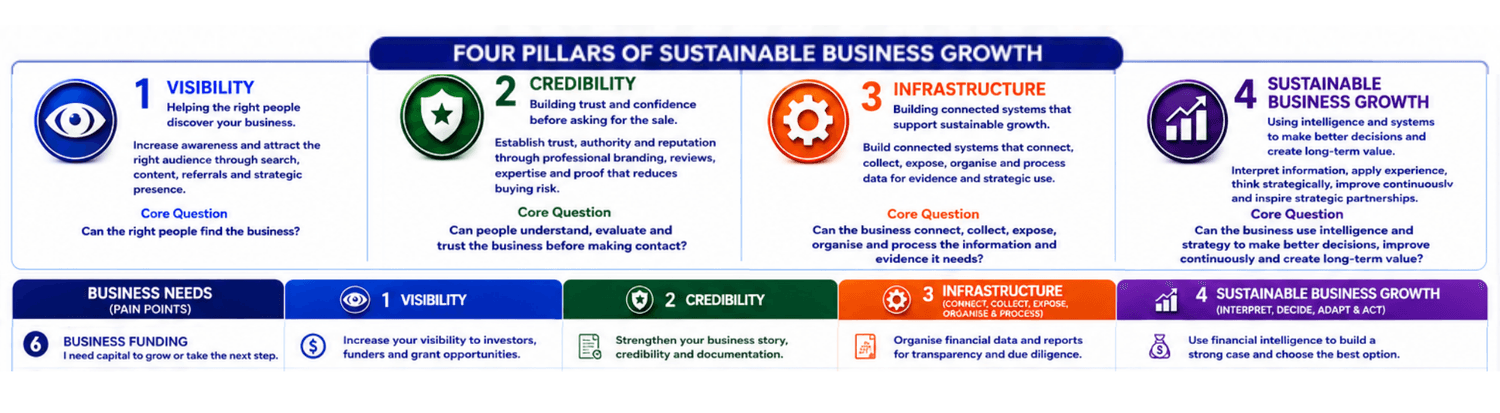
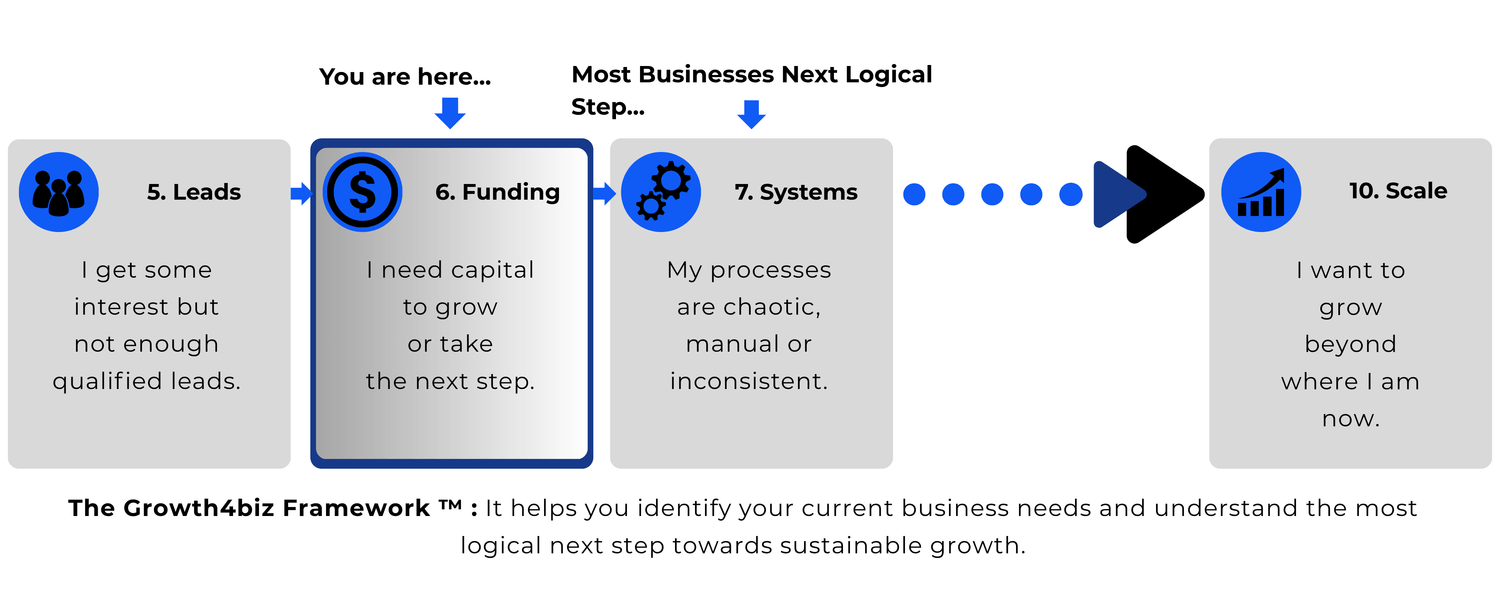

Primary Pillar — Infrastructure
Connecting, Collecting, Organizing, Exposing, Monitoring and Supporting of businesss activity.
A business plan brings together important parts of a business that might otherwise be considered separately. It connects the business's direction to its products or services, customers, operations, people, finances, resources, and intended outcomes. It also helps the owner organize the information needed to make decisions and implement the plan.
This is why Infrastructure is the primary pillar for this article.
Supporting Pillars:
Visibility — Deliberate Decisions
Credibility — Audience Interpretation
Sustainable Business Growth — Interpretation and Strategic Decision-Making
Primary Application Lens: Operational Lens
Business Need Hub: Business Funding
The business plan helps connect and organize the information, resources, systems, and capabilities required to move the business forward.
The other pillars contribute in different ways.
Visibility relates to the decisions that shape the business's direction and what it intends to offer.
Credibility becomes relevant when the business presents its plans and supporting evidence to customers, funders, partners, or other audiences.
Sustainable Business Growth relates to how the owner interprets available information and uses it to make strategic decisions.
These are interconnected perspectives, not four mandatory stages that every business must follow in a fixed order.
The purpose of this guide is to help you build and use the plan itself.
1. What Is a Business Plan?
A business plan is a structured document that explains what a business does, where it intends to go, how it expects to get there, and what resources and capabilities it will require.
Depending on the business and its objectives, a plan may cover:
The business's purpose, direction, and objectives.
The products or services it provides.
Its customers, market, and competitors.
How it attracts customers and generates revenue.
How it operates and delivers its products or services.
The people, systems, equipment, and other resources it needs.
Its financial position and future financial expectations.
The actions required to achieve its objectives.
The risks that could affect its plans.
How progress will be monitored and evaluated.
A business plan is therefore more than a description of the business.
It connects the different elements of the business to a proposed direction.
For example:
A business may want to increase its revenue. That objective could require more customers, higher-value services, improved sales processes, additional production capacity, or a combination of these.
The business plan helps the owner determine which approach makes sense, what it will require, and how it could affect the rest of the business.
A business plan is not the same as a funding application
Although the two are related, they serve different purposes.
Business plan
Funding application
1. Explains the business and its intended direction.
1. Requests support under a particular funding opportunity.
2. Helps the owner evaluate decisions and plan implementation.
2. Explains why the applicant should receive the specific funding being requested.
3. Can be used for general business planning and growth.
3. Must address the requirements of the relevant funding organization.
4. Can be reviewed and updated as the business changes.
4. Must be prepared and submitted according to the applicable application process.
A funding application may require a business plan, a project proposal, a feasibility study, financial forecasts, or a prescribed combination of documents.
The exact requirements depend on the organization and funding product.
For example, the IDC's published funding process asks applicants to provide an executive summary and business plan alongside relevant supporting documents. The National Empowerment Fund (NEF) also specifies a comprehensive business plan proposal and supporting financial information in its application materials. IDC application process and NEF application guidelines.
The practical lesson is to develop a useful business plan first, then adapt the information and format to the funding opportunity when required.
2. When Do You Need a Business Plan?
A business plan is useful at different stages of a business's development. It should not be treated as a document reserved for start-ups or businesses seeking finance.
When starting a business
A plan helps you examine whether the business idea is practical before committing substantial time and money.
You can use it to evaluate the intended customers, the proposed offer, start-up costs, operating requirements, pricing, and likely sources of revenue.
It can also reveal assumptions that need to be tested before the business launches.
When improving an existing business
An established business may need a plan when its current approach is no longer producing the desired results.
For example, sales may be inconsistent, operating costs may be increasing, or the owner may be spending too much time on activities that do not contribute sufficiently to business performance.
A plan helps the owner examine the situation, identify possible changes, and determine what needs to be implemented.
When expanding
Expansion introduces new requirements.
A business that wants to serve more customers may need additional equipment, staff, premises, suppliers, working capital, or operational systems.
The owner needs to understand not only the cost of expansion but also the additional capacity required to sustain it.
A business plan helps connect the proposed expansion to the business's actual requirements.
When applying for funding
A funding-oriented plan helps explain the relationship between the business's current position, the opportunity it wants to pursue, the resources it requires, and the expected results.
This is particularly important when requesting money for equipment, technology, staff, working capital, or another investment.
The IDC's funding checklist, for example, asks for information covering the business, market, management, funding requirements, equipment, quotations, and financial projections. Its requirements demonstrate how a funding organization may examine several connected aspects of a proposal rather than considering the requested amount in isolation. IDC Funding Checklist.
When seeking partnerships or contracts
A business plan can also help explain what the business can deliver, the resources and capabilities it has established, and what it intends to develop.
A potential partner or institutional client may need to understand how the business operates, whether it can deliver the proposed work, and what additional capacity would be required.
The level of detail will depend on the opportunity. A complete traditional business plan will not always be necessary, but the underlying planning remains valuable.
Why this matters: The business plan should be developed according to what the business needs to understand and achieve, not merely according to the document someone might request later.
3. Before You Write: Understand the Business
One of the easiest mistakes is to begin writing before the important decisions have been examined.
A business plan can look professional while still containing unclear objectives, unsupported assumptions, unrealistic forecasts, or activities that do not connect to the intended outcome.
Before drafting, establish a clear understanding of the business and the reason for planning.
Define the purpose of the plan
Ask yourself what you need the plan to help you accomplish.
Are you:
Starting a business?
Improving an existing operation?
Introducing a new product or service?
Increasing sales?
Expanding into a new market?
Purchasing equipment?
Hiring additional staff?
Applying for funding?
Preparing to work with a strategic partner?
The purpose influences which information deserves the most attention.
A plan for launching a small service business may need a different level of operational detail from a plan for expanding a manufacturing operation.
Similarly, a plan used internally to improve performance may differ from one prepared for a particular funding opportunity.
4. Research and Validate the Business Plan
A business plan should reflect the business's actual circumstances and the evidence available to support its decisions.
Research is important because owners can become attached to an idea and interpret their expectations as if they were established facts.
A plan becomes more useful when it distinguishes what is known from what is assumed.
Research the market
Understand the market the business intends to serve.
Investigate:
Who the potential customers are.
What problems or needs they have.
How they currently address those needs.
What alternative products or services are available.
What customers appear willing to pay.
What competitors offer.
What factors could influence demand.
What barriers might affect the business's ability to enter or grow in the market.
Use relevant information rather than relying entirely on general statements about the industry.
Depending on the business, useful evidence may include customer interviews, surveys, competitor research, enquiries, quotations, sales records, pilot results, contracts, letters of intent, or industry information.
Distinguish facts, estimates, and assumptions
This is especially important when preparing financial forecasts or a funding proposal.
Facts are supported by available evidence.
For example, the business has completed 24 paid projects in the past six months, as shown by its records.
Estimates are reasoned approximations based on the information available.
For example, the owner estimates that a project will require three working days based on comparable jobs.
Assumptions are conditions the plan expects to hold true but that have not yet been sufficiently established.
For example, the business assumes that it can secure ten additional customers per month after launching a new service.
Assumptions are not automatically wrong. Planning often requires them, especially when a business is new or entering a new market.
The important point is to identify them, explain their basis where possible, and determine how they will be tested.
This approach is consistent with the IDC's published guidance that financial projections should be realistic and supported by evidence such as letters of intent, signed contracts, or off-take agreements where relevant. IDC guidance for applicants in Gauteng.
What if the business has no trading history?
A new business may not have historical sales records or established customer relationships.
That does not mean it cannot prepare a business plan.
Instead, it must be transparent about what has and has not been demonstrated.
Depending on the business, useful supporting information may include:
Market research.
Interviews with potential customers.
Evidence of early customer interest.
Results from a pilot or trial.
Supplier quotations.
Comparable pricing information.
Relevant industry experience.
Letters of intent, where available.
A realistic financial model with clearly stated assumptions.
A new business should not present projected sales as if they were existing revenue or treat expressions of interest as guaranteed contracts.
The purpose of the research is to develop a reasoned view of the opportunity and identify what still needs to be proven.
5. The Main Components of a Business Plan
There is no single format that is appropriate for every business and every purpose.
The U.S. Small Business Administration distinguishes between traditional plans, which provide more comprehensive detail, and lean business plans, which use a more streamlined format. It advises businesses to choose a format according to their needs and notes that traditional plans are often useful when seeking financing from conventional sources. SBA: Write Your Business Plan.
For a business developing a substantial plan for growth and potential funding, the following components provide a useful structure.
1. Executive summary
The executive summary gives the reader a concise overview of the business and its plans.
It should generally cover:
The business and what it does.
The customers or market it serves.
The products or services it offers.
Its current position.
The opportunity or objective being pursued.
The main strategy.
The resources required, if relevant.
The intended outcomes.
If the plan is being prepared for funding, the summary should also explain the funding requirement and its purpose.
Although the executive summary appears first, it is often easier to write it after developing the rest of the plan.
2. Business overview
Explain the business in sufficient detail for the reader to understand its activities and position.
Include relevant information about its background, ownership or legal structure, location, products or services, customers, business model, development stage, and current capabilities.
For an established business, this may include relevant achievements, customer relationships, operating history, or evidence of demand.
For a new business, explain what has been established so far and what remains to be developed.
3. Products and services
Describe what the business offers and the value it intends to provide to customers.
Explain:
What is being sold.
Which customer needs the offer addresses.
How the product or service is delivered.
How it is priced.
What it costs to provide.
What distinguishes it from available alternatives, where relevant.
Avoid describing an offer only in terms of the activities the business performs.
The plan should explain why the offer matters to the intended customer and how it contributes to the business model.
4. Market and customer analysis
Identify the market the business intends to serve.
Describe the relevant customer groups, their needs, the alternatives available to them, and the evidence supporting the business's understanding of the opportunity.
Where relevant, examine market size, demand, competitors, industry conditions, customer purchasing behavior, and barriers to entry.
Do not include market statistics simply to make the plan look impressive. The information should help the owner understand the opportunity and make better decisions.
5. Marketing and sales strategy
Explain how the business intends to reach potential customers, generate enquiries, convert opportunities into sales, and retain customers where appropriate.
This may include:
Marketing channels.
Customer acquisition activities.
Sales processes.
Pricing and offers.
Lead management.
Follow-up procedures.
Customer relationships.
Retention and repeat business.
Connect the strategy to the business's actual customers, resources, and capacity.
For example:
A business may plan to generate more enquiries through digital marketing. The plan should also consider who will respond to those enquiries, how they will be tracked, and whether the business can fulfil the additional work.
6. Business model and revenue
Explain how the business generates or expects to generate revenue.
Identify the main revenue streams, pricing approach, important costs, and the relationship between the offer and the way the business earns money.
A business can attract customers and still struggle financially if its pricing does not cover its costs or its delivery model is inefficient.
The plan should therefore examine how the business intends to generate sufficient revenue to support its operations and development.
7. Operations and required capabilities
Explain how the business operates and what it needs to deliver its products or services.
Depending on the business, this may include:
Equipment and physical assets.
Premises and facilities.
Technology and digital systems.
Suppliers and service providers.
Staff and specialist skills.
Operational procedures.
Quality control.
Inventory and logistics.
Working capital.
Management and administrative capacity.
Connect these requirements to the business's objectives.
If equipment is needed to increase production capacity, explain the existing constraint and how the equipment is expected to address it.
If staff are needed, explain the responsibilities they will perform and why the existing team cannot adequately perform those functions.
The objective is to establish the relationship between the resources required and the business activity they are intended to support.
8. Management and responsibilities
Identify who will manage the business and implement its plans.
Explain the responsibilities of the owner, management team, employees, and relevant external specialists.
Include relevant experience and skills, as well as any important gaps that need to be addressed.
A plan that requires significant expansion should consider whether the business has the management capacity to implement and sustain that expansion.
9. Financial plan
The financial plan translates the business's activities and objectives into financial terms.
Depending on the business's stage and the purpose of the plan, it may include:
Start-up or expansion costs.
Historical revenue and expenses.
Profit and loss projections.
Cash-flow forecasts.
Working capital requirements.
Capital expenditure.
Existing liabilities.
Funding requirements.
Financial assumptions.
Expected financial performance.
For an established business, historical financial information can help show how the business has performed.
For a new business, projections will rely more heavily on research, estimates, and assumptions.
In both cases, the figures should be consistent with the activities described elsewhere in the plan.
10. Risks and sustainability
Identify the factors that could prevent the business from implementing its plans or achieving the intended results.
These may include:
Lower-than-expected demand.
Increasing operating costs.
Supplier delays.
Equipment failure.
Staff shortages.
Cash-flow constraints.
Changes in the market.
Delays in implementation.
Dependence on a small number of customers.
Explain how the business intends to manage these risks.
Also consider whether the business can sustain the additional activity after the initial investment has been made.
A plan should not assume that acquiring a resource automatically creates a successful outcome. The business must still manage and use that resource effectively.
6. Develop the Financial Plan
Financial planning deserves particular attention because it tests whether the business's objectives and proposed activities make financial sense.
A business may have a compelling opportunity but still struggle if it underestimates its costs, overestimates demand, or fails to account for the timing of income and expenses.
Understand the difference between revenue, profit, and cash flow
These concepts are related, but they are not interchangeable.
Revenue is the income generated through selling products or services before expenses are deducted.
Profit is what remains after the relevant expenses have been accounted for.
Cash flow concerns the movement of money into and out of the business.
A business can report a profit but experience cash-flow pressure if customers pay late, expenses fall due before receipts arrive, or it must purchase materials before receiving payment.
Your financial plan should therefore consider not only whether the business expects to make money, but also whether it will have sufficient cash available to operate.
Estimate the full cost of the plan
Consider all the resources and expenses required to implement the proposed activities.
For an expansion, this might include equipment, delivery, installation, training, maintenance, additional staff, insurance, software, premises, and working capital where relevant.
Some costs occur once. Others recur monthly or annually.
Leaving recurring costs out of the plan can create a misleading picture of what the investment will require.
Prepare realistic projections
Financial projections should follow from the business's activities and assumptions.
For example, if the plan projects an increase in revenue because the business intends to serve more customers, explain:
How the additional customers are expected to be acquired.
What evidence supports the expected demand.
How much each customer is expected to spend.
Whether the business has sufficient capacity to deliver.
What additional costs will be incurred.
When the revenue is expected to be received.
Avoid inserting a growth percentage simply because it looks attractive.
The projections should explain the business's reasoning rather than conceal uncertainty.
The IDC specifically advises funding applicants to prepare realistic projections supported by evidence. Its published application guidance also identifies financial information and supporting documents as part of the funding process. IDC guidance for applicants in Gauteng and IDC Funding Checklist.
That is useful information.
The purpose of financial planning is not to make every idea appear viable. It is to help determine whether the idea is financially practical and what would need to change.
You may discover that:
The investment is too expensive at the current stage.
A smaller initial investment would be more appropriate.
The business needs additional customer evidence.
The proposed price is too low.
The business needs to reduce operating costs.
The expected revenue would take longer to materialize.
The business needs a different source of capital.
A business plan is valuable when it helps you identify these issues before committing resources.
7. Turn the Plan into an Implementation Plan
A business plan should lead to action.
If it describes an objective without identifying what must be done to achieve it, the business may struggle to translate the plan into day-to-day decisions.
An implementation plan connects the intended direction to specific activities.
For each major objective, identify:
The action required.
The person responsible.
The resources needed.
The expected timing.
The dependencies or prerequisites.
The expected output.
How progress will be measured.
Consider a business that wants to increase its capacity to produce video content.
The objective may require more than purchasing a camera. It could involve developing a repeatable recording process, acquiring suitable equipment, establishing storage and file-management procedures, selecting editing tools, training a team member, and creating a publishing schedule.
The implementation plan helps identify these connected requirements.
It also helps the owner avoid spending money on one component while overlooking the other resources needed to make it useful.
Distinguish resources, capabilities, and outcomes
This distinction is particularly important when preparing a plan for growth or funding.
Resources are the inputs the business acquires or uses, such as equipment, software, staff, or capital.
Capabilities are what the business becomes able to do with those resources, such as producing content more consistently, handling additional orders, or managing customer enquiries more effectively.
Outcomes are the results the business hopes to achieve, such as increased sales, improved delivery capacity, reduced processing time, or additional employment.
These are connected, but they are not the same.
Purchasing equipment does not automatically guarantee more sales. Hiring a staff member does not automatically improve performance. Implementing software does not automatically create an effective operating process.
The plan should explain how the resources are expected to create the required capabilities and how those capabilities could contribute to the intended outcomes.
Establish milestones and measures
Use milestones to monitor implementation.
For example:
A business may set milestones for acquiring equipment, completing installation, training staff, launching a new service, and reaching a defined level of operating capacity.
Measures should reflect the purpose of the plan.
Depending on the objective, these might include:
Number of completed projects.
Production capacity.
Customer acquisition.
Conversion rates.
Delivery time.
Revenue.
Operating costs.
Cash flow.
Customer retention.
Jobs created.
The appropriate measures depend on what the business is trying to achieve.
The purpose is to establish a practical way to review progress and identify when the plan needs to change.
8. What Should a Funding-Oriented Business Plan Contain?
A funding-oriented business plan builds on the general business plan but gives particular attention to the proposed investment.
The central question becomes:
Why does this business need these resources?
What will they enable it to do?
Why is the proposed investment reasonable?
The answer should be grounded in the business's actual position, the opportunity being pursued, the evidence available, and the requirements of the funding opportunity.
The following components are common in comprehensive funding-oriented plans, although not every funder requires every component in the same format.
1. Executive summary
Summarize the business, its current position, the opportunity, the funding requirement, and the intended outcomes.
The reader should be able to understand the purpose of the proposal without first reading every section.
2. Business overview
Explain what the business does, whom it serves, how it generates revenue, and what it has established so far.
Include relevant information about the business's stage of development, capabilities, experience, and current operations.
3. Market and customer analysis
Explain the opportunity the business intends to pursue.
Support important claims with relevant research, customer evidence, sales information, contracts, or other material where available.
Distinguish between demonstrated demand and demand the business expects to establish.
4. Products, services, and business model
Describe the offer and how the business expects to generate revenue from it.
Explain how the proposed investment relates to the offer, its delivery, pricing, costs, and sustainability.
5. Operations and required capabilities
Explain what the business currently has, what it lacks, and what it needs to implement the proposal.
Identify the resources required and show how they relate to the business's operational requirements.
6. Management and responsibilities
Explain who will implement the plan, what responsibilities they will carry, and whether additional skills or management capacity will be required.
7. Financial information and projections
Include relevant historical financial information and projections appropriate to the business and funding opportunity.
Explain the assumptions underlying the forecasts and ensure that the figures are consistent with the proposed activities and resources.
8. Funding request and use of funds
Clearly explain:
The amount being requested.
What the funds will be used for.
How the amount was calculated.
Why the resources are necessary.
How the proposed investment addresses the identified constraint.
Whether the business or another partner will contribute resources.
How the investment relates to the implementation plan.
Support the request with quotations, budgets, or other documentation where required.
9. Implementation plan and expected outcomes
Explain what will happen once the resources become available.
Identify the main activities, their expected timing, the people responsible, and the outcomes the business intends to achieve.
Distinguish between:
What will be purchased,
What the investment is expected to enable,
What results the business hopes to produce.
10. Risks and sustainability
Identify the risks that could affect implementation or the expected outcomes.
Explain how the business intends to manage those risks and sustain the additional activity after the funding has been used.
Where the funding involves a loan or other repayable finance, the plan should also address the relevant repayment obligations and the business's ability to meet them.
These components reflect real funding requirements
South African funding organizations provide useful examples of how these elements are applied.
The Industrial Development Corporation (IDC) lists requirements that include business information, market analysis, management information, funding breakdowns, quotations, financial projections, and supporting documents.
The National Empowerment Fund (NEF) specifies a comprehensive business plan proposal and relevant financial information in its application materials.
The U.S. Small Business Administration (SBA) identifies business descriptions, market analysis, management, funding requests, and financial projections among the common components of a traditional business plan.
These sources support the general approach described in this section. They do not establish that every funder requires the same structure, level of detail, or documents.
Always check the current requirements of the specific funding opportunity before finalizing a funding-oriented plan.
9. From Business Activity to a Reasoned Funding Proposal
Consider a small business that provides production services to customers.
The business has been receiving enquiries and has completed several projects. However, it cannot fulfil larger orders because its current equipment limits the amount of work it can handle.
The owner believes additional equipment would help the business grow.
That may be correct, but the owner still needs to examine the proposal.
Step 1: Identify the opportunity
The owner investigates the demand for larger projects.
This may involve reviewing customer enquiries, previous sales, potential contracts, customer discussions, or other relevant evidence.
The objective is to understand whether the opportunity is sufficiently credible to justify further investment.
Step 2: Identify the constraint
The owner examines why the business cannot fulfil the larger orders.
The issue may be insufficient equipment, but it could also involve staffing, working capital, delivery capacity, or another operational limitation.
The owner needs to identify the actual constraint rather than assume that purchasing equipment will solve the entire problem.
Step 3: Identify the required resources
The owner determines which equipment is necessary and obtains appropriate quotations.
The plan also considers delivery, installation, training, maintenance, insurance, operating costs, and any other relevant requirements.
Step 4: Examine the financial implications
The owner estimates the cost of the investment and assesses its potential effect on the business.
This includes examining expected revenue, additional expenses, cash flow, and the assumptions behind the projections.
If the expected additional sales are uncertain, that uncertainty should be acknowledged and assessed.
Step 5: Develop the implementation plan
The owner identifies how the equipment will be acquired, installed, operated, and maintained.
The plan also identifies who will be responsible and whether the business needs additional skills, staff, or working capital.
Step 6: Evaluate the expected outcomes
The owner considers what the investment is expected to enable.
It may increase production capacity or allow the business to accept certain types of orders. Those capabilities could contribute to higher revenue if sufficient demand exists and the business can deliver effectively.
However, the additional revenue is not guaranteed simply because the equipment has been acquired.
The plan should explain the expected relationship and the evidence supporting it.
Step 7: Determine whether funding is appropriate
Only after examining these issues can the owner make a more informed decision about the funding requirement.
The investment may be justified. It may need to be reduced or phased. The business may need to demonstrate more demand first. Alternatively, a partnership or different operational approach may address the constraint more effectively.
The point is not to make every funding request appear convincing.
The point is to establish whether the proposed investment is reasonable, explain why it is needed, and show how the business intends to use it.
That is the difference between presenting a shopping list and developing a reasoned funding proposal.
10. How the Growth4biz Framework™ Helps You Develop the Plan
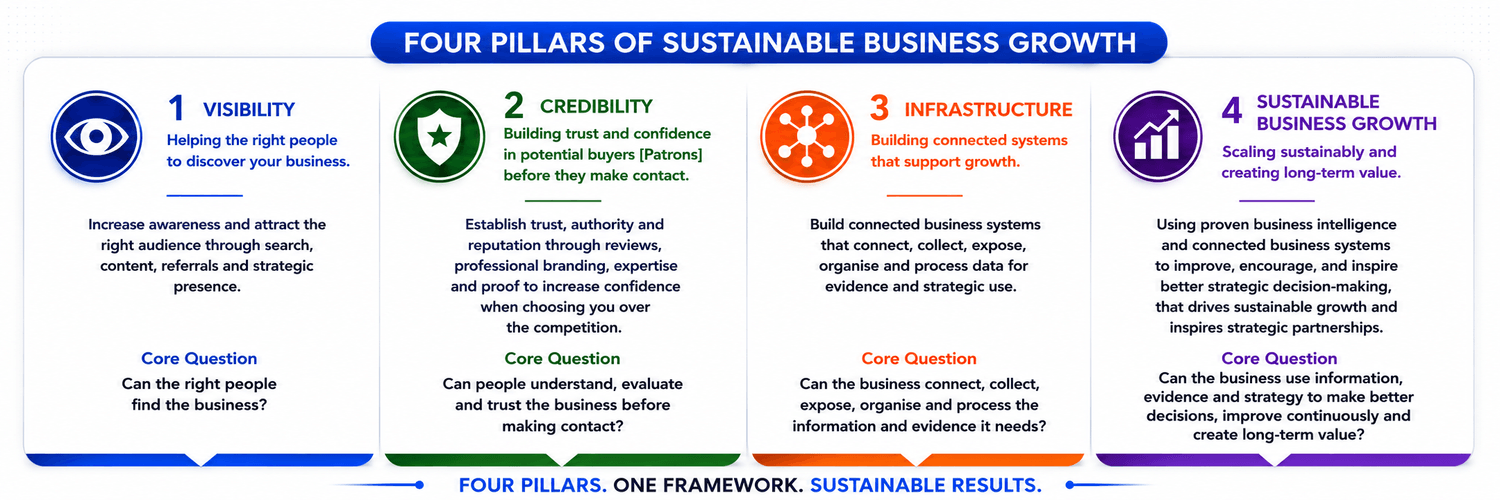
The Growth4biz Framework™ provides four interconnected perspectives that can help a business owner examine the decisions, evidence, infrastructure, and strategic implications involved in business planning.
The Framework does not replace the business plan. It helps the owner think through the business issues that the plan needs to address.
Visibility — Deliberate Decisions
Visibility begins with the decisions the business makes about what it intends to build, whom it wants to serve, what it will offer, and which opportunities it intends to pursue.
When developing a business plan, these decisions establish the direction of the business.
For example:
An owner may decide to expand into a new customer segment. The plan then needs to explain why that segment has been selected, what the business will offer, and what the expansion will require.
The quality of the plan depends partly on the clarity of these decisions.
Credibility — Audience Interpretation
Credibility concerns how an audience interprets the business's activity, presentation, and available evidence.
When a business presents its plan to a funder, partner, or potential investor, it can explain the opportunity, provide supporting information, and make a reasoned case for the proposed investment.
However, the business cannot dictate how the recipient will interpret the information or what decision that person or organization will make.
The plan should therefore distinguish established facts from estimates, assumptions, and projected outcomes.
It should also avoid claims that cannot be supported by the available evidence.
Infrastructure — Connecting, Collecting, Organizing, Exposing and Supporting
Business planning often requires information from different parts of the business.
This may include financial records, customer information, market research, supplier quotations, operational details, staffing requirements, and financial forecasts.
Bringing this information together can reveal gaps that were not previously obvious.
For example:
An owner may discover that the business has identified an opportunity but does not yet have reliable cost information, a clear implementation process, or the systems needed to manage additional work.
Organizing the relevant information makes the plan more useful and helps the owner identify what still needs attention.
Sustainable Business Growth — Interpretation and Strategic Decision-Making
The owner must interpret the information and use it to make decisions.
Does the opportunity make sense?
Is the identified constraint real?
Are the requested resources appropriate?
Can the business implement the plan?
What additional capability might result?
What risks could affect the outcome?
These questions help the owner evaluate the proposed direction instead of simply assembling documents.
The plan may confirm that the proposed investment is appropriate. It may also reveal that the business needs more evidence, a different approach, or a smaller initial step.
Either result can be valuable.
The four pillars are not mandatory stages that must always occur in a fixed order. They are complementary perspectives that help the business examine its decisions, evidence, supporting capabilities, and intended direction.
11. Choosing the Right Business Plan Template
A template can make business planning easier by providing a structure for organizing information.
However, a template should support the planning process rather than replace it.
The two templates associated with this guide are designed for related but different purposes.
Template 1: General Business Plan Template
Purpose: To help you develop, understand, manage, and grow your business.
This template is appropriate when you need to establish or review the overall direction of the business, whether or not funding is involved.
It should help you document:
Business overview and objectives.
Products and services.
Business model and revenue.
Customers, market, and competitors.
Marketing and sales strategy.
Operations and capabilities.
Management and responsibilities.
Financial planning.
Risks and sustainability.
Implementation milestones and performance measures.
Use it to develop a clearer picture of the business and determine what needs to be established, strengthened, or changed.
Template 2: Funding-Oriented Business Plan Template
Purpose: To help you prepare a business plan that explains a specific funding requirement.
This template builds on the general business plan and gives greater attention to the proposed investment.
In addition to the relevant general business information, it should help you document:
The funding purpose and amount requested.
The current business position and identified constraint.
The opportunity being pursued.
The resources required and their cost.
Supporting quotations and evidence.
The proposed use of funds.
Financial projections and their assumptions.
Implementation activities and responsibilities.
Expected capabilities and outcomes.
Risks and sustainability.
Repayment considerations where relevant.
Documents required by the specific funding opportunity.
How the templates work together
The general template establishes the broader business plan.
The funding-oriented template adapts that foundation to explain a particular investment requirement.
You should not need to invent a new business from scratch every time you consider funding. Instead, you can maintain the general plan and develop a funding-specific version that reflects the relevant project and funder's requirements.
A funding organization may prescribe its own application form, business plan format, financial model, or supporting documents. Where it does, those requirements take precedence.
The templates should therefore be used as planning and preparation tools, not as a guarantee that a particular funding application will be accepted.
The templates can be introduced here as downloadable resources once they have been finalized and published.
12. Common Business Planning Mistakes
A business plan is only as useful as the thinking and information behind it.
The following mistakes can reduce its value.
Mistake 1: Writing the plan only to obtain funding
Why it happens: The owner believes a business plan is primarily a document required by funders.
Why it causes problems: The plan may focus on presenting the business attractively without examining whether the proposed activities are practical.
How to avoid it: Develop the plan to guide decisions and implementation. When funding becomes relevant, adapt it to explain the proposed investment.
Mistake 2: Treating the plan as a shopping list
Why it happens: The owner identifies resources they want to acquire and assumes that obtaining them will lead to growth.
Why it causes problems: The requested items may not address the actual constraint or may require other resources to become useful.
How to avoid it: Explain the relationship between the opportunity, the current constraint, the required resources, the capabilities they should create, and the intended outcomes.
Mistake 3: Making unsupported assumptions about demand
Why it happens: The owner expects customers to buy because the product or service seems valuable.
Why it causes problems: The plan may overestimate revenue or underestimate the work required to attract customers.
How to avoid it: Conduct relevant research, collect customer evidence where possible, and distinguish demonstrated demand from expected demand.
Mistake 4: Overestimating revenue
Why it happens: The owner builds projections around an ambitious growth target rather than a reasoned assessment of the business's capacity and market.
Why it causes problems: Revenue forecasts may not be supported by customer demand, pricing, sales capacity, or delivery capability.
How to avoid it: Explain the assumptions behind the projections and test whether the business can realistically generate and deliver the expected volume of work.
Mistake 5: Ignoring cash flow
Why it happens: The owner concentrates on revenue and profit without examining when money will actually enter and leave the business.
Why it causes problems: The business may struggle to pay expenses even if it expects to make a profit.
How to avoid it: Prepare cash-flow forecasts and consider payment timing, operating costs, working capital, and the financial effect of implementing the plan.
Mistake 6: Ignoring implementation requirements
Why it happens: The plan describes what the business wants to achieve but not how it will be achieved.
Why it causes problems: The owner may overlook staffing, training, systems, maintenance, responsibilities, or other requirements.
How to avoid it: Develop an implementation plan with activities, resources, responsibilities, timing, and measures of progress.
Mistake 7: Using one format for every funding opportunity
Why it happens: The owner assumes that one completed business plan will meet every funder's requirements.
Why it causes problems: Different funding organizations may require different information, supporting documents, financial models, or application formats.
How to avoid it: Maintain a comprehensive general plan, then adapt the funding-oriented version to the current requirements of the specific opportunity.
Mistake 8: Preparing the plan once and never updating it
Why it happens: The owner treats the business plan as a completed document rather than an ongoing management resource.
Why it causes problems: The plan may stop reflecting the business's current position, costs, market, capabilities, or objectives.
How to avoid it: Review the plan periodically and whenever important circumstances change.
13. Review and Update the Business Plan
A business plan should remain useful as the business develops.
The original assumptions may change. Customers may respond differently than expected. Costs may increase. A new opportunity may emerge. The business may develop capabilities that create a different path for growth.
These changes should inform the plan.
Review the plan when:
The business introduces a major product or service.
It enters a new market.
Its financial position changes significantly.
It considers a substantial investment.
It experiences an important operational constraint.
Its objectives change.
A funding or partnership opportunity requires a different approach.
Actual performance differs materially from projections.
Compare actual performance with the plan's assumptions and expected results.
Ask what has changed, what the available information suggests, and whether the business should continue with its current approach.
The purpose is not to preserve the original plan at all costs. It is to maintain a useful basis for decisions.
This is consistent with the IDC's published business plan guidance, which describes a business plan as a working document that should be maintained and updated as circumstances change. IDC Business Plan Guidelines.
14. Business Plan Checklist
Before considering your plan complete, use the following checklist.
Business understanding
I can explain what the business does and whom it serves.
I have identified the business's current position.
I have defined the objectives the plan is intended to support.
I understand the main constraints affecting progress.
Market and business model
I have researched the relevant market and customer needs.
I have considered competitors and available alternatives.
I can explain how the business generates or expects to generate revenue.
I have distinguished demonstrated demand from assumptions about future demand.
Operations and implementation
I have identified the resources and capabilities required.
I have explained how those requirements relate to the objectives.
I have identified the people responsible for implementation.
I have established practical activities, milestones, and measures.
Financial planning
I have identified the relevant costs.
My financial projections are based on explained assumptions.
I have considered cash flow and working capital where relevant.
I have assessed the risks that could affect the financial plan.
Funding preparation, where applicable
I can explain why funding is required.
I have justified the amount being requested.
I can explain how the proposed resources will be used.
I have considered the capabilities and outcomes the investment is expected to enable.
I have identified the supporting documents required.
I have checked the current eligibility and application requirements of the specific funding opportunity.
I have adapted the plan to the required format where necessary.
Ongoing use
I know how the plan will guide implementation.
I have identified when and how it will be reviewed.
I am prepared to revise the plan when the evidence or circumstances change.
15. Frequently Asked Questions:
A business plan explains what a business does, where it intends to go, how it expects to get there, and what resources it will require. It can guide decisions, implementation, growth, and preparation for funding or partnerships.
Yes, a business plan can be useful even when no funding is involved. It can help you evaluate opportunities, understand constraints, plan operations, manage finances, and establish priorities for development.
The level of detail should reflect the business's needs.
Yes. You can develop your own plan using a structured template, relevant research, and accurate business information. You may also choose to obtain professional assistance where the business or funding opportunity requires more specialized analysis.
The important point is that you understand and can explain the decisions, assumptions, and projections in the plan.
There is no universal length. A simple internal plan may be relatively short, while a comprehensive plan for a major expansion or funding application may require substantial detail and supporting documentation.
The plan should be sufficiently complete for its intended purpose without including unnecessary information.
Common components include an executive summary, business overview, market analysis, products or services, operations, management, financial projections, funding request, implementation plan, and risk assessment.
The exact requirements depend on the funding organization and the opportunity. Always consult the current application guidelines.
You can still develop a plan using market research, customer feedback, supplier quotations, relevant experience, and clearly stated financial assumptions.
Be transparent about what has been demonstrated and what remains uncertain. Do not present projections as historical results.
No. A business plan can help explain and evaluate a proposal, but it does not guarantee approval.
A funding decision may also depend on eligibility, the funding product, financial viability, available resources, supporting evidence, risk, compliance, and other requirements established by the funder.
Review it periodically and whenever significant changes affect the business's objectives, market, financial position, operations, or proposed investments.
A plan that no longer reflects the business's circumstances may be less useful for making decisions.
Final Thoughts
A Plan Is Only Valuable When It Guides Action
A business plan should do more than describe the business or make it appear ready for growth.
It should help the owner understand the current position, examine opportunities, identify constraints, evaluate the resources required, and determine how the business intends to move forward.
When funding is involved, that work becomes particularly important.
A well-developed funding proposal connects the business's opportunity to its current position, explains why the proposed resources are necessary, and shows how the business intends to implement the investment and manage the risks.
It does not need to pretend that every outcome is guaranteed. Instead, it should provide a clear and reasoned explanation of what the business intends to do, why it believes the plan is practical, and what evidence supports that view.
This reflects the Growth4biz Framework™ perspective: make deliberate decisions, understand how the available evidence may be interpreted, organize the infrastructure and information needed to act, and use that understanding to guide strategic decisions.
The objective is not simply to produce a business plan that looks convincing.
It is to develop a plan that helps the business make better decisions and provides a practical basis for implementation and sustainable growth.
Funding may help accelerate that development, but the business still needs the capabilities, systems, people, and decisions required to put the investment to work.
Start with the business you have, establish what you want it to become, and develop a plan that connects the two.
Continue Your Growth Journey
A business plan connects several important areas of business development. The following resources can help you explore the related topics as the Growth4biz Business Knowledge System develops.
Related Articles
What Is Business Funding? The Complete Guide for Small Businesses
Business Funding Readiness: How to Prepare Your Business Before Applying for Funding
Related Downloads
General Business Plan Template — [Coming Soon]
Funding-Oriented Business Plan Template — [Coming Soon]
Funding Readiness Checklist — [Coming Soon]
Related Checklists
Business Plan Checklist — Included in this guide
Business Need Hub
Book a Consultation
Developing a business plan can reveal opportunities, but it can also expose gaps in your systems, operations, financial planning, or implementation capacity.
Growth4biz Media helps businesses examine these challenges, strengthen relevant business capabilities, and develop practical approaches to business development.
If you need assistance translating your business objectives into a clearer development plan, consider booking a consultation with Growth4biz Media.
Sources and Further Reading
The following official sources informed the funding-related guidance in this article. Requirements can change, so consult the relevant organization's current information before applying.
Industrial Development Corporation (IDC) — Apply for Funding: explains the IDC's application process and the role of a business plan and supporting documents.
Industrial Development Corporation (IDC) — Funding Checklist: lists business, market, management, funding, quotation, and financial documentation requirements.
Industrial Development Corporation (IDC) — Gauteng Regional Office: Funding Guidance: highlights business viability, market demand, credible information, and evidence-supported projections.
Industrial Development Corporation (IDC) — Business Plan Guidelines: describes a business plan as a working document that should be maintained and updated.
National Empowerment Fund (NEF) — Application Programme Guidelines: provides an example of a funding application requiring a comprehensive business plan proposal and supporting financial information.
U.S. Small Business Administration (SBA) — Write Your Business Plan: explains common business plan formats and the role of a plan in business management and financing.
These sources support the general principles discussed in this guide. They should not be interpreted as evidence that every funding organization uses identical criteria or that meeting the listed requirements guarantees approval.
SHARE




ABOUT
Growth4biz Media is a Digital Business Infrastructure Agency helping businesses establish, strengthen and evolve the digital capabilities that support how they operate, communicate, connect with people and grow.
We do more than keep websites alive or help people monetise their intellectual property or expertise. We are helping businesses keep their digital capabilities relevant and useful as their operating environments change.
Copyright 2026 • Growth4biz Media (Pty) Ltd.