
Business Funding Readiness: How to Prepare Your Business Before Applying for Funding
Introduction
A funding opportunity can appear at exactly the right time.
Your business needs equipment. You want to hire someone. You have an opportunity to serve more customers, or you need working capital to fulfil orders.
You find a funding programme that appears suitable and decide to apply.
Then the requests begin.
Registration documents.
Financial records.
Bank statements.
Tax information.
A business plan.
Cash-flow projections.
Supplier quotations.
Evidence of customers.
Details about ownership.
An explanation of how the money will be used.
Suddenly, applying for funding becomes an exercise in reconstructing your business's history and gathering information that should ideally have been available already.
The problem is not necessarily that your business is weak. You may have genuine customers, valuable experience and a promising opportunity. The difficulty may be that you are not adequately prepared to demonstrate those strengths.
This is where funding readiness matters.
Funding readiness means preparing the information, evidence, documents, plans and operational arrangements that may be required when pursuing a suitable funding opportunity.
It also means understanding what you need, why you need it and what additional resources could enable your business to achieve.
This guide provides a practical way to assess your funding preparation, identify missing information and understand what a specific funding opportunity may require.
The focus is on preparing to apply: organizing records, understanding your financial position, identifying the actual funding requirement, assembling supporting evidence, checking eligibility and preparing a coherent application.
The objective is not to guarantee funding or to cover every aspect of building an investable business.
It is to help you evaluate suitable opportunities, demonstrate your position and prepare a stronger, better-supported application.
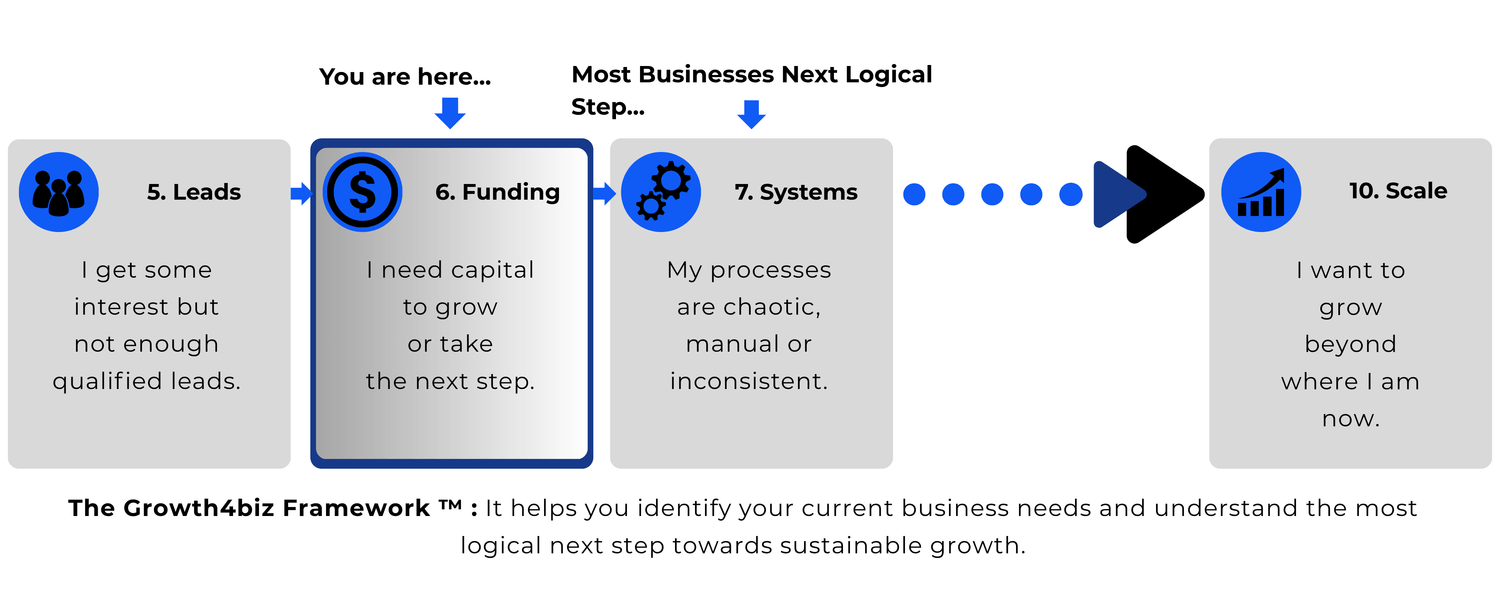
Your Position in the Growth4biz Framework™
I need capital to grow and or take the next step.
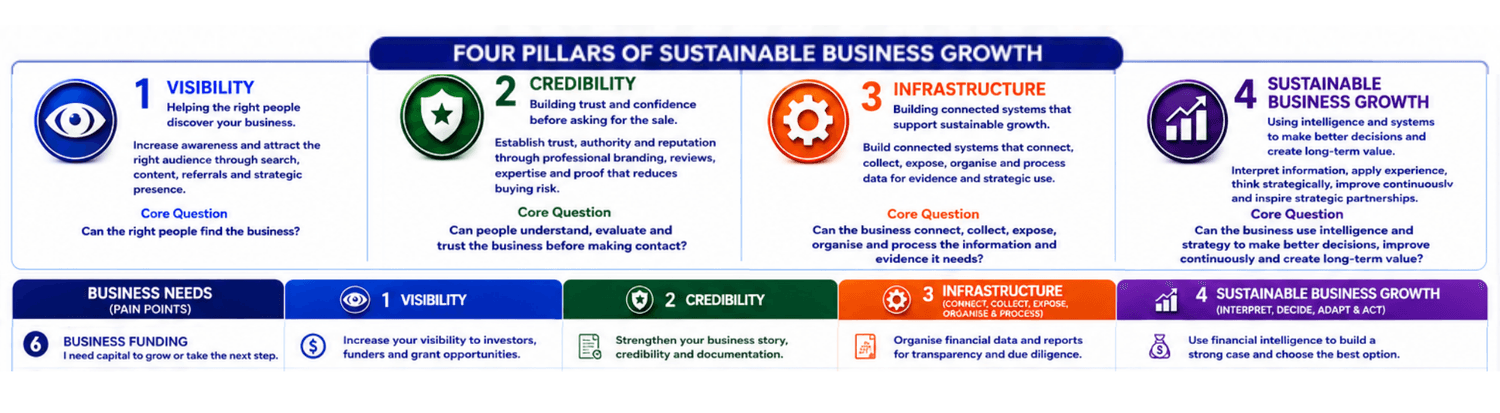

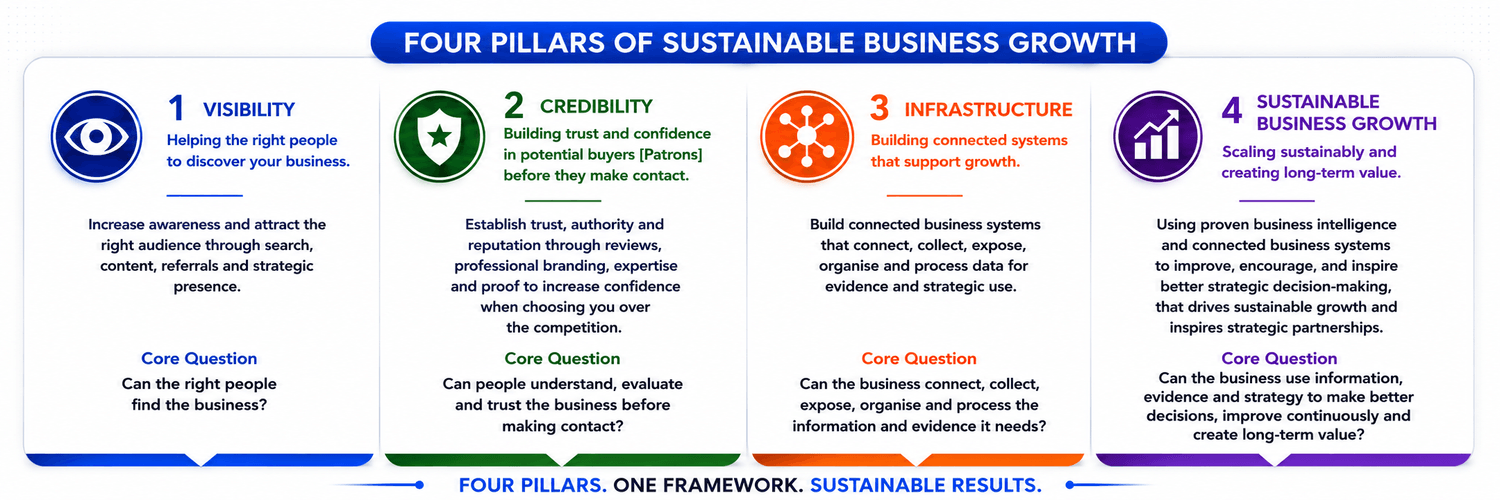
Primary Pillar — Infrastructure
Building connected systems that support growth.
Funding readiness depends heavily on whether a business can retrieve, organize and present relevant information. This makes Infrastructure the primary pillar for this article.
Supporting Pillars: Visibility, Credibility and Sustainable Business Growth
Primary Application Lens: Operational
Business Need Hub: Business Funding
Visibility can help others discover and understand the business. Credibility concerns how they interpret the business's activities and available evidence. Sustainable Business Growth concerns how the business interprets information and experience to make strategic decisions about resources, capacity and future development.
These pillars are interconnected, but they are not a fixed sequence. Their relative importance depends on the business and the funding opportunity.
The focus here is narrower: what should a business prepare before applying for funding?
1. Understand Funding Readiness Before You Apply
Funding readiness and fundability are related, but they are not interchangeable.
Funding readiness
Fundability
1. Preparation to pursue a funding opportunity
1. The business's suitability and attractiveness for a particular opportunity
2. Organized records and documentation
2. Business strengths, risks and capabilities
3. Available supporting evidence
3. The strength of the case the evidence supports
4. A clear funding requirement and budget
4. Whether the proposed investment makes sense to the funder
5. Preparation to implement the proposed project
5. The business's ability to use resources successfully
A business can be well prepared but still fail to qualify for a particular programme. Another business may have a promising opportunity but struggle to apply because its records are incomplete.
Completing a readiness checklist therefore does not establish that a business is fundable, eligible or guaranteed approval.
It helps reveal what is already in place and what needs attention.
Why this distinction matters
Without it, business owners can spend months preparing documents for opportunities they do not qualify for—or assume that a strong business idea is enough to support an application.
Preparation should begin with two questions:
What information and evidence can my business currently provide?
What does the specific funding opportunity require?
The answers help determine whether to proceed, address gaps first or pursue a more suitable opportunity.
2. Organize Your Business Information
Before preparing a funding application, establish a reliable place for the business's important information.
Business identity and ownership
Prepare the relevant information for your business structure and application, including:
Requirements vary. A registered company, sole proprietor, nonprofit organization and other applicant types may have different documentation needs.
Why this matters: The applicant must be able to establish who is applying, which entity is responsible and who has authority to act on its behalf.
Management and responsibilities
Where relevant, keep information about the people responsible for running the business and implementing the proposed project.
A proposal is not implemented by paperwork alone. The people responsible for delivering it are part of the funding case.
Establish a central document system
Create a secure, organized location for business documents. Use consistent filenames, control access appropriately and make it clear which versions are current.
Avoid allowing essential information to remain scattered across personal email accounts, old computers, messaging applications or individual employees' devices.
A central system makes it easier to retrieve information, check consistency and respond when a funding opportunity appears.
3. Understand Your Financial Position
Financial preparation is a central part of funding readiness.
A business should understand its income, expenses, assets, liabilities and available cash before asking another organization to provide resources.
Prepare the records relevant to your business and the opportunity:
Know what the numbers mean
Collecting documents is not enough. You should also understand the information they contain.
Can you explain:
How much revenue the business generates?
What its major expenses are?
What customers owe it?
What it owes others?
How much cash is available?
Whether it is profitable?
What regular financial commitments it must meet?
The exact records requested will depend on the funder, business structure, business stage and funding purpose.
For South African businesses, verify the relevant tax, compliance and financial-document requirements directly with the organization offering the funding.
A useful principle: organize your financial records continuously instead of trying to reconstruct your financial history when an application deadline approaches.
4. Prepare for Cash-Flow Requirements
Historical records explain what has happened. Cash-flow planning helps you examine what may happen next.
A business can be profitable and still experience cash-flow pressure.
For example, it may need to pay suppliers and workers before customers settle their invoices.
Before applying, consider:
The question is not simply, "How much money do we want?"
It is also: When will the business need the resources, what will they cover, and how will the funding affect its financial position?
This is particularly important when funding is intended to bridge a period between spending money and receiving revenue.
5. Demonstrate Your Business Model and Market Activity
A funding application may need to explain what the business does, who it serves and how it creates value.
Prepare to explain:
Where possible, support your explanation with evidence of actual market activity.
This may include:
Sales history.
Customer enquiries.
Existing contracts.
Purchase orders.
Repeat business.
Customer feedback.
Letters of intent or pre-orders, where relevant.
Market research.
Pilot projects or demonstrations.
New businesses will not necessarily have the same evidence as established businesses. They may need to rely more heavily on market research, early customer feedback, pilot results or other relevant evidence.
The objective is not to pretend that every business has an established track record. It is to demonstrate what is genuinely known about the opportunity and distinguish that from assumptions.
6. Prepare Evidence That Supports Your Claims
Businesses frequently describe themselves as experienced, reliable, innovative or successful.
Those descriptions may be accurate, but supporting evidence makes them easier to evaluate.
Depending on the business and opportunity, organize:
Evidence should be genuine, relevant and presented in context. Do not exaggerate results or imply that a testimonial proves more than it actually demonstrates.
Visibility and credibility are not the same
A public website or business profile may help someone discover and understand a business. It does not automatically establish that the business is credible or eligible for funding.
Similarly, a business may have excellent evidence without maintaining an extensive public presence.
Consider whether the following are appropriate for your business:
These are not universal funding requirements. Prioritize the specific evidence and documents the opportunity requests.
7. Assess Your Operational Readiness
Funding may increase activity, but the business must be able to manage the work that follows.
Before applying, consider whether the business has the processes, people, equipment and systems required to implement the proposed project.
Use these questions to assess your position:
For example, a business may seek funding to promote its services and attract more customers. If it already struggles to respond to enquiries, additional demand may increase the problem rather than solve it.
The issue is not that the business should have perfect systems before seeking funding. It should understand its limitations and account for them in its plans.
Ask yourself: If the proposed funding succeeds, what additional work will the business need to handle, and what must be in place to handle it?
8. Define the Actual Funding Requirement
Before deciding how much money to request, identify what is limiting the business and whether funding is an appropriate response.
A useful way to structure the assessment is:
Problem → Opportunity → Constraint → Required Resource → Capability → Expected Outcome
For example, a business may have more confirmed work than its current equipment can support. If the equipment is the genuine constraint, an investment may increase production capacity and enable the business to fulfil more orders.
But if the real problem is weak demand, poor pricing or an ineffective process, purchasing equipment may not solve it.
Before proceeding, ask:
What problem are we trying to solve?
What opportunity are we trying to pursue?
What currently limits the business?
What resource is required?
Why is that resource the appropriate response?
What capability will it create or improve?
What additional capacity could result?
How will we assess whether the intended outcome was achieved?
These questions help prevent the business from treating funding itself as the objective.
9. Build a Defensible Budget and Funding Case
Once the requirement is understood, calculate the amount needed.
Prepare the relevant details:
Requirements and eligible expenses differ across funding programmes. Check the official rules before including an expense in your request.
Explain what the investment will enable
A budget explains what the money will pay for. A funding case also explains why that expenditure matters.
Investment
Capability it may create
Possible outcome to measure
1. Equipment
1. Greater production capacity
1. Units produced or orders fulfilled
2. Additional staff
2. Greater delivery capacity
2. Customers served or projects completed
3. Technology
3. Improved processing capability
3. Transactions handled or processing time
4. Working capital
4. Greater ability to fulfil orders
4. Orders fulfilled within the required period
These are examples, not guaranteed results. The relationship must make sense for the actual business.
Where possible, establish a baseline and identify a measurable target. Avoid promising outcomes that depend on assumptions you cannot reasonably support.
10. Prepare the Business Plan and Supporting Documents
Some funding opportunities require a formal business plan. Others may request a project proposal, a funding application form, a budget, financial projections or a combination of supporting documents.
The first step is to establish exactly what the funding organization requires. Do not assume that every funder uses the same format or expects the same level of detail.
Regardless of the format, you should be prepared to explain:
Where the business currently stands.
What opportunity it intends to pursue.
What is preventing it from progressing.
What resources are required and why.
How the proposed resources will be used.
Who will be responsible for implementation.
What risks or constraints need to be managed.
What outcomes the business expects to achieve.
How the resulting activities will be sustained, where relevant.
The information should be consistent with your financial records, funding budget, supporting evidence and implementation plans.
Prepare the Supporting Documents
Depending on the opportunity, you may need to provide:
Business registration and ownership documents.
Financial statements and bank statements.
Tax or other compliance documentation.
A business plan or project proposal.
Cash-flow forecasts and financial projections.
Supplier quotations and a detailed budget.
Evidence of customers, demand or existing contracts.
Information about management and implementation responsibilities.
Supporting documents specified by the funding organization.
Treat this as an opportunity-specific checklist rather than a universal list. Only include documents that are relevant or required, and verify the latest requirements through the official funding source.
Connect the Documents to the Funding Request
The documents should work together to explain the same proposal.
For example, if you are requesting funding for equipment, the budget should show the equipment's cost, the proposal should explain why it is needed, and the implementation plan should explain how it will be used.
If you project increased revenue or production, explain the assumptions behind those projections and how the proposed investment could contribute to the expected result.
A collection of documents is not automatically a convincing application. The information must be accurate, consistent and relevant to the funding request.
The objective is to prepare the information needed to explain and support your proposal, in the format required by the specific funding opportunity.
For a detailed explanation of how to develop a business plan, see the:
Related Read: Business Plan Guide when it becomes available.
11. Check Eligibility Before Investing in an Application
Being prepared does not mean every funding opportunity is suitable.
Before committing significant time to an application, verify:
Where age restrictions or other specific applicant criteria apply, verify exactly who must meet them and when eligibility is assessed.
Use the funder's official information as the final authority. Requirements can differ between programmes offered by the same organization and may change over time.
It is reasonable to conclude that an opportunity is unsuitable and focus on a better match instead.
12. Complete an Application-Readiness Review
Once you have identified a suitable opportunity, prepare the application itself.
Inconsistencies can lead to questions and delays. If different figures are correct for different reporting periods or purposes, make the distinction clear rather than leaving the reviewer to guess.
13. Build a Clear Funding Case
Preparing documents is only part of funding readiness. You should also be able to explain how the information supports the funding request.
A clear funding case connects the business's current position to the opportunity it wants to pursue, the resources it requires and the outcomes it expects to achieve.
Explain the Relationship Between the Need and the Investment
Consider a business that receives enquiries for larger orders but lacks the equipment needed to fulfil them.
Simply requesting money to purchase equipment does not explain the entire proposal.
The business should be prepared to explain:
What customer opportunity it has identified.
What evidence supports the existence of that opportunity.
What currently prevents it from fulfilling the work.
Why the proposed equipment is an appropriate response.
What the equipment will cost.
How the business intends to implement and maintain it.
What additional production or delivery capacity may result.
What assumptions, risks and financial implications need to be considered.
This helps the funder evaluate the reasoning behind the request rather than simply reviewing a list of intended purchases.
Why a Business Plan Matters Before You Apply for Funding
Imagine a business owner who wants to expand.
The owner has been creating content, promoting the business and trying to acquire customers. Those activities may have helped establish a market presence, generate enquiries and identify potential opportunities.
But the owner now wants funding for equipment and additional staff.
The funding request requires more than a list of items the business would like to purchase.
The owner needs to explain what the business currently does, what opportunity it wants to pursue, what is preventing it from progressing, why the proposed resources are necessary and how the investment could improve its ability to operate.
The owner must also consider the cost of implementing the plan, the revenue or other outcomes that may result, the risks involved and the business's ability to sustain the additional activity.
A business plan helps bring these questions together.
It does not guarantee that the proposal will succeed or that a funder will approve it. Instead, it provides a structured way to explain the proposal, examine its assumptions and prepare for implementation.
Keep Claims and Projections Evidence-Based
Distinguish between what the business has already demonstrated and what it expects to achieve.
For example, existing sales, signed contracts and completed projects may provide evidence of past activity. Forecast sales, anticipated contracts and projected production increases are different: they depend on assumptions about what may happen in the future.
Explain those assumptions and avoid presenting projected outcomes as guaranteed results.
Review the Consistency of Your Funding Case
Before submitting, check that:
The stated funding requirement matches the proposed activities.
The budget supports the requested amount.
The supporting documents are consistent with the proposal.
The expected outcomes relate logically to the resources being requested.
The implementation plan identifies the work and responsibilities involved.
Financial projections use reasonable, explainable assumptions.
Important risks and limitations have been acknowledged.
The proposal follows the requirements of the specific funding opportunity.
A business plan may bring many of these elements together, but not every funding opportunity requires a comprehensive business plan. Follow the format and documentation requirements set by the funder.
The goal is to make your request understandable, supportable and practical to implement—not simply to make it appear attractive.
Once you have checked the funding case, assess any remaining gaps before proceeding to the next stage.
14. Identify Your Funding-Readiness Gaps
You do not need to have every possible document or system in place before considering funding.
What matters is understanding your current position against the requirements of a suitable opportunity.
A simple status system can help prioritize the work.
Status
Meaning
Next action
1. Ready
1. The information or requirement is addressed and can be demonstrated
1. Keep it current
2. Needs attention
2. Some information exists, but it is incomplete, outdated or difficult to retrieve
2. Improve or organize it
3. Significant gap
3. An important requirement cannot currently be demonstrated
3. Investigate what is missing and how to address it
For example, your financial records may be ready while your funding budget still needs attention. Your business plan may be complete while a required quotation is missing.
The next step is not necessarily to delay every funding effort. Assess whether the gap is essential to eligibility, required for submission, or something that can be addressed before implementation.
Prioritize the gaps that matter most to the opportunity you intend to pursue.
Common Funding-Readiness Mistakes
Applying before checking eligibility
Why it happens: The opportunity looks attractive and the business owner wants to move quickly.
Why it causes problems: Time is spent on an application that may not qualify.
How to avoid it: Review official eligibility and application requirements first.
Waiting until a deadline to organize records
Why it happens: Funding was not previously a priority.
Why it causes problems: Information may be missing, outdated or difficult to reconstruct.
How to avoid it: Maintain business records and documentation as part of normal operations.
Requesting an arbitrary amount
Why it happens: The business starts with a desired funding figure rather than a defined requirement.
Why it causes problems: The budget and business justification become difficult to explain.
How to avoid it: Calculate the actual resource requirement and connect it to the intended use.
Assuming funding will fix every problem
Why it happens: Money appears to be the most immediate solution.
Why it causes problems: Funding may increase activity without resolving weak demand, poor processes or other underlying constraints.
How to avoid it: Identify the actual constraint before choosing a response.
Making claims without supporting evidence
Why it happens: The business relies on general descriptions of its strengths.
Why it causes problems: Reviewers may be unable to evaluate those claims.
How to avoid it: Maintain genuine records of customer activity, financial performance, experience and results.
Ignoring post-funding responsibilities
Why it happens: Attention is focused entirely on obtaining approval.
Why it causes problems: The business may be unprepared to implement the project or meet its obligations.
How to avoid it: Consider implementation, financial controls and reporting before applying.
Practical Ways to Maintain Funding Readiness
You can improve readiness gradually instead of treating it as a major project every time a funding opportunity appears.
Maintain a central document folder. Keep registration, financial, ownership and other important records organized.
Review financial information regularly. Know where the business stands instead of relying on estimates.
Maintain an evidence library. Preserve genuine customer, project, contract and performance evidence.
Keep a current business summary. Document what the business does, whom it serves, how it earns revenue and who manages it.
Record important processes. Do not allow essential operational knowledge to exist only in someone's memory.
Track business capacity. Understand what the business can currently produce, deliver or manage.
Document potential investments. Record the constraint, resource required, estimated cost and intended outcome.
Review opportunities carefully. Match the business to the programme instead of applying indiscriminately.
Review readiness periodically. A quarterly review may help identify gaps before they become urgent.
Protect business information. Maintain appropriate access, backups and control over essential records, accounts, contracts and digital assets.
The aim is not paperwork for its own sake. It is to create a more reliable way to understand and demonstrate the business.
Frequently Asked Questions:
It is a practical tool for assessing whether a business has the information, documentation, evidence and plans it may need when pursuing a funding opportunity.
Requirements vary, but may include registration and ownership documents, financial records, bank statements, tax information, a business plan, budgets, quotations and supporting evidence. Always check the requirements of the specific funding opportunity.
You should be able to explain your business's current position, provide the required information, demonstrate relevant claims, identify the funding requirement and describe how the proposed resources would be used. You must also check eligibility for the particular opportunity.
Some programmes require a formal business plan, while others request different forms of business information. Check the programme's requirements and prepare a clear explanation of the business case regardless of format.
Yes. A new business can organize its registration documents, business model, market research, funding budget and implementation plan. Its available evidence will differ from that of an established business, and eligibility will depend on the specific opportunity.
A website is not a universal funding requirement. Where appropriate, it can help communicate the business's identity, services and activities. However, it does not replace required documents, financial evidence or eligibility criteria.
Identify the gaps, reconstruct what can reasonably be reconstructed, and establish better record-keeping practices. Do not present unsupported information as fact. Whether you can still apply depends on the missing information and the requirements of the opportunity.
No. It can improve preparation, but approval depends on the programme's criteria, eligibility requirements, assessment process and the circumstances of the applicant.
Follow the approved plan and funding terms, track expenditure, maintain appropriate financial controls, monitor performance and meet the funder's reporting requirements.
Final Thoughts
Funding readiness is not about making a business appear stronger than it is.
It is about understanding the business well enough to explain its current position, provide relevant evidence, identify what it needs and demonstrate how the proposed resources would be used.
The Growth4biz Framework™ helps put this preparation into context:
Visibility: What decisions has the business made about how it presents and communicates itself?
Credibility: How might audiences interpret its activities and available evidence?
Infrastructure: Can the business connect, organize, retrieve and support the information and systems required?
Sustainable Business Growth: Can the business interpret its information and experience to make sound decisions about resources, capacity and future development?
These are interconnected perspectives, not a universal funding formula. A particular funder may prioritize specific criteria, and the official requirements of that opportunity remain decisive.
The practical objective is to be better prepared before the deadline appears.
Funding readiness is not the same as obtaining funding.
It is the work that helps you understand your business, evaluate opportunities and prepare a stronger application when a suitable opportunity arises.
Continue Your Growth Journey
Related Articles
What Is Business Funding? The Complete Guide for Small Businesses
Business Plan Guide: How to Develop a Business Plan for Growth and Funding
Grants vs Business Loans vs Equity Investment: Which Type of Funding Is Right for Your Business?
Coming Soon:
Business Plan Guide
Cash Flow Management Guide
Funding Readiness Checklist
What Funders Look for in Small Businesses
Funding vs. Business Partnerships
Related Downloads
Funding Readiness Checklist - [Coming Soon]
Funding Needs Assessment Worksheet - [Coming Soon]
Primary Pillar: Infrastructure
Supporting: Visibility, Credibility, Growth
Book a Consultation
Preparing for funding can be difficult when business records, systems or requirements are unclear.
Growth4biz Media helps businesses strengthen their digital infrastructure, organize relevant business systems and identify areas that may need attention as they prepare for their next stage of development.
If you are considering funding but are unsure what your business needs to prepare, book a consultation to discuss your current position and potential next steps.
SHARE




ABOUT
Growth4biz Media is a Digital Business Infrastructure Agency helping businesses establish, strengthen and evolve the digital capabilities that support how they operate, communicate, connect with people and grow.
We do more than keep websites alive or help people monetise their intellectual property or expertise. We are helping businesses keep their digital capabilities relevant and useful as their operating environments change.
Copyright 2026 • Growth4biz Media (Pty) Ltd.