
Grants vs Business Loans vs Equity Investment: Which Type of Funding Is Right for Your Business?
Introduction
A business can need money for very different reasons. One entrepreneur may need equipment to begin operating. Another may need working capital to fulfil a confirmed order. A third may have a proven business model and need substantial investment to expand into new markets.
Although all three businesses need funding, they may not need the same type of funding.
A grant, a business loan and an equity investment can each help a business move forward, but they work differently. Grants have eligibility and use-of-funds conditions. Loans create repayment obligations. Equity investment generally involves giving an investor an ownership interest in the business in exchange for capital.
Choosing between them is therefore not simply a matter of finding out which option offers the most money. It means understanding what the business is trying to achieve, what it can realistically support, what evidence it can provide and what obligations it is prepared to accept.
For South African entrepreneurs, this distinction matters because funding programmes, development-finance institutions, commercial lenders and private investors serve different purposes and assess businesses against different criteria.
A Quick Comparison:
Grants vs Business Loans vs Equity Investment
Consideration
Grant funding
Business loans
Equity investment
1. What the business receives
1. Financial assistance subject to programme conditions
1. Money that must be repaid
1. Capital in exchange for an ownership interest or agreed equity-linked instrument
2. Must the money be repaid?
2. Generally not, provided the conditions are met; specific agreements matter
2. Yes, according to the agreement
2. Not normally repaid like a conventional loan; investor returns depend on the investment terms and eventual outcomes
3. Does the founder give up ownership?
3. Usually not
3. Usually not, although security or other conditions may apply
3. Generally yes, through an ownership stake or an instrument that may convert into equity
4. Typical purpose
4. Eligible development, equipment, enterprise support or programme-specific outcomes
4. Equipment, working capital, contracts or expansion
4. Scaling a business with substantial growth and investment potential
5. What providers may assess
5. Eligibility, intended use, development outcomes, documentation and compliance
5. Affordability, cash flow, creditworthiness, repayment capacity and sometimes security
5. Market opportunity, scalability, traction, management, financial potential and exit prospects
6. Main consideration
6. Meeting the programme's requirements and reporting obligations
6. Being able to repay the debt, including when trading conditions weaken
6. Sharing ownership and potentially some strategic influence or future financial returns
7. Often worth investigating when…
7. The business or project fits a specific support programme
7. The business can reasonably service the debt
7. The business has the potential and structure to support an investor's return expectations
These are general distinctions, not universal rules. Some development programmes combine grants with loans, while some investment instruments combine features of debt and equity. The actual agreement determines the obligations.
Your Position in the Growth4biz Framework™
I need capital to grow and or take the next step.
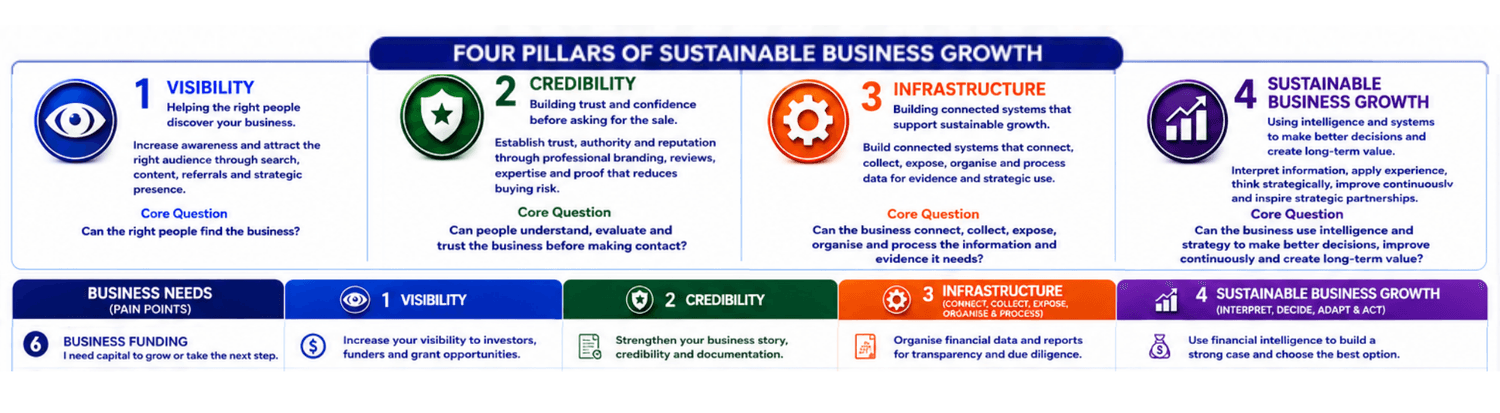

Primary Pillar — Sustainable Business Growth
Interpreting, Deciding, Acting, Adapting, Developing Capacity and Strategic Decision-Making.
This article examines how a business can interpret its circumstances and make a more informed funding decision for Sustainable Business Growth.
Supporting Pillars: Visibility • Credibility • Infrastructure
Primary Application Lens: Analytical Lens
Business Need Hub: Business Funding
The Growth4biz Framework™ is not a funding eligibility test, and it cannot predict whether a provider will approve an application. It offers a way to consider the decisions, information, evidence and capabilities involved in preparing for funding.
The central question is not simply, “Where can I get money?”
It is:
“Which form of funding fits the business I am building, the purpose of the money and the obligations I can realistically manage?”
1. What Is Grant Funding?
Grant funding is financial support provided under specified conditions. Depending on the programme, a grant may help an eligible business acquire equipment, develop a capability, access training, purchase approved inputs or achieve a defined development objective.
A grant generally does not require the recipient to repay the money in the same way as a conventional loan, provided the recipient complies with the applicable conditions. However, a grant is not unrestricted cash. The provider may specify who qualifies, what the money can be used for, what documentation is required and how the recipient must account for the support.
How grant funding works
A typical grant process may involve:
Identifying a programme that supports the relevant type of business or project.
Checking the eligibility requirements.
Preparing the required business information and supporting documents.
Submitting an application through the prescribed process.
Undergoing assessment and, where required, additional verification.
Signing the relevant agreement if approved.
Using the funding for the approved purpose and meeting reporting requirements.
The precise process varies between programmes. Some offer financial assistance directly, while others provide a combination of financial and non-financial support.
Why a grant may be appropriate
A grant may be worth investigating when the business needs support for a defined purpose and meets a programme's requirements.
For example:
A small manufacturing business may need a specific machine to increase production. If a suitable programme supports eligible equipment purchases, grant assistance could help the business develop that capability without creating the same repayment obligation as a conventional loan.
However, the business must still consider costs that may fall outside the grant. These could include installation, transport, training, maintenance, insurance, additional stock or working capital. Receiving assistance for an asset does not necessarily cover the full cost of putting it to productive use.
The limitations of grant funding
Grant funding has several practical limitations.
Eligibility is programme-specific:
A programme may be restricted by business size, sector, ownership, location, turnover, registration status or other criteria.
Funding is not guaranteed:
Meeting the eligibility requirements does not necessarily mean an application will be approved.
The application process takes time:
The business may need to gather documentation, obtain quotations and wait for assessment or approval.
The money may be restricted:
A programme may approve equipment but not salaries, marketing, rent or other operating costs.
The funding may come with obligations:
These could include reporting, monitoring, implementation milestones and restrictions on how supported assets are used.
A grant may not solve the underlying business problem:
If the business lacks customers, operational capacity or a viable way to generate revenue, buying equipment may not resolve the problem.
South African grant and development-support examples
The following are useful starting points for researching possible support. They are not interchangeable, and programme terms and application status should be checked directly with the provider.
1. NYDA Grant Programme
The National Youth Development Agency's grant programme provides financial and non-financial support to eligible young entrepreneurs. Its published programme information includes business-development support such as mentorship, consultancy, market linkages and business-management training. The programme has specific youth, business and funding-use requirements.
This may be relevant to an eligible young entrepreneur who needs support to establish or develop a business. It should not be treated as a general grant programme for every South African business.
Official information: NYDA Grant Programme
2. DSBD Asset Assist Programme
The Department of Small Business Development's Asset Assist Programme describes support for qualifying micro and small enterprises, including assistance related to machinery and equipment, working capital and raw materials. Its published programme information gives a maximum grant amount of R250,000 and specifies eligibility and use-of-funds conditions.
This may be worth investigating when a business needs eligible productive assets or inputs. Applicants should confirm the current application status, applicable limits and exact eligible expenses before preparing a proposal.
Official information: DSBD Asset Assist Programme
3. Informal Micro Enterprises Development Programme (IMEDP)
The DSBD's IMEDP information describes support for qualifying informal and micro enterprises, including business-development training and assistance with basic equipment or tools. The published requirements should be reviewed carefully because the programme has specific eligibility and implementation conditions.
This is a potential starting point for an eligible informal or micro business, rather than an assumption that every informal trader or startup qualifies.
Official information: DSBD Informal Micro Enterprises Development Programme
4. Business Infrastructure Support Programme (BISP)
The DSBD's Business Infrastructure Support Programme describes support for qualifying enterprises and relevant implementing entities for enabling infrastructure, equipment, tools, technology, machinery and energy-related needs. Its published support categories include amounts substantially larger than those associated with many micro-enterprise programmes.
Because its requirements and scale may be more suited to particular projects or institutional arrangements, a small business should first establish whether it is an eligible applicant and whether its project fits the programme.
Official information: DSBD Business Infrastructure Support Programme
5. Township and Rural Entrepreneurship Programme (TREP)
TREP supports eligible enterprises operating in township and rural economies through programme-specific business-development and financial support. Its published information includes sector and compliance requirements. The DSBD also announced a planned relaunch of an enhanced programme for October 2026, so applicants should check the latest official information for final terms and application status rather than assume that previously published conditions still apply unchanged.
TREP should not automatically be classified as a pure grant. Its support model can include blended finance and other conditions.
Official information: DSBD Township and Rural Entrepreneurship Programme
When grant funding may be the wrong route
A grant may not be the most practical option when:
The business does not meet the programme's eligibility requirements.
The required expense is excluded from the programme.
The business needs money urgently but the application process cannot meet its timing.
The business needs flexible working capital that the programme does not cover.
The project depends on spending that the programme will not approve.
The business is spending substantial time pursuing grants without developing other viable funding routes.
In these circumstances, the next step is not necessarily to abandon funding altogether. It is to investigate other appropriate forms of finance or adjust the project to match a genuine funding opportunity.
2. What Is a Business Loan?
A business loan is money provided to a business under an agreement that requires repayment. Depending on the product, repayments may include interest, fees and other charges.
Loans can be used for various purposes, including purchasing equipment, financing working capital, supporting expansion or fulfilling a contract. Some products are designed for general business needs, while others are linked to specific assets, purchase orders or contracts.
The key distinction is that a loan creates a repayment obligation even if the business does not achieve the results it expected.
How business loans work
A lender assesses the application against its own criteria. Depending on the loan and provider, this may involve examining:
The business's trading history.
Revenue and cash flow.
Financial statements and bank activity.
Existing debts and repayment obligations.
The purpose and amount of the loan.
The owner's or directors' information.
Credit history.
Security or guarantees, where applicable.
The business's ability to repay the proposed debt.
If approved, the lender sets the terms, which may include the amount, interest rate, fees, repayment schedule, security and other conditions.
A business should examine the complete cost of borrowing, not only the advertised interest rate or monthly repayment.
Why a loan may be appropriate
A loan may be suitable when the business has a credible way to generate enough cash flow to repay it.
For example:
A business with a confirmed contract may need equipment or materials before it can deliver the work and receive payment. If the contract economics, payment timing and financing costs make sense, a suitable loan or contract-finance facility may help bridge the gap.
A loan may also be appropriate for an asset that supports revenue over several years, provided the expected cash flow can support repayments during weaker periods as well as stronger ones.
The importance of cash flow
A profitable business can still experience cash-flow problems. It may record sales but wait weeks or months for customers to pay. Meanwhile, wages, suppliers, rent and loan instalments may still be due.
Before taking a loan, the business should ask:
When will the borrowed money be used?
When is the business likely to receive the revenue associated with that use?
Will customer payments arrive before repayments become difficult?
Can the business make repayments if sales are lower than expected?
What happens if a customer pays late?
Will the loan leave enough cash for normal operating expenses?
A simple cash-flow forecast can reveal whether the repayment schedule fits the business's operating cycle.
The limitations of business loans
Repayment is mandatory:
The business must meet the agreement even if its plans change or revenue falls.
Interest and fees increase the total cost:
The amount repaid may be considerably more than the original loan.
Eligibility can be restrictive:
Some lenders require a minimum trading history, established revenue, creditworthiness or security.
Debt can reduce flexibility:
Existing repayments may make it harder to absorb unexpected costs or finance later opportunities.
Borrowing can magnify a weak business model:
If the business cannot generate enough revenue from its core activities, more debt may increase pressure rather than solve the problem.
A loan is therefore not automatically the next step simply because a grant is unavailable.
South African business-loan and finance examples
1. Standard Bank Business Term Loan
Standard Bank's published Business Term Loan information describes a product with defined repayment terms and eligibility requirements, including a requirement for the business to have been trading for at least two years. The product's interest and fees should be checked against the latest terms supplied by the bank.
This may be relevant to an established business that meets the lender's criteria and can demonstrate repayment capacity. It is not necessarily suitable for a business that has only recently started trading.
Official information: Standard Bank Business Term Loan
2. Absa Empowerment Business Finance
Absa's Empowerment Business Finance product is designed for qualifying businesses with specified ownership and other requirements. The published product information describes financing options that may include term loans, vehicle or asset finance and overdrafts, subject to assessment and approval.
This is a product to investigate where the business fits the eligibility requirements and can demonstrate the ability to service the proposed finance.
Official information: Absa Empowerment Business Finance
3. Absa SME Contract Financing
Absa's SME Contract Financing is an example of finance linked to a qualifying contract or purchase order. The published information describes funding subject to the relevant contract, documentation and credit approval, with funds paid to suppliers under the product's arrangements.
This type of facility may be relevant when a business has secured work but needs support to obtain the goods or services required to fulfil it. A contract alone does not guarantee approval, and the business must understand the costs and obligations.
Official information: Absa SME Contract Financing
4. Industrial Development Corporation (IDC)
The IDC provides development finance for businesses in sectors and activities aligned with its mandate. Its funding solutions vary, so an applicant should examine the relevant product rather than assume that all IDC support takes the form of a conventional loan or grant.
It may be worth investigating for a suitable industrial, manufacturing or other development-oriented project that fits the IDC's sector and funding criteria.
Official information: IDC Funding Solutions Hub
When a business loan may be the wrong route
A loan may be unsuitable when:
The business has no credible plan for generating the cash needed for repayment.
The proposed asset or project is unlikely to produce sufficient economic value.
The repayment schedule does not fit the timing of the business's revenue.
The business is already under significant debt pressure.
The loan is being used to cover a recurring operating shortfall without addressing its cause.
The business is borrowing mainly because a lender has made an offer, rather than because the funding supports a sound business decision.
The objective is not to avoid debt in every circumstance. It is to use debt only when its cost, timing and repayment obligations make sense for the business.
3. What Is Equity Investment?
Equity investment involves an investor providing capital in exchange for an ownership interest in a business. The precise arrangement may vary. Some investments involve ordinary shares, while others use instruments such as convertible notes or Simple Agreements for Future Equity (SAFEs), which can convert into equity under specified conditions.
Unlike a conventional loan, an equity investment does not normally require the business to repay the original amount through fixed monthly instalments. Instead, the investor expects a financial return through the value of the business, future share sales, dividends where applicable, or another agreed outcome.
In return, the founder gives up some ownership or accepts an instrument that may result in dilution later.
How equity investment works
An investor considers whether the business offers an opportunity that fits its investment strategy.
The assessment may include:
The size and growth potential of the market.
The problem the business solves.
The product or service and its competitive position.
Evidence of customer demand.
Revenue, margins and growth.
The management team's capabilities.
The business's ability to scale.
The investment required.
The investor's potential return and exit options.
The ownership and governance arrangements.
If the investor is interested, the process may proceed through discussions, due diligence, valuation or investment pricing, negotiation, legal documentation and final approval.
The founder should understand the proposed ownership percentage, voting rights, governance provisions, future funding implications and the circumstances in which the investor may sell their interest.
Why equity investment may be appropriate
Equity may be appropriate for a business with a credible opportunity to grow significantly and a need for capital that would be difficult or risky to finance through debt alone.
For example:
A technology business may need to build a product, recruit a team and enter multiple markets before it can generate enough cash flow to support conventional debt repayments. If the business has a scalable model and fits an investor's strategy, equity may provide capital while allowing the business to pursue growth.
The investment may also bring strategic support, industry relationships, governance experience or access to additional capital. These benefits vary by investor and should be evaluated rather than assumed.
The limitations of equity investment
The founder gives up ownership:
The investor becomes a shareholder or may acquire an ownership interest through a convertible instrument.
Decision-making may change:
Depending on the agreement, investors may have voting rights, board representation, consent rights or influence over important decisions.
The investor expects a return:
Equity capital is not free money. The investor is taking a risk in expectation of a financial outcome.
The business must fit the investor's strategy:
A fund may focus on particular sectors, stages, ownership profiles, markets or levels of growth potential.
The process can be demanding:
Due diligence and negotiations may require detailed financial information, governance documents and legal advice.
Future fundraising can dilute ownership further:
If the business raises additional equity, existing shareholders' percentages may change.
Equity is therefore not automatically preferable because it does not involve conventional loan repayments. The founder must weigh the capital and strategic benefits against the ownership and governance implications.
South African and Africa-focused equity-investment examples
These examples illustrate the type of business each investor may consider. They are not a general list of investors for every small business, and an investment fund's existence does not mean it is currently accepting every application.
1. Hlayisani Venture Fund II
Hlayisani Venture Fund II focuses on medium and large high-growth businesses with technology-enabled, scalable models, a strong South African connection and substantial growth potential. Its published investment criteria include revenue-generating growth or expansion businesses, strong management teams and opportunities with large addressable markets. The fund may acquire significant minority or majority ownership stakes.
This is a potential avenue for businesses that fit a high-growth investment model, not a typical microenterprise looking for a small equipment grant.
Official information: Hlayisani Venture Fund II
2. MIC Khulisani Ventures
MIC Khulisani Ventures describes itself as an investment vehicle for businesses ready to expand their market footprint. Its published investment criteria include black South African ownership and management, an innovative and scalable business model, post-revenue performance, positive cash flow and high-growth potential. Its FAQ makes clear that the funding is equity investment rather than grant funding.
The published FAQ includes a historical application window that ended in January 2025. Entrepreneurs should therefore verify whether a new window or current investment process is available before treating this as an active opportunity.
Official information: MIC Khulisani Ventures
3. Launch Africa Ventures
Launch Africa describes its focus as investing in innovative African startups with strong business models and growth potential. Its published founder FAQ describes a preference for businesses with commercial traction and meaningful recurring revenue, with investments structured through instruments such as SAFEs or convertible notes.
This is a more relevant example for qualifying technology-enabled startups seeking venture capital than for a conventional small business looking for a once-off grant or an ordinary working-capital loan.
Official information: Launch Africa Ventures — Founder FAQs
When equity investment may be the wrong route
Equity may be unsuitable when:
The founder wants to retain full ownership and control.
The business is designed to remain small, stable and owner-operated rather than scale rapidly.
The potential return is not large enough to fit an investor's requirements.
The business does not fit the investor's sector, stage or investment criteria.
The founder is not ready for the governance and reporting expected by investors.
The amount of capital required does not justify the ownership given up.
A business does not need to become a venture-backed company to be successful. Equity is one possible route for certain growth ambitions, not a universal measure of business quality.
4. How Do You Decide Which Type of Funding Is Right?
The most useful starting point is the business's actual requirement—not the funding type that sounds most attractive.
A business seeking R50,000 for a defined equipment purchase may have different options from a business seeking R5 million to expand a production facility. A company with a confirmed contract may need a different solution from an early-stage business that is still testing whether customers will pay for its product.
Work through the following questions before choosing a route.
Step 1: Define exactly what the money is for
Avoid describing the need only as “business funding” or “capital to grow.”
Be specific.
Are you trying to:
Buy a particular asset?
Purchase materials for a confirmed order?
Develop a new product?
Pay for an expansion?
Hire staff to fulfil existing demand?
Build a digital or operational capability?
Enter a new market?
Cover a short-term cash-flow gap?
The more clearly the purpose is defined, the easier it becomes to identify relevant funding providers and determine whether the expense is eligible.
Step 2: Establish what the business can demonstrate
The business's current evidence matters.
Depending on the funding route, useful evidence may include:
Sales and revenue history.
Bank statements and financial records.
Customer enquiries or orders.
Signed contracts or purchase orders.
Quotations for the intended expenditure.
A business plan and cash-flow forecast.
Evidence of a working product or service.
Customer feedback and repeat business.
Operational systems and delivery capacity.
A clear explanation of the expected outcome.
Not every provider requires the same evidence. A grant programme may emphasize eligibility and the intended development outcome, a lender may focus heavily on repayment capacity, and an equity investor may prioritize growth potential and scalability.
Step 3: Consider the business's stage
Different stages can lead to different funding routes.
Idea or pre-launch stage: The business may need to validate demand, test its offer and establish basic operating requirements. Some grants or development programmes may support eligible early-stage entrepreneurs, but many lenders and equity investors require stronger evidence than an idea alone.
Early trading stage: The business may have initial customers but limited financial history. Relevant routes may include eligible enterprise-support programmes, carefully scoped funding, customer-funded growth or suitable partnerships.
Established and trading: The business may be able to demonstrate revenue, financial records and operating performance. Depending on the purpose, it could investigate grants, loans, asset finance, contract finance or investment.
Growth and expansion stage: A business with repeatable revenue and an opportunity to scale may consider a combination of retained earnings, debt, development finance, strategic partnerships or equity investment.
These are broad patterns, not fixed rules. Each provider's actual eligibility and assessment criteria take precedence.
Step 4: Test the obligations before accepting the money
Ask what the business will owe in return.
With a grant, understand the eligible expenditure, implementation conditions and reporting obligations.
With a loan, calculate the total repayment cost and test whether cash flow can support the repayments under realistic conditions.
With equity, understand the ownership given up, the investor's rights and how the arrangement may affect future decisions and fundraising.
The funding amount alone is not enough to determine whether an option is suitable.
Step 5: Compare the funding with the business outcome
A useful funding proposal connects the amount requested to a clear outcome.
For example:
The equipment will increase production capacity.
The working-capital facility will enable the business to fulfil a profitable contract.
The investment will support product development, recruitment and expansion into a defined market.
The funding will establish an operational capability that the business can use repeatedly.
The outcome should be realistic and supported by evidence. Do not promise a particular level of revenue, job creation or impact unless the business has a reasonable basis for the projection.
Step 6: Identify alternatives
If the first option is unsuitable, consider alternatives before abandoning the objective.
Could the business:
Purchase the asset in stages?
Negotiate supplier terms?
Seek a customer deposit?
Partner with an organization that already owns the required equipment?
Lease an asset instead of buying it?
Use contract finance for eligible work?
Apply for a programme that supports the specific capability?
Delay the expense until demand is clearer?
Combine internal funds with a smaller external facility?
The best solution may be a different funding structure—or a change to the project itself.
5. What If Your Business Has No Sales Yet?
Having no sales does not automatically mean that every funding option is unavailable. However, it changes the evidence the business can provide and may limit which providers are suitable.
A lender may be concerned about how the business will service repayments without revenue. An equity investor may be unwilling to invest until there is sufficient evidence of market demand, although some investors do consider very early-stage opportunities. A grant or development programme may support eligible businesses at an earlier stage, depending on its rules.
Where sales history is limited, the business may need to demonstrate other evidence, such as:
A clear problem and target market.
Customer interviews or documented demand research.
A tested prototype or service.
Letters of interest or pilot arrangements.
A credible plan for reaching customers.
Supplier quotations and a realistic start-up budget.
Relevant founder experience.
Evidence of the ability to deliver the proposed product or service.
This evidence can strengthen the case for a business, but it does not override mandatory requirements. If a provider requires a minimum trading history or existing revenue, an applicant cannot replace that requirement with a business plan alone.
For a more detailed discussion, see the planned related article:
“What If Your Business Has No Sales Yet? Understanding Funding Options Before You Have Trading History.”
6. Can a Business Combine Different Types of Funding?
Yes, a business may be able to combine funding sources, provided each provider's terms allow it and the overall structure remains practical.
The purpose is not to collect as many sources of money as possible. It is to match each source to the expense or capability it is best suited to support.
Example: An equipment purchase and expansion
Imagine a small manufacturing business that wants to increase production.
It may investigate whether a suitable grant programme can support an eligible piece of equipment. It may then assess whether a loan or asset-finance arrangement could cover additional costs that are not grant-funded. If the business has a substantial, scalable growth opportunity, it may also consider whether equity investment is appropriate.
That does not mean the business should automatically use all three. It must check whether the grant permits other funding alongside it, whether the lender accepts the proposed arrangement, and whether an investor's terms fit the business's goals.
Example: A contract that requires working capital
A business secures a contract but must pay suppliers before the customer pays.
Depending on the contract and provider criteria, contract finance may be more relevant than an unrestricted business loan. The business should assess the contract's margins, delivery costs, payment terms and ability to meet its obligations if payment is delayed.
A confirmed contract can strengthen the funding case, but it does not remove delivery risk or guarantee finance approval.
Example: An entrepreneur-development programme
An organization supports a group of entrepreneurs but does not provide every participant with money to spend freely.
Instead, it could potentially fund eligible implementation services from a suitable provider. Entrepreneurs might receive approved digital infrastructure, business systems or other support as part of the programme.
This is a different model from a direct grant to each entrepreneur. It is a contractual or programme-delivery arrangement that must be agreed with the organization and comply with its procurement, budget and programme requirements.
Understand blended finance
The term blended finance is used in different ways. In some programmes, it refers to a combination of grant and repayable finance. In broader development-finance contexts, it can also refer to the use of concessional or public capital alongside other investment to support development objectives.
Do not assume that a programme described as blended finance is partly a grant without repayment obligations. Read the specific terms to establish which portions are repayable, what interest or fees apply and what conditions must be met.
For example:
DSBD programme information includes support structures that combine different forms of assistance. The exact structure should be verified against the relevant programme's current terms.
7. How the Growth4biz Framework™ Can Help You Assess Funding
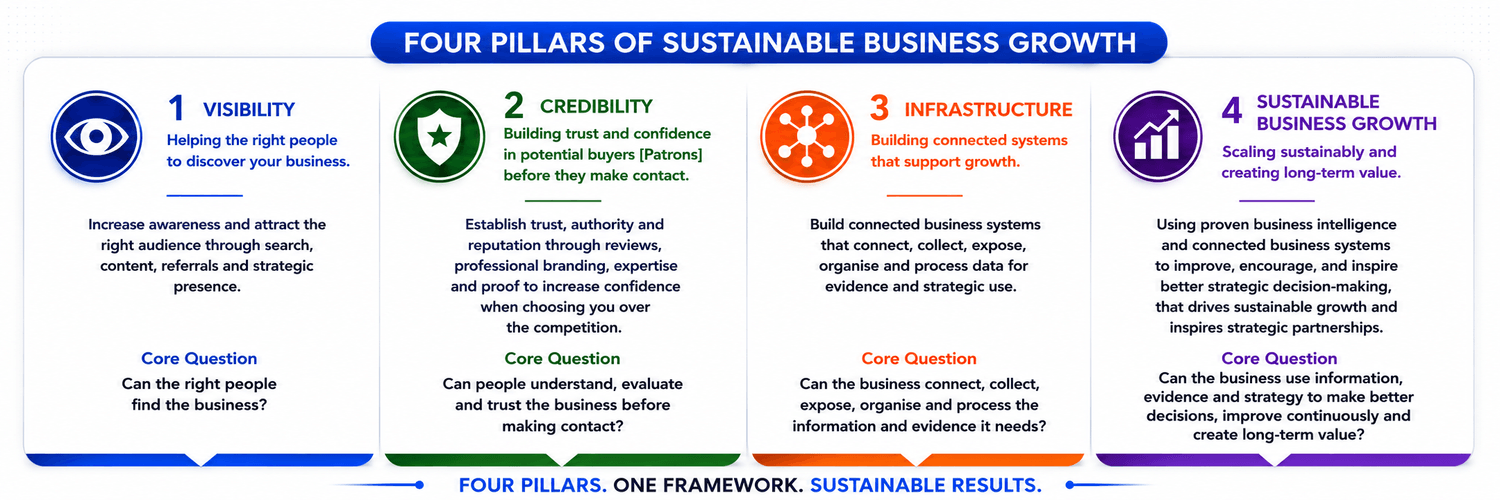
The Growth4biz Framework™ can help a business examine its funding position without treating the four pillars as separate funding products or eligibility categories.
The pillars remain the same. What changes is the context in which the business applies them.
Visibility — Deliberate Decisions
In a funding context, visibility includes deliberately identifying relevant providers and presenting the business or project clearly.
This involves understanding what the business is building, what it needs, which funding routes may be relevant and how to communicate the purpose of the proposed funding.
A long list of funders is not necessarily useful. The goal is to identify providers whose stated criteria align with the business and its project.
Credibility — Audience Interpretation
Credibility concerns how the intended audience interprets what the business presents and the evidence supporting it.
For a funding provider, this may involve the business's financial records, project plan, customer evidence, operational readiness, compliance and ability to explain how the funding will be used.
The business cannot control every assessment decision. It can, however, work to make its information accurate, clear, consistent and supported by appropriate evidence.
Infrastructure — Connecting, Collecting, Organizing, Exposing, Monitorting and Supporting
Funding readiness depends on more than a polished proposal.
The business may need reliable financial records, documented processes, clear budgets, quotations, customer information, operational systems and relationships that support implementation.
These capabilities help the business prepare applications, respond to requests for information and manage the funding responsibly if approved.
Sustainable Business Growth — Interpretation and Strategic Decision-Making
This pillar is particularly relevant when deciding whether to apply for a grant, take on debt, seek an investor, find a partner or postpone an expense.
The business needs to interpret the available information, consider the implications and choose a route that supports its long-term direction.
The decision is not successful merely because funding is secured. It must also make sense for the business after the money has been received.
The practical takeaway: use the framework to examine the business's decisions, evidence, supporting capabilities and long-term implications. Then assess the proposed funding against the actual provider's requirements.
8. Benefits of Choosing the Right Funding Structure
Selecting an appropriate funding route can help a business in several ways.
It aligns the money with the business need
A defined equipment requirement, a short-term contract-financing need and a long-term expansion opportunity may require different solutions. Matching the funding to the purpose can help avoid unnecessary costs and obligations.
It improves financial planning
Understanding repayments, ownership implications, spending restrictions and implementation requirements makes it easier to plan what happens after approval.
It supports better risk management
A business can examine what happens if revenue is delayed, the project costs more than expected or the intended outcome takes longer to achieve.
It helps focus application preparation
Once the business identifies relevant funding routes, it can prepare the information those providers actually require instead of sending the same generic proposal everywhere.
It encourages long-term thinking
Funding becomes part of a broader growth decision. The question is not only whether the business can secure capital, but whether the capital will help build a capability, solve a genuine problem or support a sustainable opportunity.
9. Common Funding Mistakes—and How to Avoid Them
Mistake 1: Choosing a funder before defining the need
Why it creates a problem: The business may pursue an opportunity that does not cover the required expense or does not fit the intended project.
How to avoid it: Define the purpose, budget, timing and expected outcome before researching providers.
Mistake 2: Treating grants as free money without conditions
Why it creates a problem: The business may overlook restrictions on expenditure, documentation, reporting or implementation.
How to avoid it: Read the programme guidance and agreement carefully. Confirm which expenses are eligible and what obligations continue after approval.
Mistake 3: Taking a loan because the business cannot obtain a grant
Why it creates a problem: A loan introduces repayment obligations that may not suit the business's cash flow.
How to avoid it: Assess repayment capacity independently. If the business cannot reasonably service the debt, investigate other options or reconsider the expense.
Mistake 4: Giving away equity without understanding the implications
Why it creates a problem: The founder may focus on the amount offered and overlook ownership dilution, governance rights, future fundraising and exit expectations.
How to avoid it: Understand the proposed investment structure and obtain appropriate legal and financial advice before signing.
Mistake 5: Assuming that every funding provider wants the same documents
Why it creates a problem: A generic application may fail to address the provider's actual requirements.
How to avoid it: Prepare a reusable master funding pack, then customize each application to the specific programme or investment opportunity.
Mistake 6: Treating a funding announcement as proof that applications are open
Why it creates a problem: A programme may be announced, paused, fully allocated or operating under revised conditions.
How to avoid it: Verify the current application status, eligibility criteria, closing date and submission channel directly with the official provider.
Mistake 7: Assuming that approval means the business is ready to grow
Why it creates a problem: Capital cannot automatically replace missing customers, weak operations, inadequate skills or an unclear business model.
How to avoid it: Identify the capabilities required to use the money productively. Include implementation costs, staff, systems, working capital and realistic timelines in the plan.
Mistake 8: Applying without considering alternatives
Why it creates a problem: The business may spend months pursuing one route when a more suitable finance product, supplier arrangement, customer-funded approach or partnership could meet the need.
How to avoid it: Maintain a shortlist of realistic alternatives and assess each against the same business requirement.
10. Practical Tips for Preparing to Seek Funding
Use the following checklist before committing substantial time to an application.
Define the funding purpose. State exactly what the money will pay for.
Calculate the amount required. Include relevant supporting costs, not just the headline purchase price.
Separate essential expenses from optional upgrades. This helps you prioritize if only partial support is available.
Prepare a realistic budget. Obtain current quotations where appropriate.
Document the business's current position. Gather registration documents, financial records and relevant operating information.
Identify the intended outcome. Explain what the funding is expected to make possible.
Check provider eligibility. Review sector, ownership, business stage, location, turnover and other applicable conditions.
Check timing. Establish whether the provider is accepting applications and whether its process fits the project's schedule.
Calculate the full cost of borrowing. Include interest, fees and the effect of repayments on cash flow.
Understand equity terms. Consider ownership, governance and future fundraising implications.
Check restrictions on combining funds. Do not assume two programmes can support the same expense.
Prepare an implementation plan. Explain who will use the money, when it will be used and how progress will be monitored.
Keep a record of submissions and communications. Track deadlines, outstanding documents and responses.
Plan for the possibility of rejection. Identify another viable route rather than allowing one unsuccessful application to stop the project.
A strong application cannot guarantee approval. The purpose of preparation is to help the business make a credible case, identify unsuitable opportunities early and make informed decisions about the funding it is willing to accept.
Frequently Asked Questions:
Neither is automatically better. A grant may be suitable when the business qualifies for a programme that supports its intended expenditure. A loan may be suitable when the business can use the money productively and repay it under realistic conditions. The right choice depends on the purpose, eligibility, timing, financial position and obligations involved.
Some programmes may support eligible new or early-stage businesses, while many lenders and investors require evidence of trading, revenue or market traction. Check the individual provider's criteria. A business plan and other evidence may strengthen an application, but they do not replace mandatory requirements.
A grant is generally not repaid like a conventional loan when the recipient complies with the programme's conditions. However, the agreement may specify restrictions, reporting requirements and circumstances in which funds could be recovered. Read the relevant terms rather than assuming all grants operate identically.
Some finance products may not require traditional collateral, while others may require security, guarantees or other protections for the lender. Requirements depend on the provider, product and assessment of the business. Do not assume that a loan is unsecured until the actual terms confirm it.
There is no universal percentage that is right for every business. The outcome depends on factors such as the amount invested, valuation, business stage, risk, negotiated rights and future funding requirements. The founder should understand the full investment structure and seek appropriate advice before agreeing to terms.
Potentially, but it depends on the programmes, lenders and expenses involved. Some providers may permit complementary funding, while others may impose restrictions or require disclosure of other support. Confirm the rules and avoid claiming the same expense twice where this is prohibited.
A business loan creates a contractual repayment obligation, usually with interest and fees. Equity investment generally gives the investor an ownership interest or an instrument that may convert into ownership. The investor's return depends on the investment arrangement rather than ordinary scheduled loan repayments.
First, confirm why the business is ineligible. Then look for other programmes, lenders, development-finance providers, asset-finance options, customer-funded approaches or strategic partnerships that fit the business. Youth-focused funding is only one part of the wider funding landscape.
Start with official sources such as the Department of Small Business Development, the National Youth Development Agency, the Industrial Development Corporation and relevant banks or investment firms. Check eligibility and current application status on the provider's official website before spending time preparing an application.
Final Thoughts
Choose Funding That Supports the Business You Are Building
Grants, business loans and equity investment are different tools. Each has a purpose, a set of conditions and implications for the business.
A grant may help an eligible business develop a specific capability without conventional loan repayments.
A loan may help finance an asset, working-capital requirement or expansion when the business can reasonably service the debt.
Equity investment may support a business with significant growth potential when the founder is prepared to share ownership and work within the agreed investment structure.
The decision should begin with the business itself: its current stage, the purpose of the money, the evidence available, the capability it needs to develop and the future it is trying to build.
Do not choose a funding type simply because it is available.
Choose it because it fits the business need and the obligations the business can realistically manage.
Funding is one mechanism for developing a business. The larger objective is to build an organization that can use resources responsibly, demonstrate its capabilities and create sustainable value.
Continue Your Growth Journey
The right funding decision is easier to make when it forms part of a broader understanding of your business.
Explore these Growth4biz Related Articles:
Business Funding Readiness: How to Prepare Your Business Before Applying for Funding
Business Plan Guide: How to Develop a Business Plan for Growth and Funding
Related Downloads
General Business Plan Template
Funding-Oriented Business Plan Template
Related Checklists
Funding Readiness Checklist
Business Need Hub
The resources address different parts of the funding journey. Use the ones that fit your current position rather than assuming every business needs to complete every resource before taking its next step.
Book a Consultation
Need to strengthen the business behind the funding request?
Before pursuing funding, you may need to clarify how the business presents itself, organize its information, strengthen its digital presence or improve the systems that support its activities.
Growth4biz Media focuses on digital business infrastructure for businesses and organizations. If your next step involves assessing those areas, a Growth4biz consultation may help you identify relevant infrastructure needs and practical priorities.
A consultation cannot guarantee funding or replace the requirements and advice of a specific funding provider. The aim is to help you understand what the business may need to strengthen as it works toward its wider goals.
Sources and Further Reading
The following official provider pages were consulted to support the South African programme and finance examples. Programme details, eligibility requirements, product terms and application status may change. Always verify the latest information with the provider before acting.
Grants and development support
NYDA Grant Programme — youth-enterprise eligibility and financial and non-financial support.
DSBD Asset Assist Programme — published programme information on eligible enterprise support and asset-related needs.
DSBD Informal Micro Enterprises Development Programme — programme information for qualifying informal and micro enterprises.
DSBD Business Infrastructure Support Programme — infrastructure, equipment, technology and related support.
DSBD Township and Rural Entrepreneurship Programme — support for eligible township and rural enterprises.
DSBD Programmes — overview of departmental programmes.
DSBD announcement on the planned enhanced TREP relaunch — announcement to consult alongside the latest programme guidance.
Business loans and development finance
Standard Bank Business Term Loan — product information and eligibility requirements.
Absa Empowerment Business Finance — financing options for qualifying businesses.
Absa SME Contract Financing — finance linked to qualifying contracts or purchase orders.
Industrial Development Corporation Funding Solutions Hub — development-finance options and sector-specific funding information.
Equity investment
Hlayisani Venture Fund II — investment focus and criteria for high-growth, technology-enabled businesses.
MIC Khulisani Ventures — investment information for qualifying high-growth businesses.
Launch Africa Ventures — Founder FAQs — startup investment criteria and investment structures.
This article is for general business information and educational purposes. It is not a guarantee of funding eligibility, financial advice or legal advice. Confirm current requirements and seek qualified professional advice where appropriate.
SHARE




ABOUT
Growth4biz Media is a Digital Business Infrastructure Agency helping businesses establish, strengthen and evolve the digital capabilities that support how they operate, communicate, connect with people and grow.
We do more than keep websites alive or help people monetise their intellectual property or expertise. We are helping businesses keep their digital capabilities relevant and useful as their operating environments change.
Copyright 2026 • Growth4biz Media (Pty) Ltd.