Google Business Profile Optimisation Guide: How Small Businesses Can Get More From Google Search
Introduction
A business can have a Google Business Profile, appear on Google Maps and even receive occasional views — yet still struggle to turn that visibility into enquiries.
The profile may have been created months ago.
The business name may be correct.
The phone number may be there.
There may even be a few reviews.
But the profile is rarely updated, the services are incomplete, the photos are outdated, the business description says very little, and the information customers see on Google may not fully match the business website.
This creates a common problem:
The business is visible, but it is not making the most of that visibility.
Many small business owners assume that creating a Google Business Profile is the end of the process.
It is actually the beginning.
A Google Business Profile can help potential customers discover a business when they are searching for products or services. But discovery is only one part of the customer journey.
The customer may then visit the website.
They may look at reviews.
They may compare services.
They may check photos.
They may call.
They may send an enquiry.
And eventually, they decide whether the business is worth contacting.
This is why Google Business Profile optimisation needs to be viewed as part of a broader business system rather than as an isolated Google task.
A useful Growth4biz principle is:
Use platforms you do not control to reach people, but build assets you do control to build your business.
Your Google Business Profile helps with distribution and discovery.
Your website, domain, email and internal systems provide assets the business can control.
Together, they can create a stronger foundation for visibility, credibility and growth.
Your Position in the Growth4biz Framework™
I need more eyes on my business consistently.
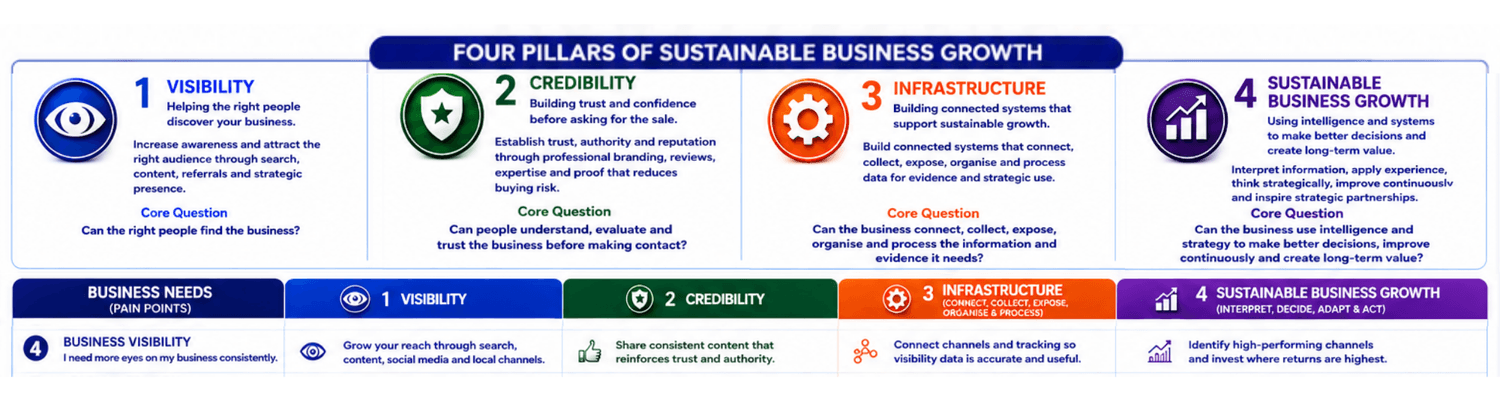

Primary Pillar - Visibility
What the Business Decided and Deliberately Presents
Google Business Profile optimisation belongs within the Visibility Business Need because businesses eventually reach a point where simply having an online presence is no longer enough and strengthening Visibility is the logical next step.
Supporting Pillars: Credibility • Infrastructure
Customers need to be able to find the business when they are looking for what it provides.
This is particularly important for businesses that serve a specific geographic market.
That may include:
Businesses with physical premises.
Service-area businesses.
Businesses serving customers within particular towns, suburbs or regions.
Professionals who meet customers locally.
Businesses that operate primarily online but still target specific geographic markets.
A Google Business Profile can contribute to that discovery process.
But visibility should not exist by itself.
The business also needs credible information, a professional website where appropriate, accurate business details and systems capable of handling the enquiries that visibility creates.
This creates a broader progression:
Infrastructure → Visibility → Credibility → Leads → Growth
Optimising a Google Business Profile therefore helps solve one part of the visibility challenge while preparing the business for the next stage of the Growth4biz Business Growth Journey.
What Is Google Business Profile Optimisation?
A Google Business Profile is a business listing that can appear across Google Search and Google Maps.
Optimisation means improving the profile so that the information presented to potential customers is:
Accurate.
Complete.
Relevant.
Consistent.
Useful.
Trustworthy.
Aligned with the actual business.
Optimisation is therefore more than adding keywords.
It is about helping Google and customers understand the business more clearly.
For example, imagine a local plumbing company.
Its profile might currently say:
ABC Plumbing
Phone number: listed.
Address: listed.
Website: listed.
But very little else is explained.
A stronger profile might clearly communicate:
The services offered.
The areas served.
The business category.
Relevant service information.
Photos of actual work.
Customer reviews.
Opening or response information.
A professional website.
Consistent business information.
The second profile gives both Google and potential customers more useful information.
That does not guarantee higher rankings or more customers.
But it creates a stronger foundation for local visibility.
Having a Google Business Profile Is Not the Same as Optimising It
This distinction is important.
Creating a profile establishes a presence.
Optimising a profile improves the quality of that presence.
A business may technically have a profile while still having:
The wrong category.
Missing services.
Poor descriptions.
Inconsistent business information.
Few useful photos.
Outdated information.
Weak review management.
An incomplete website connection.
Poor customer conversion pathways.
This is similar to having a website that exists but has not been properly developed.
The asset exists.
The system around the asset may not.
A Google Business Profile should therefore be treated as one part of a wider digital presence.
How Google Evaluates Local Relevance
Google does not simply show businesses because they have a Google Business Profile.
Local search results are influenced by factors such as relevance, distance and prominence.
The exact systems Google uses are complex and change over time.
Small businesses do not need to reverse-engineer Google's algorithm.
They need to make it easy for Google and customers to understand:
What the business does.
Where it operates.
Who it serves.
Which services it provides.
Whether the information appears credible and consistent.
How established and relevant the business appears within its market.
This is why accurate information matters.
If a business describes itself as a marketing agency on its website but uses an unrelated primary category on Google, the signals become less consistent.
Likewise, if the business says it serves Johannesburg but its online information suggests a completely different location, confusion can occur.
The goal is not to manipulate local search.
The goal is to create a clear and accurate digital representation of the business.
Different Platforms, Different Customer Intent
A business can be visible on several digital platforms and still struggle to understand why those platforms produce different results.
A customer who discovers a business on Facebook is not necessarily in the same mindset as a customer who discovers that business through Google Search or Google Maps.
The platforms may both create visibility, but they often serve different customer intentions.
Social Media Users Are Often Discovering:
Someone scrolling through Facebook or another social media platform may not be actively looking for a particular business.
They may encounter:
A business post.
A product or service.
A customer story.
A promotional offer.
A video.
A recommendation from someone they know.
Social media can therefore be valuable for awareness, familiarity and ongoing engagement.
The customer may not have been looking for the business when they encountered it.
The business is creating an opportunity to become known.
Google Users Are Often Searching
Google Search and Google Maps are different.
A person searching for:
"plumber near me"
or:
"accountant in Johannesburg"
or:
"hair salon near Sandton"
is already expressing a need.
They may be actively comparing businesses, checking reviews, looking for directions, checking operating hours or deciding who to contact.
This means the Google Business Profile can appear at a much later point in the customer's decision journey.
The customer is not simply discovering a business.
They may be trying to find a business that can solve a problem.
The Difference Matters
This creates an important distinction:
Social Media
Google Business Profile
1. Often creates awareness
1. Often captures existing demand
2. Customer may not be actively searching
2. Customer may already be searching
3. Useful for discovery and engagement
3. Useful for local discovery and evaluation
4. Content can encourage interest
4. Business information can support a decision
5. Frequency and engagement can matter
5. Relevance, accuracy and usefulness matter
6. Primarily a platform for attention
6. Often a platform for active intent
Neither platform is automatically better.
They simply perform different jobs.
A business may use social media to become familiar to potential customers and Google to help customers who are actively looking for its services find and evaluate it.
How Often Should a Business Post?
This is another area where businesses sometimes apply the wrong expectations.
A business may hear that it needs to post on social media several times a week and then assume the same approach should be applied to its Google Business Profile.
The purpose of the platforms is different.
On social media, regular publishing can help maintain awareness and engagement.
On a Google Business Profile, the priority should be useful, accurate and relevant information rather than publishing simply to meet an arbitrary posting target.
Useful Google Business Profile updates might include:
A new service.
A seasonal service or offer.
A completed project.
A business announcement.
New photos.
Important operating information.
An event or meaningful business update.
The principle is simple:
Do not post merely because you feel you have to post. Post when you have something useful for the customer.
The exact frequency can therefore vary according to the business.
A business with frequent changes, seasonal services, regular projects or new offerings may have more useful updates to share.
Another business may have fewer meaningful changes and therefore publish less frequently.
Consistency is useful, but usefulness should come first.
Do Not Confuse Visibility With Ownership
There is another strategic difference worth understanding.
Businesses can build audiences on platforms such as Facebook and other social networks, but they do not control those platforms.
The platform controls the environment, algorithms, policies and much of the customer experience.
A Google Business Profile is also hosted on Google's platform, so it should not be treated as an asset the business completely owns.
However, it can serve as an important discovery and intent layer that connects customers to assets the business has greater control over.
For example, a customer might:
Discover the business on Google → Read the profile → Visit the website → Contact the business → Become a customer.
The long-term objective should therefore not be to depend entirely on any one platform.
The stronger approach is to use platforms for what they do well while gradually moving customer relationships toward business-controlled assets such as the website, email communication and customer records.
This creates a broader digital ecosystem:
Social Media → Discovery → Google → Evaluation → Website → Conversion → Customer Relationship
The platforms can help create opportunities.
The business should build the underlying assets and systems that allow it to keep serving those customers.
Why This Matters
Imagine two businesses offering the same service.
One spends most of its effort posting on Facebook but has an incomplete Google Business Profile.
The other has a complete profile, accurate information, useful photos, genuine reviews and a website where customers can learn more.
The first business may generate awareness.
The second may be easier to find when someone is actively looking for the service.
This is why Google Business Profile optimisation should be considered part of a broader visibility strategy rather than simply another social media task.
The goal is not to choose between platforms.
The goal is to understand the role each platform plays in the customer's journey and use each one appropriately.
Step-by-Step Google Business Profile Optimisation
Step 1: Claim and Verify the Business Profile
Before optimisation can begin, the business needs appropriate ownership and verification of its Google Business Profile.
This is important because the profile represents the business publicly.
The business should know:
Who owns the profile.
Who has access.
Which Google account controls it.
How access is managed.
Who is responsible for updates.
This becomes increasingly important as a business grows.
A profile should not depend entirely on an employee's personal account or an agency that may eventually stop working with the business.
Where possible, the business should maintain appropriate control over its core digital assets.
Step 2: Get the Business Name Right
The business name should accurately reflect the real-world business.
This sounds simple, but businesses sometimes try to add unnecessary keywords to their names in an attempt to improve visibility.
For example:
ABC Plumbing
is different from:
ABC Plumbing – Best Emergency Plumber Johannesburg
The second name may look like an attempt to manipulate search visibility rather than represent the actual business name.
The safest approach is to use the genuine business name and ensure that it is consistent across important business assets.
This also connects with:
Related Read
Business Name vs Domain Name: What's the Difference and Why It Matters?
Your business name is part of the foundation on which your digital identity is built.
Step 3: Choose the Correct Primary Category
The primary category helps communicate what the business fundamentally is.
This is one of the most important decisions within the profile.
A business should select the category that most accurately represents its primary offering.
For example:
A dentist should not select a generic health category simply because it sounds broad.
A restaurant should not choose a catering category if catering is only a minor part of the business.
A marketing agency should choose a category that accurately represents its core business.
The objective is relevance.
Businesses should avoid choosing categories simply because they appear popular or attractive.
Step 4: Add Relevant Secondary Categories
Where appropriate, additional categories can help communicate other important aspects of the business.
These should remain relevant.
A business should not attempt to select every possible category.
Think about the question:
"What other important aspects of this business would a customer reasonably expect to find represented?"
For example, a company may have one primary service and several legitimate supporting services.
The categories should reflect the actual business rather than an attempt to capture unrelated searches.
Step 5: Complete the Business Information
Incomplete information creates unnecessary uncertainty.
Review the profile carefully.
Check:
Business name.
Address.
Phone number.
Website.
Hours.
Business category.
Service areas where applicable.
Services.
Business description.
Other available profile information.
The information should be accurate and consistent with the business's other important digital assets.
This is especially important when customers are deciding whether to contact the business.
A customer who cannot determine whether a business is open, where it operates or how to contact it may simply choose another option.
Step 6: Write a Useful Business Description
The business description should help customers understand what the business does.
It should not simply be a collection of keywords.
A useful description can explain:
What the business does.
Who it serves.
Where it operates.
Its key services.
What makes its offering relevant.
For example, instead of:
"Best plumber plumber plumbing plumbing Johannesburg."
A better description might explain the actual business and services in natural language.
The objective is clarity.
Write for people first.
Search visibility should come from relevance rather than awkward keyword repetition.
Step 7: Add and Organise Services
Where the profile supports service information, businesses should use it to communicate what they actually provide.
Think about the services customers are likely to search for.
A building company, for example, might provide:
Renovations.
Home extensions.
Commercial construction.
Project management.
A professional services company might have several clearly defined service areas.
The service information should match the website and actual offering.
This creates a consistent set of signals across the digital presence.
Step 8: Use Photos to Build Confidence
Photos can help potential customers understand what the business looks like and what it actually does.
Depending on the business, useful photos may include:
Premises.
Staff.
Products.
Equipment.
Completed projects.
Work in progress.
Vehicles.
Branding.
Customer-facing environments.
The best images are usually authentic and relevant.
A service business should consider showing examples of its actual work.
A restaurant can show its environment and food.
A professional service business may show its team, office or customer-facing environment.
The objective is not simply to make the profile attractive.
It is to provide evidence and context.
Step 9: Build Genuine Customer Reviews
Reviews are an important part of local business credibility.
But businesses should approach reviews carefully.
The objective is not to collect artificial praise.
The objective is to create a process that makes it easy for genuine customers to provide honest feedback.
A business can encourage customers to leave reviews after completing a service or transaction.
It should avoid:
Fake reviews.
Buying reviews.
Creating reviews for itself.
Pressuring customers to leave only positive feedback.
A strong review profile is ultimately built through the customer experience.
This creates an important relationship:
Service → Experience → Review → Evidence → Credibility
The Google Business Profile provides the place where some of that evidence becomes visible.
Step 10: Respond Professionally to Reviews
Reviews are not simply something to collect.
They are also opportunities to communicate.
Positive reviews can be acknowledged professionally.
Negative reviews should be handled calmly.
A business should avoid arguing with customers publicly.
Instead:
Acknowledge the concern.
Remain professional.
Avoid exposing private information.
Clarify misunderstandings where appropriate.
Take the conversation offline when necessary.
Use recurring complaints as business feedback.
A negative review may reveal a weakness in the business.
That can make it valuable.
Visibility can expose the customer experience.
Credibility depends on what the business does with that information.
Step 11: Keep the Website and Google Business Profile Connected
A Google Business Profile should not operate in isolation from the website.
The website can provide information that the profile cannot fully communicate.
For example:
Google Business Profile
Helps customers discover and quickly evaluate the business.
Website
Provides deeper information about:
Services.
Expertise.
Pricing or packages where appropriate.
Portfolio.
Case studies.
FAQs.
Testimonials.
Contact options.
Resources.
The profile can therefore act as an entry point into the broader digital presence.
A useful customer journey may look like this:
Google Search → Google Business Profile → Website → Evaluation → Contact → Enquiry → Customer
Not every customer will follow this exact path.
Some will call directly.
Others may visit the website first.
The important point is that the profile should help move interested people toward the next useful interaction.
Google Business Profile vs Website
Google Business Profile
Business Website
1. Helps customers discover the business
1. Helps customers understand the business
2. Strong local visibility function
2. Strong information and conversion function
3. Controlled by Google
3. Controlled by the business
4. Appears within Google's ecosystem
4. Exists as a business-owned digital asset
5. Supports reviews and local information
5. Supports deeper content and customer journeys
6. Limited control over platform
6. Greater control over presentation
7. Useful for distribution
7. Useful for ownership and infrastructure
The two should not be treated as competitors.
They perform different jobs.
Your Google Business Profile helps distribute your business into Google's ecosystem.
Your website gives the business a digital asset it controls.
This is why Growth4biz recommends thinking beyond individual platforms.
Social media is for distribution. Your website is for ownership. Your digital infrastructure connects it all.
Step 12: Keep Business Information Consistent
A business may appear across many digital environments.
For example:
Google Business Profile.
Website.
Social media.
Business directories.
Industry directories.
Review platforms.
Local listings.
Important business information should remain accurate and consistent.
This includes:
Business name.
Address.
Phone number.
Website.
Core services.
If an old phone number remains on one directory while the current number appears elsewhere, customers may become confused.
Consistency also makes the business easier to understand across its digital footprint.
Step 13: Think About Local Keywords Naturally
Local SEO often involves geographic terms.
For example:
Plumber in Johannesburg.
Accountant in Sandton.
Web designer in Pretoria.
Electrician in Randburg.
But businesses should not simply insert location names everywhere.
Instead, consider how customers naturally describe:
The service.
The location.
The problem.
The surrounding area.
These concepts can then be reflected naturally across relevant business assets.
The goal is not keyword repetition.
The goal is relevance.
Step 14: Optimise for the Areas You Actually Serve
A business should accurately communicate where it operates.
This becomes particularly important for service-area businesses.
For example:
A plumber may not have a customer-facing storefront.
Instead, the plumber travels to customers in several suburbs.
The business needs to communicate its service area accurately.
The same applies to:
Mobile services.
Contractors.
Consultants who meet clients locally.
Home-service providers.
Delivery businesses.
The objective is to help customers understand whether the business can actually serve them.
Step 15: Understand Different Business Types
Not every business should approach Google Business Profile optimisation in exactly the same way.
Physical Location Businesses
These businesses have a customer-facing location.
Examples include:
Restaurants.
Retail stores.
Dentists.
Salons.
Gyms.
Their profile should make it easy for customers to understand where they are and what the physical experience is like.
Service-Area Businesses
These businesses travel to customers.
Examples include:
Plumbers.
Electricians.
Builders.
Cleaners.
Mobile mechanics.
Their service areas become particularly important.
Hybrid Businesses
Some businesses have a physical location but also travel to customers.
Their digital presence needs to communicate both.
Multi-Location Businesses
Businesses with several branches need to manage each location carefully.
Each location should represent the actual business presence in that market.
Virtual Businesses
This is an important distinction.
A business such as Growth4biz Media may operate primarily online.
It may serve clients remotely rather than receiving customers at a physical premises.
In such cases, the business should not attempt to create a misleading local presence simply because local SEO sounds attractive.
Instead, its visibility strategy may focus on:
The markets it genuinely serves.
Website SEO.
Service-specific search visibility.
Content.
Digital authority.
Professional business information.
Relevant geographic targeting where appropriate.
A virtual business may still have a defined market.
It may serve businesses in Johannesburg, South Africa, multiple South African cities or customers internationally.
The question is not:
"How do we make a virtual business look local?"
The better question is:
"Where and how does this business genuinely compete for attention?"
That distinction matters.
Local SEO is powerful when the business actually has a local search opportunity.
It should not be forced onto a business simply because it is a popular SEO tactic.
Step 16: Use Google Business Profile Posts Strategically
Where appropriate and available, businesses can use profile posts to communicate timely information.
Potential uses include:
New services.
Special offers.
Events.
Announcements.
Useful updates.
Customer resources.
But businesses should not post simply to create activity.
The content should have a purpose.
A useful post should help customers understand something, take an action or discover something relevant.
Step 17: Connect the Profile to the Broader Local System
This is where Google Business Profile optimisation becomes part of local SEO rather than an isolated task.
A broader local system may include:
Google Business Profile
↓
Website
↓
Consistent Business Information
↓
Local Directory Presence
↓
Customer Reviews
↓
Relevant Local Content
↓
Local Search Visibility
↓
Customer Evaluation
↓
Enquiry
↓
Customer Experience
The exact system will differ between businesses.
A small restaurant may rely heavily on its Google profile, reviews, website, photos and local search visibility.
A service-area contractor may need stronger service-area pages and enquiry systems.
A professional service business may need stronger website content, case studies and credibility assets.
The important principle is that the profile is one component of a connected system.
The Local Customer Journey
A useful way to understand local visibility is to follow the customer.
Imagine someone needs an electrician.
They search:
"Electrician near me."
They see several results.
They compare:
Business names.
Ratings.
Reviews.
Photos.
Services.
Distance.
Opening information.
They click on one business.
They visit the website.
They look at the services.
They decide whether the business appears credible.
They call or submit an enquiry.
The business responds.
The service is delivered.
The customer forms an opinion.
They may eventually leave a review.
This creates a cycle:
Search → Discovery → Evaluation → Enquiry → Experience → Review → Credibility → Future Discovery
Local SEO therefore does not end when someone clicks the business listing.
The real objective is to create a better path from discovery to business outcome.
Visibility Is Not the Same as Conversion
A business can receive visibility without receiving enough enquiries.
This is an important distinction.
Imagine a profile receives:
10,000 views
but only:
10 enquiries.
The problem may not be visibility alone.
It may involve:
Poor positioning.
Weak reviews.
Unclear services.
An unconvincing website.
Poor calls to action.
Slow response times.
Weak customer experience.
This is where the Growth4biz Framework becomes useful.
Visibility gets attention.
Credibility supports confidence.
Infrastructure helps the business respond.
The combination creates opportunities for growth.
Google Business Profile Optimisation Across the Growth4biz Framework™
Optimising a Google Business Profile should not be treated as a checklist that is completed once and forgotten.
A profile can be technically complete and still fail to support the broader needs of the business.
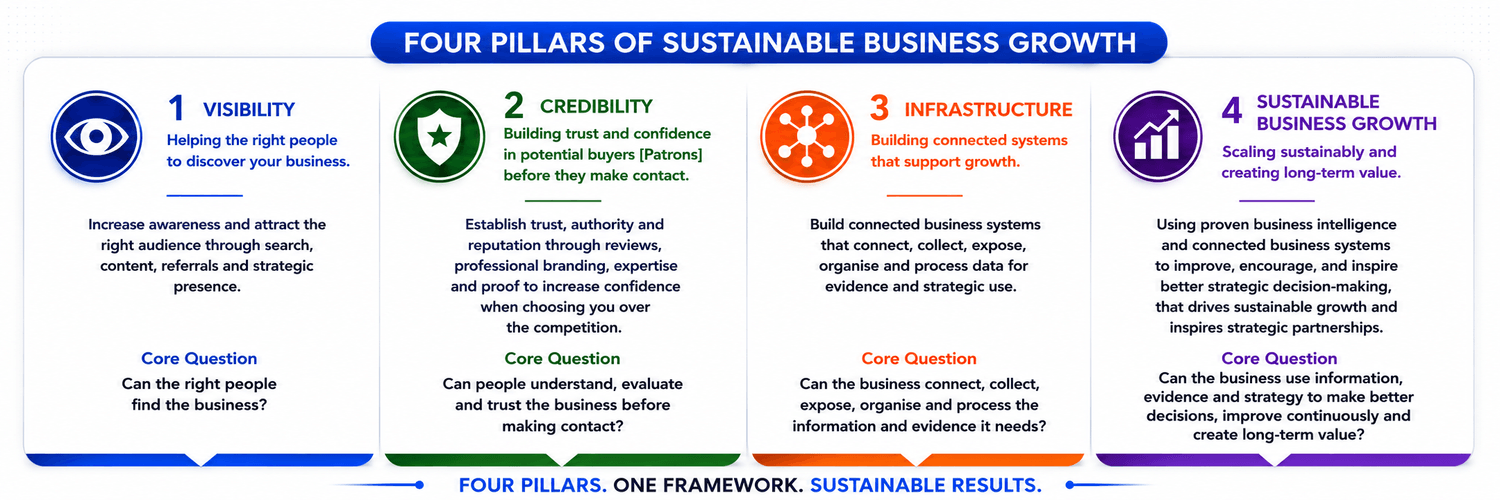
A stronger approach is to look at the profile through the four Growth4biz Framework™ pillars:
Visibility → Credibility → Infrastructure → Sustainable Business Growth
Each pillar asks a different question.
1. Visibility — How Does the Business Deliberately Present Itself So Relevant Customers Can Find It?
Within the Growth4biz Framework™, Visibility begins from the business's perspective.
The business makes deliberate decisions about what it wants to present, communicate and make visible.
In the context of a Google Business Profile, this means considering how the business presents itself so that Google and relevant customers can understand:
What the business is.
What it does.
Which services it provides.
Where it operates.
When it is available.
How customers can contact it.
Businesses should review:
Correct business name.
Correct primary category.
Relevant secondary categories where appropriate.
Accurate business location or service area.
Complete business information.
Correct operating hours.
Relevant services.
Accurate website link.
Relevant business description.
Useful and current photos.
Consistent business information across the wider web.
Appropriate local keywords and service terminology.
The goal is not simply to add as many keywords as possible.
The goal is to make the business's deliberate presentation clear and relevant.
A business that provides plumbing services should make it easy for Google and customers to understand what it does, where it operates and which services it provides.
In this sense, the Google Business Profile becomes one of the signals through which the business deliberately presents itself to the wider world.
Why This Matters:
A business cannot generate enquiries from relevant local customers if those customers cannot discover what the business is presenting.
Visibility creates the opportunity for the business to be encountered.
But the business's deliberate presentation does not automatically determine how that presentation will be understood.
Once customers encounter the business, they begin evaluating what they see.
That leads to the next pillar.
2. Credibility — How Does the Google Business Profile Help Customers Understand and Trust the Business?
Within the Growth4biz Framework™, Credibility begins from the audience's perspective.
The business can decide what it presents.
It cannot decide exactly what every customer will understand, believe or trust.
Once customers encounter a Google Business Profile, they may begin asking:
"Can I understand what this business does?"
"Does this business appear capable?"
"Is there evidence?"
"Can I trust what I am seeing?"
The Google Business Profile can contribute to that evaluation.
Businesses should review:
Genuine customer reviews.
The quality and recency of reviews.
Responses to customer reviews.
Business photos.
Service information.
Accurate contact information.
Consistent branding.
Professional presentation.
Links to a professional website.
Evidence of experience or completed work where appropriate.
Reviews deserve particular attention.
A business should not simply collect reviews and ignore them.
Responding professionally to genuine customer feedback demonstrates that the business is paying attention.
Positive reviews can provide evidence that supports the expectations created by the business's presentation.
Negative reviews can also provide an opportunity to demonstrate professionalism through an appropriate response.
The objective is not to manufacture credibility.
It is to make genuine evidence of the business easier for potential customers to understand, evaluate and trust.
Why This Matters
Imagine a customer finds three businesses offering the same service.
One has an incomplete profile with old photographs and very little customer feedback.
Another has a complete profile, current photographs and genuine reviews.
The third has strong reviews but never responds to customers and provides very little useful information.
The customer is no longer simply considering whether the businesses are visible.
They are evaluating what they understand about each business and whether they have sufficient reason to trust it.
This is where the Google Business Profile becomes connected to the broader Credibility Business Need.
But visibility and credibility also create something else.
They create activity.
Customers may call, visit the website, submit enquiries or request appointments.
That activity creates information.
The business then needs the capability to capture, connect and organise what happens next.
That leads to Infrastructure.
3. Infrastructure — How Does the Business Capture, Connect and Organise Information to Support Customer Opportunities?
Within the Growth4biz Framework™, Infrastructure connects, collects and organises information generated through business activity.
Visibility creates information about how and where the business is being discovered.
Credibility creates information through reviews, feedback, questions and customer interactions.
The Google Business Profile can contribute to both.
But what happens when a customer takes action?
A business may receive:
Phone calls.
Website visits.
Contact form enquiries.
Appointment requests.
Customer messages.
Reviews.
Questions.
Infrastructure helps the business capture, connect and organise those interactions so they can become useful.
In practical Google Business Profile terms, this also means considering whether the business is prepared to handle the opportunities its visibility and credibility are creating.
Businesses should review:
Phone systems.
Business email.
Website contact forms.
Enquiry management.
Response processes.
Customer records.
Appointment or booking processes where applicable.
Internal responsibility for responding to enquiries.
Website information.
Systems for collecting and organising customer interactions.
Consistency between the Google profile and the actual service.
Ownership and access to important digital assets.
For example, imagine a business finally improves its Google visibility and starts receiving five additional enquiries every week.
If those enquiries are not captured, assigned, recorded or followed up, the visibility improvement has exposed an infrastructure problem.
The problem is no longer simply:
"How do we get found?"
It also becomes:
"How do we capture, connect and manage the information and opportunities being created?"
This is an important Growth4biz principle:
Visibility creates opportunities and activity. Infrastructure helps the business capture, connect and organise what those activities produce.
Google Business Profile optimisation should therefore connect with the rest of the business's digital infrastructure.
Contact information should work.
Website links should work.
Enquiries should reach someone responsible.
Customer interactions should be captured where appropriate.
Information should be organised in a way that the business can use.
The purpose is not simply to collect more information.
It is to make information and customer activity usable.
But collecting and organising information is not the final objective.
The business still needs to interpret what the information means, decide what matters and determine what should happen next.
That leads to Sustainable Business Growth.
4. Sustainable Business Growth — How Can the Business Interpret Information, Decide, Adapt and Act?
Within the Growth4biz Framework™, Sustainable Business Growth is where information and experience are interpreted and used to support decision-making and action.
The Google Business Profile can generate useful information about:
Calls.
Website visits.
Direction requests where applicable.
Customer actions.
Search visibility.
Reviews.
Customer questions.
Changes in services.
Changes in operating areas.
New products or services.
Seasonal opportunities.
Customer feedback.
But information alone does not create growth.
The business needs to ask:
What does this information mean?
What matters?
What should we change?
What opportunities are emerging?
What should we do next?
This is where the business:
Interprets information.
Applies experience.
Makes decisions.
Tracks progress.
Adapts.
Takes action.
Improves continuously.
Identifies opportunities.
Increases capacity.
Develops strategy.
Inspires strategic partnerships.
For example, if customers repeatedly ask whether a particular service is available, the business may need to make that service more visible.
If customers regularly mention a specific strength in reviews, the business may have discovered a genuine differentiator that can be communicated more clearly.
If enquiries increase but conversions remain weak, the business may discover that the problem exists beyond the Google Business Profile.
If patterns in customer behaviour reveal new opportunities, those insights may also contribute to future strategic decisions or inspire potential partnerships.
This creates a more complete cycle:
Optimise → Capture → Organise → Interpret → Decide → Adapt → Act → Improve
Google Business Profile optimisation is therefore not simply a setup task.
It becomes one source of information within a broader process of continuous business learning, decision-making and improvement.
The Four-Pillar Google Business Profile Review
A useful way to audit a Google Business Profile is to ask four questions that reflect the underlying Growth4biz Framework™:
Growth4biz Pillar
Core Question
What to Review
1. Visibility
1. How are we deliberately presenting the business so relevant customers can find and understand it?
1. Categories, services, location, business information, website, photos and presentation
2. Credibility
2. How does the profile help customers understand and trust the business?
2. Reviews, responses, photos, evidence, information and consistency
3. Infrastructure
3. How do we capture, connect and organise the information and opportunities being created?
3. Phone, email, website, enquiries, records, processes, systems and ownership
4. Sustainable Business Growth
4. How do we interpret what we are learning, decide what matters, adapt and act?
4. Performance, customer behaviour, reviews, opportunities, decisions and continuous improvement
The value of this framework is that it prevents Google Business Profile optimisation from becoming a narrow SEO exercise.
A profile can be highly visible while customers struggle to trust it.
It can create a professional impression while relevant customers struggle to find it.
It can generate enquiries while the business lacks the infrastructure to capture and manage those opportunities.
Or the business can collect significant amounts of information while failing to interpret it and use it to make better decisions.
The four pillars encourage the business to consider the complete system.
Why This Matters:
Imagine a local business that spends months improving its visibility.
Eventually, more customers find it.
The business receives more calls, more website visits and more enquiries.
But its website is outdated, enquiry responses are slow and there is no clear process for capturing or following up leads.
The visibility strategy worked.
The business created activity.
But the infrastructure was not capable of effectively capturing, connecting and organising what that activity produced.
And without interpreting what was happening and deciding how to improve, the business may continue repeating the same problems.
This is why the Growth4biz Framework™ treats visibility as one part of a larger business system.
Visibility shapes what the business deliberately presents.
Credibility reflects what the audience understands and trusts.
Infrastructure captures, connects and organises information.
Sustainable Business Growth interprets information, supports decisions, inspires action and enables adaptation.
When these capabilities work together, the Google Business Profile becomes more than a listing.
It becomes one component within a broader business system through which the business can deliberately present itself, be evaluated by its audience, capture and organise the resulting information, and use what it learns to make decisions, improve and identify future opportunities.
When Google Business Profile Optimisation Is Not Enough
Optimising the profile is valuable.
But it cannot solve every business problem.
If a business has:
Poor reviews.
An outdated website.
Slow responses.
Weak service delivery.
Unclear pricing.
Poor customer service.
No effective enquiry process.
then better Google visibility may simply expose those weaknesses to more people.
That is not necessarily a bad thing.
It creates a clearer picture of where the business needs to improve.
A useful principle is:
Do not use better visibility to hide a weak business system. Use better visibility to create opportunities for a stronger business system.
Digital Protection and Long-Term Considerations
A Google Business Profile is valuable.
But it is not an asset the business fully controls.
Google controls the platform, its features and the environment in which the profile appears.
This does not mean businesses should avoid Google.
It means they should understand the difference between distribution and ownership.
A business should ideally maintain appropriate control over assets such as:
Its domain.
Its website.
Its business email.
Its customer information.
Its internal systems.
Its brand assets.
Its important business documentation.
Google Business Profile can help distribute the business into Google's ecosystem.
The website provides a platform the business has significantly more control over.
This leads to another Growth4biz principle:
Build on assets you control. Use platforms for distribution.
That approach reduces unnecessary dependence on any single platform.
For more context, see:
Related Read
Google Business Profile vs Website: Which One Does Your Business Need?
Benefits of Google Business Profile Optimisation
A properly managed Google Business Profile can provide several benefits:
Greater local visibility
Improved customer discovery
Clearer business information
Stronger credibility signals
Better customer evaluation
More useful local search presence
A stronger connection between Google and the website
More opportunities for enquiries
Better understanding of customer feedback
A stronger foundation for local SEO
Greater Local Visibility
A well-maintained profile gives Google clearer information about the business and creates a stronger presence within Google's local ecosystem.
Better Customer Discovery
Customers searching for relevant products and services have an opportunity to discover the business.
Stronger Credibility
Reviews, photos, accurate information and a professional website can give potential customers more information to evaluate.
Better Customer Experience
Accurate opening information, services, contact details and location information make it easier for customers to take the next step.
More Enquiry Opportunities
When discovery connects effectively with a website, phone number or enquiry process, visibility can create opportunities for new business.
Better Customer Feedback
Reviews and customer interactions can provide useful information about what the business is doing well and where improvements may be needed.
Common Google Business Profile Optimisation Mistakes
1. Creating the Profile and Forgetting About It:
Businesses often create the profile and never review it again.
Why it happens: The owner assumes setup means the job is finished.
Why it causes problems: Information becomes outdated and opportunities for improvement are missed.
How to avoid it: Review the profile periodically.
2. Choosing the Wrong Category:
Businesses sometimes select a category because it sounds popular rather than because it accurately represents the business.
Why it causes problems: Relevance becomes less clear.
How to avoid it: Choose categories based on the actual business.
3. Keyword Stuffing the Business Name:
Adding unnecessary keywords to the business name can create an inaccurate representation.
How to avoid it: Use the genuine business name.
4. Using Poor or Irrelevant Photos:
Low-quality or unrelated images can weaken the customer's impression.
How to avoid it: Use relevant, current and authentic images.
5. Ignoring Reviews:
Some businesses collect reviews but never respond.
Why it causes problems: Customers may see an organisation that appears disconnected from feedback.
How to avoid it: Respond professionally and use feedback constructively.
6. Buying or Creating Fake Reviews:
Artificial reviews may seem like an easy shortcut.
Why it causes problems: They undermine credibility and can create serious platform and reputation risks.
How to avoid it: Build genuine reviews through real customer experiences.
7. Treating the Profile as the Entire Website:
A Google Business Profile cannot provide all the information a professional website can.
How to avoid it: Use the profile as an entry point into the wider digital presence.
8. Inconsistent Business Information:
Different phone numbers, addresses or business names across platforms create confusion.
How to avoid it: Maintain accurate and consistent core business information.
9. Ignoring the Website:
Some businesses optimise Google but leave the website outdated.
Why it causes problems: Customers may click through and encounter a weaker experience.
How to avoid it: Treat Google and the website as connected parts of the customer journey.
10. Optimising for Locations the Business Does Not Actually Serve:
Businesses may be tempted to list every nearby location.
Why it causes problems: The business creates expectations it may not be able to fulfil.
How to avoid it: Focus on areas the business genuinely serves.
11. Expecting Rankings to Produce Instant Sales:
A profile can become more visible without immediately producing significant revenue.
Why it happens: Visibility feels like a direct measure of business success.
How to avoid it: Track the full journey from discovery through enquiry and customer experience.
Practical Tips for Google Business Profile Optimisation
The following process provides a practical starting point:
Claim and verify the profile.
Confirm the correct business ownership and access.
Check the business name.
Select the most accurate primary category.
Add relevant secondary categories where appropriate.
Complete all important business information.
Write a clear business description.
Add relevant services.
Define genuine service areas where applicable.
Add high-quality, authentic photos.
Encourage genuine customer reviews.
Respond professionally to reviews.
Connect the profile to the correct website.
Keep business information consistent across important platforms.
Review local search terms customers actually use.
Create useful local content where appropriate.
Use profile posts strategically where relevant.
Monitor customer actions and enquiries.
Review the profile periodically.
Improve the underlying business systems when visibility exposes weaknesses.
The goal is not to manipulate Google.
The goal is to make the business easier to understand, easier to find and easier to evaluate.
Google Business Profile Optimisation Audit
A business can use a simple audit to identify weaknesses.
Business Information
Is the business name accurate?
Is the phone number correct?
Is the website correct?
Are the hours accurate?
Is the address or service area correct?
Categories
Is the primary category accurate?
Are secondary categories relevant?
Services
Are important services listed?
Do the services match the website?
Content
Is the description clear?
Does it describe the real business?
Are relevant customer needs addressed?
Photos
Are the photos current?
Do they show the real business?
Do they help customers understand what to expect?
Reviews
Are genuine customers leaving reviews?
Are reviews being responded to professionally?
Are recurring complaints being analysed?
Website
Does the website match the profile?
Can visitors quickly understand the services?
Is there a clear way to contact the business?
Customer Journey
What happens after someone finds the profile?
Can they easily call?
Can they visit the website?
Can they submit an enquiry?
Does the business respond quickly?
Infrastructure
Can the business handle additional enquiries?
Are enquiries tracked?
Are follow-ups managed?
Does the customer experience support the brand promise?
This last section is important.
A visibility strategy should not create more demand than the business can reasonably handle.
Frequently Asked Questions:
Google Business Profile optimisation is the process of improving a business's Google profile so that its information is accurate, complete, relevant, useful and aligned with the actual business.
No.
Google Business Profile optimisation is an important part of local SEO, but local SEO can involve a broader system that includes the website, local content, business information, reviews, directories and other relevant signals.
Not necessarily.
It is particularly useful for businesses that have a legitimate local search opportunity, such as physical businesses and many service-area businesses.
A purely virtual business may have different visibility priorities depending on its target market.
Eligibility depends on the business and how it operates. A virtual business should not create a misleading local presence simply to pursue local visibility.
Instead, it should focus on the markets and search opportunities it genuinely serves.
There is no universal schedule.
The profile should be reviewed whenever important business information changes and periodically to ensure that services, hours, photos and other information remain accurate.
Reviews are an important part of local business credibility and can contribute to the broader local search ecosystem. Businesses should focus on earning genuine reviews through good customer experiences rather than attempting to manufacture them.
The business name should accurately represent the real business rather than being modified simply to include keywords.
Photos can improve the quality and usefulness of the profile and help customers evaluate the business. Businesses should focus on relevant, authentic and useful imagery rather than simply adding large numbers of photos.
No.
Optimisation can improve the business's foundation for discovery and evaluation, but customer results also depend on factors such as competition, demand, reputation, service quality, website experience, pricing and enquiry handling.
For many businesses, yes.
The profile can help customers discover the business, while the website can provide deeper information, credibility, content and conversion opportunities.
Google Business Profile optimisation focuses specifically on improving the business's Google presence.
Local SEO is broader and can include the website, local content, business information, reviews, directories and other visibility signals.
Yes, where eligible.
Service-area businesses should accurately communicate the areas they genuinely serve rather than attempting to appear everywhere.
The priorities depend on the business.
In many cases, both should be developed together because the profile and website support different parts of the customer journey.
Look beyond visibility.
Review the profile information, reviews, services, photos, website, calls to action and enquiry process.
The problem may be conversion or credibility rather than visibility.
It can act as an important discovery and evaluation point within a broader local visibility system.
The profile can connect customers to the website, reviews, contact channels and other business information.
Final Thoughts
A Google Business Profile can be one of the most useful digital visibility tools available to a small business.
But the profile should not be viewed as the entire local SEO strategy.
It is one part of a larger system.
The business needs accurate information.
Customers need useful information.
Reviews need to reflect genuine experiences.
The website needs to support the next stage of evaluation.
The enquiry process needs to work.
And the business needs the infrastructure required to deliver what its visibility promises.
This is why Growth4biz approaches Google Business Profile optimisation as part of the broader Business Growth Journey.
Visibility creates opportunity.
Credibility helps customers evaluate that opportunity.
Infrastructure helps the business deliver on it.
The customer journey may begin with a Google search:
Search → Google Business Profile → Website → Evaluation → Enquiry → Customer → Review
But the long-term objective is bigger than getting a business listed on Google.
It is about building a digital presence that helps the right customers discover the business and then gives them enough information and confidence to take the next step.
There is also an important distinction between distribution and ownership.
Google is a platform the business uses.
The business website, domain, email and internal systems are assets the business has significantly more control over.
That leads to a simple Growth4biz principle:
Build on assets you control. Use platforms for distribution.
A strong local visibility system therefore does not make the business dependent on Google.
It uses Google intelligently while continuing to build the underlying business assets.
And when visibility exposes weaknesses — whether in the website, customer service, response times or internal systems — the answer is not to hide those weaknesses.
The answer is to improve the business.
That is where visibility becomes part of sustainable growth.
Continue Your Growth Journey
Related Articles
Google Business Profile vs Website: Which One Does Your Business Need?
Google Business Profile for Small Businesses: How to Set It Up Correctly and Why It Matters
Local SEO Guide: How Small Businesses Can Get Found by Customers in Their Area
Business Name vs Domain Name: What's the Difference and Why It Matters?
Coming Soon
Local SEO for Service-Area Businesses
Local SEO for Virtual and Online Businesses
Local Business Citations and Directory Guide
Customer Reviews vs Testimonials: What's the Difference and Why Both Matter
How to Build Trust Online: A Practical Guide for Small Businesses
Related Downloads
Google Business Profile Optimisation Checklist (Coming Soon)
Local Visibility Audit (Coming Soon)
Local SEO Implementation Checklist (Coming Soon)
Related Checklists
Google Business Profile Audit Checklist (Coming Soon)
Local Search Visibility Checklist (Coming Soon)
Local Business Information Consistency Checklist (Coming Soon)
Related Worksheets
Local SEO Planning Worksheet (Coming Soon)
Local Customer Journey Worksheet (Coming Soon)
Google Business Profile Optimisation Planner (Coming Soon)
Business Need
Visibility
Primary Pillars
Visibility
Supporting
Credibility
Infrastructure
Book a Consultation
Getting a business visible online is only part of the challenge.
The bigger opportunity is creating a connected digital presence that helps the right customers discover the business, understand what it offers, trust what they see and take the next step.
Growth4biz Media can help businesses strengthen that visibility system — from Google Business Profile optimisation and local search strategy to websites, digital infrastructure and the customer journey that connects them.
If your business is visible but not generating the opportunities you expect, a consultation can help identify where the gap exists.
Book a consultation and let's build a stronger visibility foundation for the business you are building.
SHARE




ABOUT
Growth4biz Media is a Digital Business Infrastructure Agency helping businesses establish, strengthen and evolve the digital capabilities that support how they operate, communicate, connect with people and grow.
We do more than keep websites alive or help people monetise their intellectual property or expertise. We are helping businesses keep their digital capabilities relevant and useful as their operating environments change.
Copyright 2026 • Growth4biz Media (Pty) Ltd.