
What Is a Lead? A Practical Guide for Businesses
Introduction
A business can receive dozens of enquiries and still struggle to generate sales.
The problem is sometimes obvious: there are not enough enquiries.
But sometimes the problem is very different.
The business is receiving enquiries, form submissions, social-media messages, email subscribers or people requesting information — yet very few of those interactions turn into genuine business opportunities.
This often leads to a familiar reaction:
"We just need more leads."
But more leads are not always the answer.
A business can generate hundreds of contacts and still have a weak sales pipeline if those contacts are poorly matched, have little genuine interest, cannot afford the offer, are not ready to buy or simply do not need what the business provides.
This creates an important distinction:
Lead quantity and lead quality are not the same thing.
Before a business can improve lead generation, lead qualification or conversion, it needs to understand what a lead actually is.
That sounds simple.
But the word "lead" is often used to describe almost anyone who interacts with a business.
A website visitor may be called a lead.
A social-media follower may be called a lead.
An email subscriber may be called a lead.
Someone who requests a quotation may also be called a lead.
These people are not necessarily at the same stage.
Understanding the difference helps businesses measure marketing more accurately, improve follow-up, protect their time and build a more sustainable path from visibility to revenue.
At Growth4biz, we view this as part of a broader business growth principle:
The objective is not simply to generate more contacts.
It is to create relevant opportunities and build the systems required to turn the right opportunities into customers.
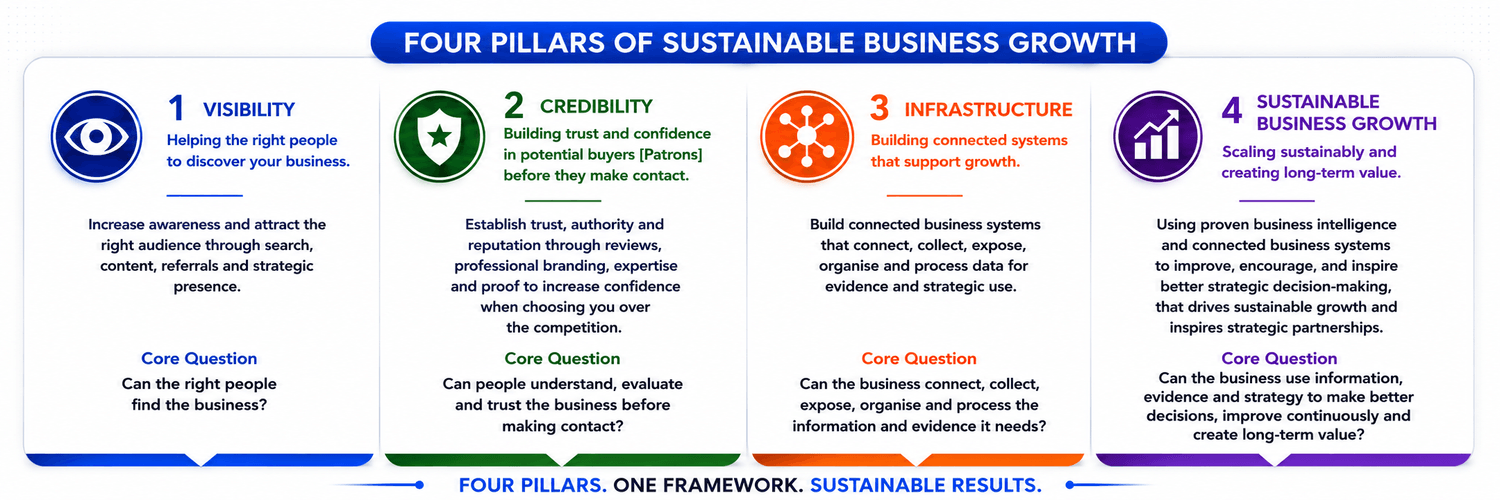
Your Position in the Growth4biz Framework™
I get some interest but not enough qualified leads consistently.
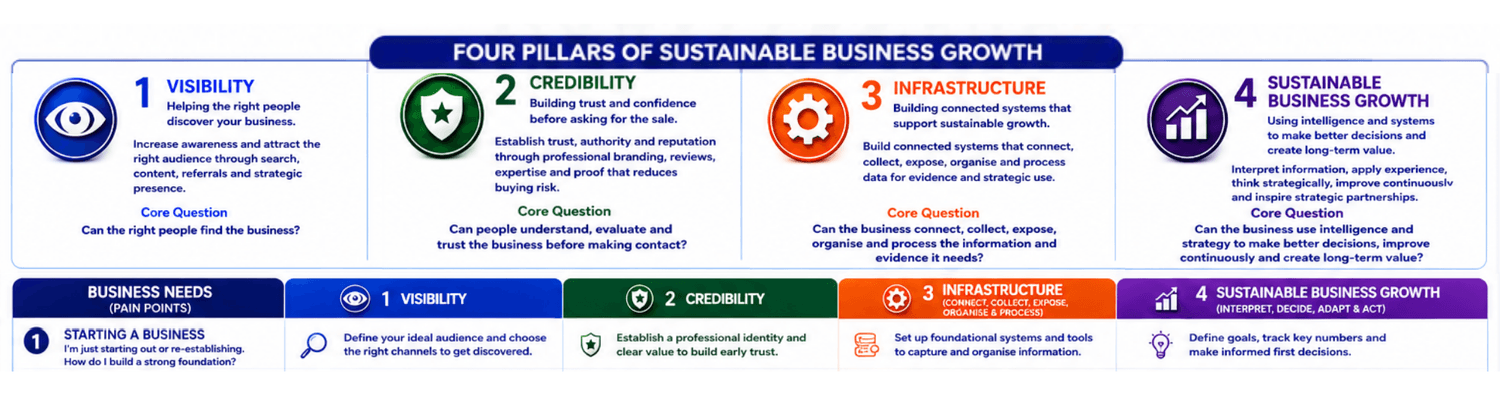

Primary Pillar - Visibility
What the Business Decided and Deliberately Presents
Leads as a Business Need becomes increasingly important once a business has begun creating visibility.
A business may already have a website, Google Business Profile, social-media presence, referrals or other sources of attention.
Supporting Pillars: Infrastructure • Growth
But visibility creates a new question:
What happens when someone becomes interested?
That is where leads become important.
A business needs to distinguish between people who have simply encountered the business and people who have taken an identifiable action indicating potential interest.
It also needs to understand which leads are relevant, which are qualified and which should be nurtured, converted or disqualified.
This prepares the business for the next stage:
understanding lead generation.
The goal is to move from simply attracting attention to creating measurable opportunities.
1. What Is a Lead?
A lead is a person or organisation that has taken an identifiable action indicating potential interest in a business's product, service or solution.
The important words are identifiable action and potential interest.
A lead has moved beyond simple awareness.
For example, someone may:
Request a quotation.
Complete a contact form.
Book a consultation.
Call the business.
Request more information.
Download a relevant resource.
Register for an event.
Request a product demonstration.
Send a direct message about a service.
The exact definition can differ between businesses.
A consulting company may consider someone who books a consultation a strong lead.
An online retailer may consider someone who submits an enquiry or begins a purchase process a lead.
A local service business may consider a phone enquiry a lead.
The important thing is not to find one universal definition.
The important thing is to define what a lead means for your own business.
Why This Matters:
If marketing and sales do not agree on what constitutes a lead, the business cannot accurately measure performance.
One person may report 100 leads.
Another may believe there were only 35 genuine opportunities.
Both may be using the same data.
The problem is the definition.
2. Where Did the Term "Lead" Come From?
The word lead has long been associated with sales and business development.
Traditionally, salespeople needed a way to describe a person, organisation or opportunity that could potentially become a customer.
A potential buyer might be identified through:
Referrals.
Personal introductions.
Direct enquiries.
Trade shows.
Business directories.
Networking.
Telephone conversations.
Existing business relationships.
The channels have changed dramatically.
The underlying concept has not.
A salesperson still needs to know:
Who might be interested?
Why might they be interested?
How strong is that interest?
What should happen next?
Digital marketing simply created many new ways for potential customers to enter that process.
Today, a lead might come from a Google search, a website form, a social-media message, a paid advertisement or a lead magnet.
This is why the evolution of the term matters.
The definition of a lead did not fundamentally change because technology changed.
The signals through which businesses identify potential interest changed.
The modern business therefore has more opportunities to generate leads — but also more opportunities to misunderstand what those leads actually represent.
3. From Suspect to Customer: Understanding the Journey
One of the easiest ways to understand the concept of a lead is to look at the stages around it.
A useful simplified progression is:
Suspect → Prospect → Lead → Qualified Lead → Opportunity → Customer
These terms can vary between businesses, but the progression is useful.
Suspect:
A suspect is someone who could potentially be a customer based on broad characteristics.
For example, a company selling accounting services might identify small business owners as potential suspects.
They may fit the general market.
But there is no evidence that they are interested.
Prospect:
A prospect is someone who appears to fit the target customer profile more closely.
The business may know that they operate in the right market, have the right type of problem or fit other relevant criteria.
But there may still be no identifiable commercial action.
Lead:
A lead has taken an identifiable action indicating potential interest.
They have moved beyond being merely a possible customer.
Qualified Lead:
A qualified lead meets additional criteria that suggest the opportunity is relevant and commercially viable.
Opportunity:
An opportunity is a lead that has progressed far enough to represent a genuine sales opportunity.
Customer:
The opportunity becomes a customer when the business relationship or transaction is established.
This progression is not always linear.
Some people move through it quickly.
Others may remain at one stage for weeks or months.
Some should never progress because they are not suitable customers.
4. A Lead Is Not the Same as a Website Visitor
A website visitor is not automatically a lead.
Someone may visit a website because they are:
Researching a topic.
Comparing businesses.
Looking for information.
Browsing.
Looking for employment.
A competitor.
A student.
An existing customer.
Simply curious.
They may never intend to purchase anything.
A visitor becomes more meaningful when they take an identifiable action that indicates potential interest.
For example:
Website visitor: Reads a service page.
Potential lead: Completes an enquiry form asking about that service.
The first action demonstrates attention.
The second provides a stronger signal of potential commercial interest.
Why This Matters:
If a business counts every website visitor as a lead, its marketing numbers can look impressive while its actual sales pipeline remains weak.
Visibility matters.
But visibility is not the same as lead generation.
5. A Lead Is Not the Same as a Social-Media Follower
The same principle applies to social media.
A follower may:
Enjoy the content.
Like the business.
Follow industry information.
Be interested in the subject generally.
Be an existing customer.
Be a competitor.
Never intend to purchase.
A follower can eventually become a lead.
But following the business does not automatically make that person a lead.
For example, someone may follow a local construction company because they enjoy seeing renovation projects.
Another person may follow the same company and later send a message asking for a quotation.
The second interaction provides a much stronger indication of commercial interest.
Why This Matters:
Social media can create visibility, familiarity and engagement.
Those are valuable.
But businesses should avoid confusing audience size with the number of genuine opportunities entering the sales pipeline.
6. A Lead Is Not Necessarily an Email Subscriber
Email subscribers sit somewhere between general audience members and identifiable leads.
Someone may subscribe to receive:
News.
Articles.
Updates.
Educational content.
Discounts.
A downloadable resource.
That does not necessarily mean they are ready to buy. However, the context matters.
Someone who downloads a detailed guide specifically related to a problem the business solves may demonstrate stronger interest than someone who simply subscribes to a general newsletter.
This is why businesses should consider the action, the context and the intent rather than relying only on labels.
Comparison Section
Interaction
Automatically a Lead?
What It May Indicate
1. Website visitor
1. No
1. Awareness or research
2. Social-media follower
2. No
2. Audience interest
3. Blog reader
3. No
3. Information seeking
4. Email subscriber
4. Not necessarily
4. Permission to communicate
5. Lead magnet download
5. Often
5. Identifiable interest
6. Direct enquiry
6. Yes
6. Potential commercial interest
7. Quote request
7. Yes
7. Stronger buying intent
8. Consultation booking
8. Yes
8. Strong identifiable intent
9. Purchase
9. No longer merely a lead
9. Customer relationship
The important lesson is that not every interaction has the same commercial meaning.
A business should define its own lead criteria based on its customer journey and business model.
7. What Makes Someone a Lead?
A useful lead generally has three characteristics.
Identifiable:
The business knows who the person or organisation is, or has enough information to continue the interaction.
Relevant:
There is some connection between the person and the problem, product or service the business provides.
Intentional:
The person has taken an action that indicates more than passive exposure.
These characteristics do not have to be equally strong.
A lead magnet download may indicate interest but relatively low buying intent.
A quotation request may indicate significantly stronger commercial intent.
A consultation booking may indicate even greater intent.
This means leads exist on a spectrum.
8. Different Businesses Define Leads Differently
There is no single definition that works perfectly for every business.
Consider three businesses.
Local Plumber:
A phone call requesting a quotation could immediately be considered a lead.
Business Consultant:
Someone downloading a general business guide may not yet be considered a sales lead.
Someone booking a consultation probably would be.
Software Company:
Someone starting a product trial may be considered a lead, while someone who only visits the website may not.
The definition depends on:
The business model.
The customer journey.
The product or service.
The buying process.
The sales cycle.
The information available.
This is why businesses should define their own lead criteria rather than simply copying another company's terminology.
9. What Is a Qualified Lead?
A lead is not automatically a qualified lead.
Qualification introduces additional questions.
Does this person:
Fit the target customer?
Have the relevant problem?
Need the solution?
Have an appropriate budget?
Have a realistic timeline?
Have the authority to make or influence the decision?
Meet other criteria important to the business?
These criteria vary.
A small business selling a R200 product may need very little qualification.
A business selling a R50,000 consulting engagement may need considerably more information before deciding whether the opportunity is commercially viable.
Why This Matters:
Without qualification, businesses can spend enormous amounts of time pursuing opportunities that were never suitable.
The objective is not to reject people unnecessarily.
It is to allocate business resources intelligently.
10. Lead Quality vs Lead Quantity
This is one of the most important distinctions in lead generation.
Imagine two campaigns.
Campaign A
1,000 leads generated.
Campaign B
100 leads generated.
At first glance, Campaign A appears to be the winner.
But imagine that only 5 of Campaign A's leads become genuine opportunities while 30 of Campaign B's leads do.
The smaller campaign produced the stronger pipeline.
This is why businesses should consider:
Relevance.
Intent.
Customer fit.
Qualification.
Conversion.
Revenue potential.
A smaller number of high-quality leads can be more valuable than a large number of poorly matched contacts.
Why This Matters:
Businesses can accidentally optimise for the wrong number.
If the goal becomes "generate as many leads as possible," marketing may begin attracting people who are easy to acquire rather than people who are valuable to the business.
The better question is:
"Are we generating the right opportunities?"
11. The Customer Journey: From Attention to Growth
A simple way to understand the Leads Business Need is:
Awareness → Interest → Lead → Qualification → Opportunity → Customer → Growth
Each stage represents a different business challenge.
Awareness:
The customer discovers the business.
Interest:
The customer begins paying closer attention.
Lead:
The customer takes an identifiable action indicating potential interest.
Qualification:
The business determines whether the opportunity is relevant.
Opportunity:
The interaction becomes a genuine sales opportunity.
Customer:
The business relationship is established.
Growth:
The business creates sustainable value from its customers and continues developing.
Not every person needs to move through every stage.
Some people will leave.
Some will become customers immediately.
Some will require education and nurturing.
The important point is that the business understands where each interaction sits.
12. Lead Intent
Not all leads have the same level of intent.
A person downloading a general educational guide may be interested in solving a problem.
A person requesting a quotation has demonstrated stronger commercial intent.
A person booking a consultation may have stronger intent still.
A useful conceptual progression is:
Low Intent → Moderate Intent → High Intent
This does not mean low-intent leads have no value.
Some people need time to research, compare options and build confidence before making a decision.
A strong business therefore understands the difference between:
"Not ready yet"
and
"Not suitable."
Those are very different situations.
13. Lead Capture and the Information You Collect
Once a business decides what qualifies as a lead, it needs a way to capture that lead.
Depending on the business, this could involve:
Name.
Email address.
Phone number.
Business name.
Service required.
Problem or need.
Budget range.
Timeline.
But businesses should avoid collecting information simply because a form allows them to.
Every additional field creates some level of friction.
The better question is:
What information do we genuinely need to understand and manage this opportunity?
For a low-cost product, asking ten questions before allowing someone to continue may be unnecessary.
For a complex consulting engagement, additional information may be reasonable.
The appropriate amount of friction depends on the value and complexity of the opportunity.
14. Lead Capture Friction Should Match the Offer
The amount of effort required from a potential customer should generally make sense in relation to the offer.
For example, a R100 product may only require a simple conversion process.
A R20,000 consulting service may reasonably require:
More information.
A qualification form.
A consultation.
Additional documentation.
A longer decision process.
The objective is not to make the funnel unnecessarily complicated.
It is to create an appropriate exchange between customer commitment and business value.
A higher-value or more complex offer can often justify a more deliberate qualification process.
A low-cost, straightforward offer may benefit from a simpler path.
This is one reason lead capture and qualification should be designed around the business model rather than copied from another company's funnel.
15. Lead Magnets and Leads
A lead magnet is a useful resource offered in exchange for information that allows a business to continue communicating with a potential customer.
Examples include:
Checklists.
Guides.
Templates.
Worksheets.
Calculators.
Educational resources.
A lead magnet can therefore become one mechanism for creating leads.
But downloading a lead magnet does not automatically mean someone is ready to buy.
The value of the lead depends on:
The relevance of the resource.
The problem it addresses.
The customer who downloads it.
The information collected.
The person's subsequent behaviour.
Related Read:
What Is a Lead Magnet? A Practical Guide for Small Businesses
16. Lead Sources
Leads can come from many sources.
Organic Search
People discover the business through search engines.
Google Business Profile
Local customers may call, visit the website or request information.
Website
Forms, consultations and enquiries can create identifiable opportunities.
Social Media
Messages, enquiries and other actions can create leads.
Paid Advertising
Search and social advertising can generate targeted traffic and conversions.
Referrals
Existing customers and business relationships can introduce new opportunities.
Lead Magnets
Educational resources can attract people who have a relevant problem or interest.
The important question is not simply:
"Which source gives us the most leads?"
It is:
"Which sources give us the most valuable leads?"
That distinction becomes increasingly important as a business invests more in marketing.
17. Cost Per Lead
Businesses using paid marketing often monitor cost per lead, or CPL.
A simple calculation is:
Cost Per Lead = Marketing Cost ÷ Number of Leads
For example:
R1,000 spend ÷ 100 leads = R10 per lead
This number can be useful.
But it should never be evaluated in isolation.
Imagine another campaign:
R1,000 spend ÷ 20 leads = R50 per lead
The second campaign appears more expensive.
But suppose the first campaign produces only one customer while the second produces five.
The cheaper leads were not necessarily better.
This is why businesses should eventually move beyond CPL and consider:
Cost per qualified lead.
Cost per opportunity.
Customer acquisition cost.
Conversion rate.
Revenue generated.
The economics of lead generation become more meaningful when they are connected to business outcomes.
18. When a Lead Becomes Valuable
A lead's value depends on the opportunity it creates.
A lead becomes more commercially valuable when it is:
Relevant.
Qualified.
Timely.
Reachable.
Commercially viable.
Aligned with the business's offer.
However, a valuable lead does not necessarily need to be ready to buy immediately.
Some customers require education.
Some need time to compare options.
Some need to obtain approval.
Some need to solve another problem first.
This is where nurturing becomes important.
The business should distinguish between:
A lead that needs time
and
A lead that should not be pursued.
19. Not Every Lead Should Become a Customer
This is an important Growth4biz principle.
It may sound strange at first.
Surely the goal of generating leads is to turn every lead into a customer?
Not necessarily.
Some leads are:
Poorly matched.
Outside the service area.
Unable to afford the offer.
Looking for something the business does not provide.
Not ready within a realistic timeframe.
Unsuitable for the business's capacity.
Better served by another provider.
Trying to convert every lead can waste time and resources.
Sometimes the correct decision is to nurture the relationship.
Sometimes the correct decision is to refer the person elsewhere.
Sometimes the correct decision is to disqualify the opportunity.
Disqualifying a lead is not cold. It is strategic.
A business has limited time, capacity and resources.
Using those resources on the right opportunities is part of sustainable growth.
The objective is not to make every person a customer.
The objective is to build relationships with customers the business can genuinely serve well.
20. Lead Management and Infrastructure
Generating leads creates another responsibility:
Managing them properly.
As lead volume increases, businesses may need:
CRM systems.
Lead databases.
Follow-up processes.
Sales pipelines.
Notifications.
Automation.
Lead assignment systems.
Reporting dashboards.
A small business may initially manage a handful of enquiries manually.
That may stop working when the number of enquiries increases.
This creates an important Growth4biz principle:
Generating leads without being able to manage them can create a new bottleneck rather than solve an existing one.
Infrastructure therefore becomes increasingly important as the Leads Business Need develops.
The business needs systems capable of recording, tracking, qualifying and following up with opportunities.
21. Lead Follow-Up
A lead is only an opportunity.
It is not a sale.
The business still needs to respond appropriately.
Effective follow-up can involve:
Timely responses.
Clear next steps.
Relevant information.
Personalised communication.
Consistent follow-up.
Proper tracking.
A business can generate excellent leads and still lose opportunities because nobody follows up properly.
This is why lead generation should not be viewed as an isolated marketing activity.
It connects marketing, sales, customer communication and infrastructure.
22. Sometimes You Don't Need More Leads
This may be one of the most valuable lessons in lead management.
A business that is struggling to generate sales may assume it has a lead-volume problem.
But the actual bottleneck may be:
Lead quality.
Qualification.
Follow-up.
Pricing.
Offer positioning.
Conversion.
Sales process.
Customer capacity.
Service delivery.
Imagine a business receiving 50 enquiries every month but converting only one.
The first instinct might be to generate 100 enquiries.
But if the underlying conversion problem remains, the business has simply doubled the number of opportunities being lost.
Sometimes the right answer is not:
"How do we generate more leads?"
It is:
"What happens after the lead arrives?"
That question can reveal the real bottleneck.
Why This Matters:
Imagine spending R10,000 on marketing and generating 500 contacts.
That sounds impressive.
But suppose only 10 are genuinely relevant and only one becomes a customer.
Now imagine spending the same amount and generating 100 contacts, of which 40 are relevant and 10 become customers.
The second campaign generated fewer leads.
But it created a much stronger business outcome.
This is why sustainable lead generation should focus on the entire journey:
Source → Lead → Qualification → Opportunity → Customer → Revenue
A business that understands this progression can make better decisions about where to invest its time and money.
Benefits of Understanding What a Lead Is
Understanding the meaning and role of a lead can provide several advantages.
Better marketing measurement
Better lead qualification
Better sales alignment
Better follow-up
Better customer targeting
Better advertising decisions
Better conversion analysis
Better use of CRM systems
Better understanding of growth
Better Marketing Measurement
A clear definition makes marketing performance easier to evaluate.
The business can distinguish traffic, engagement, leads and customers rather than combining everything into one number.
Better Lead Qualification
The business can establish criteria for determining which opportunities deserve more attention.
Better Sales Alignment
Marketing and sales can work from the same definition.
This reduces confusion about what constitutes a genuine opportunity.
Better Follow-Up
When the business knows what stage a lead is at, it becomes easier to determine what should happen next.
Better Customer Targeting
Understanding the characteristics of valuable leads helps businesses identify the customers they are best positioned to serve.
Better Advertising Decisions
Businesses can compare not only how many leads different campaigns generate, but what those leads ultimately produce.
Better Conversion Analysis
The business can identify where leads are being lost between initial contact and customer conversion.
Better Infrastructure
As lead volume grows, clearer definitions make CRM systems, automation and reporting more useful.
Common Mistakes
Counting Every Website Visitor as a Lead:
Why It Happens
Website traffic is easy to measure and can look impressive.
Why It Causes Problems
It exaggerates the size of the sales pipeline.
How to Avoid It
Define a lead based on an identifiable action indicating potential interest.
Treating Followers as Leads:
Why It Happens
Followers and engagement are visible numbers.
Why It Causes Problems
Audience size does not necessarily indicate buying intent.
How to Avoid It
Track actions that demonstrate identifiable interest separately from general social engagement.
Measuring Only Lead Quantity:
Why It Happens
More leads appear to mean better marketing performance.
Why It Causes Problems
Large numbers of irrelevant leads can consume resources without producing customers.
How to Avoid It
Track lead quality, qualification, opportunities and customer conversion.
Ignoring Lead Quality:
Why It Happens
Businesses become focused on filling the pipeline.
Why It Causes Problems
Poor-fit leads consume time that could be spent on stronger opportunities.
How to Avoid It
Define what makes a lead relevant and commercially viable.
Treating Every Lead the Same:
Why It Happens
It is easier to put every contact into one category.
Why It Causes Problems
Different leads have different levels of intent and different needs.
How to Avoid It
Use practical categories such as low, moderate and high intent where appropriate.
Asking for Too Much Information:
Why It Happens
Businesses want as much information as possible.
Why It Causes Problems
Long forms can create unnecessary friction.
How to Avoid It
Only ask for information that serves a genuine qualification or follow-up purpose.
Asking for Too Little Information:
Why It Happens
Businesses want to make conversion as easy as possible.
Why It Causes Problems
The business may receive enquiries without enough information to determine whether they are relevant.
How to Avoid It
Collect enough information to understand and manage the opportunity.
Failing to Follow Up:
Why It Happens
Lead generation and sales follow-up are treated as separate responsibilities.
Why It Causes Problems
Potential opportunities disappear while waiting for a response.
How to Avoid It
Create a defined follow-up process with clear ownership.
Generating Leads Without Infrastructure:
Why It Happens
Businesses focus on acquisition before management.
Why It Causes Problems
Enquiries become lost, duplicated or forgotten.
How to Avoid It
Introduce appropriate lead-management systems as volume increases.
Buying Leads Without Understanding Their Quality:
Why It Happens
Buying leads can appear faster than generating them organically.
Why It Causes Problems
The source may produce poor-fit, outdated or low-intent contacts.
How to Avoid It
Evaluate lead source, relevance, intent and eventual conversion rather than simply the number of contacts purchased.
Focusing Only on Cost Per Lead:
Why It Happens
CPL provides a simple number for comparison.
Why It Causes Problems
A cheap lead is not necessarily a valuable lead.
How to Avoid It
Compare CPL with qualification, conversion, customer acquisition cost and revenue.
Assuming More Leads Will Fix Every Sales Problem:
Why It Happens
Lead generation is highly visible and easy to blame.
Why It Causes Problems
The real bottleneck may exist after the lead arrives.
How to Avoid It
Examine qualification, follow-up, offer, conversion and service delivery before simply increasing lead volume.
Practical Tips / Best Practices
The easiest way to improve lead management is to work from definition to outcome.
Define what your business considers a lead.
Make sure marketing and sales use the same definition.
Define what makes a lead relevant.
Define what makes a lead qualified.
Identify your main lead sources.
Define the information you genuinely need.
Match lead-capture friction to the value and complexity of the offer.
Create a consistent follow-up process.
Track leads from source to outcome.
Measure qualified opportunities, not only total leads.
Compare lead quality across marketing channels.
Track how many leads become customers.
Review whether poor performance is actually a lead-volume problem.
Introduce infrastructure capable of supporting increasing lead volume.
Periodically review and refine your lead definitions.
The goal is not to build the most complicated system possible.
It is to build a system that provides enough information and structure to make better business decisions.
Lead Definition Audit
A simple audit can help determine whether the business has a clear understanding of its leads.
Lead Definition
Do we have a written definition of a lead?
Do marketing and sales use the same definition?
Is the definition appropriate for our business model?
Lead Quality
What makes a lead relevant?
What makes a lead qualified?
Which characteristics are associated with our best customers?
Lead Sources
Where are our leads coming from?
Which sources generate the most leads?
Which sources generate the best opportunities?
Lead Capture
Are we collecting enough information?
Are we collecting too much?
Does the level of friction match the offer?
Follow-Up
How quickly do we respond?
Who is responsible for follow-up?
How consistently do we follow up?
Conversion
How many leads become qualified opportunities?
How many opportunities become customers?
Where are leads being lost?
Economics
What is our cost per lead?
What is our cost per qualified lead?
What is our customer acquisition cost?
Which lead sources generate the most revenue?
Frequently Asked Questions:
A lead is a person or organisation that has taken an identifiable action indicating potential interest in a business's product, service or solution.
A prospect is generally someone who appears to fit the target customer profile, while a lead has taken an identifiable action indicating potential interest. Businesses may use these terms differently, so clear internal definitions are important.
Usually not. A website visitor has demonstrated awareness or interest in information, but unless they take an identifiable action indicating potential commercial interest, they would generally not be classified as a lead.
Not automatically. A follower may be interested in the business or its content without having any intention to purchase.
Sometimes. It depends on why they subscribed, what they requested and what their subsequent behaviour indicates. An email subscriber is not automatically a sales-ready lead.
A qualified lead is a lead that meets additional criteria indicating that the opportunity is relevant and potentially commercially viable for the business.
A high-quality lead is generally relevant to the business, fits the target customer, has a genuine need or interest and has a reasonable possibility of becoming a customer.
Businesses can generate leads through organic search, Google Business Profiles, websites, social media, paid advertising, referrals, direct outreach and lead magnets. The appropriate approach depends on the business, market and customer journey.
There is no universal cost. Cost depends on the industry, offer, audience, marketing channel and competition. Businesses can calculate cost per lead by dividing marketing expenditure by the number of leads generated.
Cost per lead, or CPL, is the amount a business spends to generate each lead. It is useful for comparing campaigns, but it should be evaluated alongside lead quality and eventual business outcomes.
No. A cheaper lead is not necessarily more valuable. A higher-cost lead that is more relevant and more likely to become a customer can produce a better business result.
There is no universal number. The appropriate number depends on the business's conversion rate, average customer value, capacity, sales cycle and growth objectives.
Possible causes include poor lead quality, weak qualification, slow follow-up, unclear offers, pricing issues, weak conversion processes or problems with the customer experience. More leads may not solve the underlying problem.
Not every small business needs a sophisticated CRM immediately. However, as lead volume increases, a CRM or appropriate lead-management system can make it easier to track contacts, follow-up, qualification and conversion.
The lead may be qualified, followed up, nurtured, converted into an opportunity, referred elsewhere or disqualified. The appropriate next step depends on the lead's relevance, intent and circumstances.
A lead may become a qualified opportunity, a customer or a disqualified contact. Some businesses may also classify inactive or unsuitable leads separately. The important thing is to define these stages clearly within the business.
No. Not every lead is suitable for the business. Some should be nurtured, some referred elsewhere and some disqualified. Disqualifying a lead is not cold. It is strategic.
Final Thoughts
Understanding what a lead is may seem like a simple marketing exercise.
It is actually a foundation for better business decision-making.
A lead is not simply a website visitor.
It is not automatically a follower.
It is not necessarily every person who provides an email address.
A lead is an identifiable opportunity to continue a business relationship based on some indication of potential interest.
From there, the business needs to understand relevance, intent and qualification.
That creates a more useful progression:
Visibility → Interest → Lead → Qualification → Opportunity → Customer → Growth
The objective is therefore not to collect the largest possible number of contacts.
It is to create relevant opportunities and build the capability to manage those opportunities effectively.
And this leads to an important Growth4biz principle:
Not every lead should become a customer.
The goal is to identify the right opportunities, build appropriate relationships and use business resources where they can create genuine value.
Sometimes that means pursuing a lead.
Sometimes it means nurturing the relationship.
Sometimes it means improving the business before pursuing more opportunities.
And sometimes it means disqualifying the lead.
Disqualifying a lead is not cold. It is strategic.
That mindset helps businesses move away from the idea that growth simply means generating more contacts.
Instead, it creates a more sustainable approach:
The right people. The right opportunities. The right systems.
The next question is therefore not simply what a lead is.
It is:
How does a business consistently generate leads in the first place?
That is where the next stage of the Leads Business Need begins.
Continue Your Growth Journey
Related Articles
Coming Soon
Lead Qualification Guide
Lead Scoring Guide
Lead Nurturing Guide
Cost Per Lead Guide
Related Downloads
Lead Definition Audit Checklist (Coming Soon)
Lead Quality Assessment Checklist (Coming Soon)
Related Checklists
Lead Capture Checklist (Coming Soon)
Lead Qualification Checklist (Coming Soon)
Related Worksheets
Ideal Lead Definition Worksheet (Coming Soon)
Lead Quality Assessment Worksheet (Coming Soon)
Business Need
Primary Pillars
Supporting
Infrastructure
Growth
Book a Consultation
A business cannot build a predictable lead-generation system if it does not clearly understand what a lead actually is.
Growth4biz Media helps businesses understand and improve the systems behind visibility, lead capture, qualification, conversion and sustainable growth.
If your business is generating interest but you are unsure whether you are attracting the right leads, managing them effectively or converting enough of them into genuine opportunities, a consultation can help identify where the bottleneck actually exists.
Book a consultation with Growth4biz Media and let's build a lead-generation system that focuses on the right opportunities, not simply more contacts.
SHARE




ABOUT
Growth4biz Media is a Digital Business Infrastructure Agency helping businesses establish, strengthen and evolve the digital capabilities that support how they operate, communicate, connect with people and grow.
We do more than keep websites alive or help people monetise their intellectual property or expertise. We are helping businesses keep their digital capabilities relevant and useful as their operating environments change.
Copyright 2026 • Growth4biz Media (Pty) Ltd.