
What Is a Lead Magnet? A Practical Guide for Small Businesses
Introduction
A potential customer visits your website who might become leads [Related Read: What is a Lead?].
They read about your services.
They look at a few pages.
They may even be genuinely interested.
But then.....
They leave.
No enquiry.
No phone call.
No booking.
No email address.
Nothing.
This is one of the most common challenges businesses face when trying to turn website traffic into actual business opportunities.
The problem is not always that the visitor was uninterested.
Sometimes they simply were not ready to buy.
They may still be researching their options. They may be trying to understand their problem. They may want to compare businesses. They may not yet trust the company enough to make contact.
If the only option a business gives these visitors is "Contact Us", it can lose potential customers who were interested but not yet ready to take that step.
This is where a lead magnet can become useful.
A lead magnet gives a potential customer something genuinely useful in exchange for an opportunity to continue the relationship.
It could be a checklist, guide, worksheet, template, assessment, calculator, report or another resource that helps the customer take a meaningful first step.
But there is an important distinction.
A lead magnet is not simply something a business gives away for free.
A good lead magnet is designed to attract the right people, solve a relevant problem and create a natural pathway toward the business's broader services.
That makes lead magnets part of a larger business system.
Visibility creates attention.
A lead magnet can create an identifiable lead.
Infrastructure helps manage that lead.
Follow-up develops the relationship.
Sales creates the opportunity to become a customer.
This is why lead magnets belong within the Leads stage of the Growth4biz Framework™.
Your Position in the Growth4biz Framework™
I get some interest but not enough qualified leads consistently.
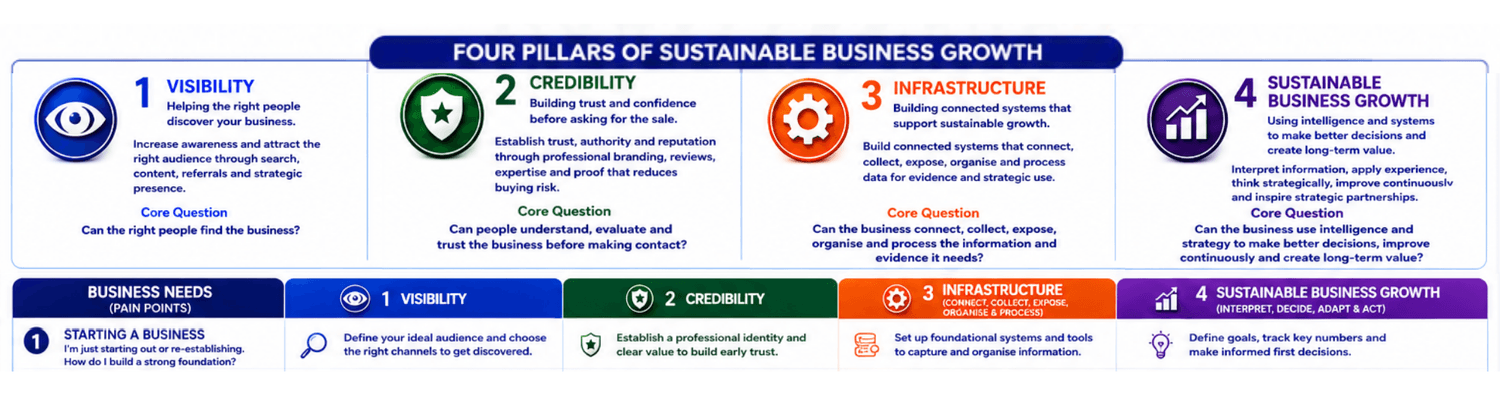

Primary Pillar - Infrastructure
What Connects, Collects, Supports, Organizes, Monitor, Sustains and Inspires Activity
Lead magnets part of a larger business system and so businesses typically encounter the need for lead magnets after they have already started attracting attention. It does not only strengthen Visibility, or Credibility but, it also stengthens Business Infrastructure.
Supporting Pillars: Visibility • Infrastructure • Growth
A website may be receiving visitors.
Google Search may be generating traffic.
Social media may be creating interest.
Advertising may be sending people to the website.
Referrals may be introducing potential customers.
But attention does not automatically become a lead.
A visitor can be interested without being ready to buy.
A lead magnet creates another possible step between interest and enquiry.
This creates an important progression:
Visibility → Interest → Lead Capture → Follow-Up → Opportunity → Customer
The lead magnet therefore sits between attracting attention and developing a business relationship.
It also prepares the business for later stages of growth.
Once a business begins generating identifiable leads, it needs systems to store, manage, qualify and follow up with those opportunities.
That is where Leads begins connecting with Infrastructure.
And when those systems become repeatable and measurable, they contribute to Growth.
What Is a Lead Magnet?
A lead magnet is a useful resource, offer or incentive that a business provides to a potential customer in exchange for contact information or another appropriate form of identification.
The purpose is to turn some anonymous interest into an identifiable business opportunity.
For example, imagine a small accounting firm.
Someone searches online for help managing their business finances.
They visit the accounting firm's website but are not yet ready to book a consultation.
Instead of giving that visitor only the option to contact the firm, the website could offer:
"Small Business Financial Records Checklist."
The visitor finds the resource useful and provides their email address to receive it.
The accounting firm now knows that someone has demonstrated interest in a problem related to its services.
That person is not automatically a customer.
They are not even necessarily a highly qualified prospect.
But they have moved from being an anonymous visitor to an identifiable lead.
That distinction is important.
A lead magnet creates an opportunity to continue a relationship. It does not guarantee a sale.
Why Do Businesses Need Lead Magnets?
The traditional website conversion model often looks like this:
Visitor → Contact Us → Enquiry
That can work.
But it assumes the visitor is ready to take a relatively significant step.
Many people are not.
A potential customer might think:
"I am still researching."
"I want to understand this problem first."
"I need to compare a few businesses."
"I am not ready to speak to someone yet."
"I need more information before I decide."
"I want to know what questions I should ask."
A lead magnet gives that person another option.
Instead of asking them to immediately become a customer, the business can offer something that helps them make progress.
Why This Matters:
Imagine someone searching for a new website for their business.
They know their current website is outdated, but they are not ready to request a quote.
A resource such as:
"10-Point Small Business Website Readiness Checklist"
could provide useful information while creating an opportunity for the business to continue the relationship.
The visitor gets something useful.
The business gets an identifiable lead.
Both sides gain value.
Lead Magnet vs Freebie
Not everything that is free is a lead magnet.
A business can give away a discount, PDF, video or promotional item without having a clear lead-generation purpose.
The difference is strategic.
Freebie Lead Magnet May simply be given away Designed to create an identifiable lead Can appeal to a broad audience Usually targets a defined customer May have little connection to the buying journey Connected to a relevant customer problem Can focus primarily on giving something away Provides value while creating a next step May have no follow-up process Can connect to a structured follow-up journey
A lead magnet should therefore not be created simply because the business thinks it needs to "offer something free."
The better question is:
What useful first step could we give the right potential customer?
That question produces much stronger lead magnets.
What Makes a Good Lead Magnet?
A good lead magnet does not need to be complicated.
It needs to be relevant.
Relevant:
The resource should address a problem the target customer actually has.
A website design company probably should not create a generic recipe book simply because people like recipes.
It may generate downloads.
But those downloads are unlikely to represent the company's ideal customers.
A website checklist would be much more relevant.
Specific:
A strong lead magnet usually solves one clearly defined problem.
Compare:
"The Complete Guide to Business Success"
with:
"Small Business Website Launch Checklist."
The second is easier to understand and easier to use.
Specificity also helps attract people with a particular need.
Useful:
The customer should receive genuine value.
A lead magnet should not contain three pages of promotional material disguised as a guide.
The customer should be able to use the resource and feel that the business has helped them.
That experience can become an important early signal of expertise.
Easy to Consume:
A resource does not necessarily become more valuable because it becomes longer.
A five-page checklist that helps someone complete an important task may be more useful than a 70-page ebook that nobody finishes.
The format should suit the problem.
Credible:
The quality of the lead magnet reflects the quality of the thinking behind the business.
If the resource contains outdated, generic or inaccurate information, it can weaken credibility rather than strengthen it.
Connected to the Business:
The lead magnet should relate naturally to the problems the business solves.
This creates a logical progression:
Problem → Lead Magnet → Business Solution
The connection should be useful rather than forced.
Actionable:
A good resource should help the customer do something.
It may help them:
Identify a problem.
Prepare for a decision.
Complete a task.
Evaluate their current situation.
Understand their options.
Plan their next step.
The objective is to create useful progress.
A Lead Magnet Should Solve a Small Problem
One of the biggest mistakes businesses make is trying to create a resource that solves everything.
They begin with:
"Let's create a huge ebook."
The result can be a long document that takes months to produce and is difficult for customers to consume.
A better approach is often to identify a smaller problem.
For example:
"How do I know whether my website is ready to generate enquiries?"
could become:
Website Readiness Checklist
Or:
"What information should I prepare before creating a Google Business Profile?"
could become:
Google Business Profile Readiness Checklist
The lead magnet does not need to solve the customer's entire business problem.
It needs to create a useful first step.
Solve one meaningful problem well rather than attempting to solve every problem at once.
This also makes the relationship with the business's paid services more natural.
If the resource helps the customer identify a problem, the business may then be able to help solve the larger problem.
Types of Lead Magnets
There is no single format that works for every business.
The right format depends on the customer, the problem and the type of business.
Checklists
Checklists work well when customers need to complete a series of tasks.
Examples:
Website Launch Checklist
Business Startup Checklist
Google Business Profile Checklist
Local SEO Checklist
They are simple, practical and easy to consume.
Guides
Guides are useful when customers need to understand a topic before making a decision.
Examples:
Small Business Website Guide
Local SEO Guide
Business Branding Guide
First-Time Business Owner Guide
Templates
Templates can save customers time.
Examples:
Email Template
Business Proposal Template
Lead Follow-Up Template
Social Media Planning Template
Worksheets
Worksheets are useful when customers need to think through a decision.
Examples:
Brand Positioning Worksheet
Business Planning Worksheet
Customer Profile Worksheet
Lead Magnet Planning Worksheet
Calculators
Calculators can be valuable when a customer needs to estimate or compare something.
For example:
Website investment calculator
Advertising budget calculator
Lead-generation cost calculator
The calculator should provide genuine value rather than simply collecting information.
Assessments
An assessment can help a potential customer identify weaknesses or opportunities.
Examples:
Website Audit
Local Visibility Assessment
Business Readiness Assessment
Lead Generation Assessment
Assessments can be particularly useful for professional services because the assessment naturally introduces a business problem.
Reports
Reports can provide research, analysis or industry insight.
For example:
"Small Business Digital Visibility Report."
Reports can help position a business as knowledgeable while giving potential customers useful information.
Resource Libraries
Instead of offering one resource, a business may eventually create a collection of related resources.
For example:
Small Business Growth Resource Library
could contain:
Website checklist
Branding worksheet
Local SEO checklist
Lead-generation guide
Business visibility planner
This can become a larger knowledge asset over time.
Consultations
For some professional services, the lead magnet may be an initial consultation, assessment or discovery session.
This is particularly relevant where the customer's situation needs to be understood before a solution can be recommended.
Quotes and Estimates
For certain service businesses, a free quote or estimate can act as a lead-generation mechanism.
The important point is that the value exchange should make sense for the customer's stage in the buying process.
Lead Magnet Examples by Business Type
Different businesses can use very different lead magnets.
Accountant:
Small Business Financial Records Checklist
The resource helps business owners identify whether their financial records are organised.
Web Design Company:
Website Launch Readiness Checklist
The resource helps a business prepare before beginning a website project.
Marketing Agency:
Local Business Visibility Audit
The resource helps a business identify gaps in its online visibility.
Plumber:
Home Plumbing Maintenance Checklist
The resource helps homeowners identify routine maintenance tasks.
Estate Agent:
First-Time Home Seller Checklist
The resource helps sellers understand the preparation involved before listing a property.
Construction Company:
Building Project Preparation Guide
The resource helps potential clients understand what information and decisions are required before starting a project.
Business Consultant:
Small Business Growth Readiness Assessment
The resource helps owners identify weaknesses that may limit future growth.
The lesson is simple:
The best lead magnet is usually connected to a problem the business already knows how to solve.
How to Choose the Right Lead Magnet
Before creating a resource, answer seven questions.
1. Who is it for?
Define the customer.
2. What problem are they experiencing?
Identify a genuine problem rather than an invented marketing problem.
3. What are they searching for?
Look at the questions customers ask, the topics they research and the problems they repeatedly mention.
4. What can the business help them understand?
The lead magnet should reflect genuine knowledge.
5. What small problem can the resource solve?
Keep the scope manageable.
6. What business service does that problem naturally connect to?
The connection should make sense to the customer.
7. What should happen after they receive it?
A lead magnet needs a next step.
That might be:
Reading another article.
Booking a consultation.
Requesting a quote.
Viewing a service.
Receiving additional educational information.
This makes the lead magnet part of a customer journey rather than an isolated download.
Lead Magnet and the Customer Journey
A lead magnet normally sits within a broader journey.
A simplified example looks like this:
Search / Social / Referral / Advertising
↓
Website or Landing Page
↓
Lead Magnet
↓
Contact Information
↓
Follow-Up
↓
Sales Conversation
↓
Customer
Each stage performs a different function.
Visibility attracts attention.
The website provides information.
The lead magnet creates a lower-friction conversion opportunity.
The follow-up process continues the relationship.
The sales process determines whether there is a genuine business opportunity.
The lead magnet is therefore a bridge between interest and relationship.
When You Don't Need a Lead Magnet
A lead magnet can be useful, but not every business needs one.
Sometimes the simplest conversion path is the best one.
If a customer is already ready to buy, asking them to download a guide before they can contact the business may create unnecessary friction.
For example, imagine someone searches for:
"Emergency plumber near me."
That person may not want a plumbing checklist.
They may simply want a plumber who can respond immediately.
In that situation, the primary conversion action should probably be:
Call Now
rather than:
Download Our Plumbing Guide
The same principle applies to many service businesses.
A customer searching for:
"Get a quote for commercial cleaning"
"Book an accountant consultation"
"Buy a R200 product"
"Request a building estimate"
"Schedule a repair"
may already have sufficient intent to take a direct action.
A lead magnet is most useful when there is a gap between interest and readiness to buy.
If that gap does not exist, adding another step may actually reduce conversion.
Situations Where a Lead Magnet May Not Be Necessary
A business may not need a lead magnet when:
Customers typically make quick purchasing decisions.
The product is inexpensive and easy to understand.
The primary conversion is already straightforward.
Customers usually contact the business directly.
The buying process is highly urgent.
There is little need for education before purchase.
The business does not yet have a reliable follow-up system.
This last point is particularly important.
A business should not create a lead magnet simply because "every business needs one."
If the business cannot properly capture, manage and follow up with the leads it already receives, adding more leads may create more problems rather than solving them.
The Better Question:
Instead of asking:
"Do we need a lead magnet?"
ask:
"Is there a meaningful group of potential customers who are interested but not yet ready to take our primary conversion action?"
If the answer is yes, a lead magnet may be appropriate.
If the answer is no, a simpler conversion path may be better.
The purpose of a lead magnet is not to add another step. It is to create the right next step for the right customer.
What Information Should You Ask For?
A business needs to decide what information is appropriate in exchange for the resource.
Possible information includes:
Name
Email address
Phone number
Company name
Business size
Service interest
But more information is not automatically better.
Every additional field can create additional friction.
A visitor may happily provide an email address for a checklist but hesitate when asked for:
Full name
Phone number
Company size
Annual revenue
Industry
Address
Several other personal details
The amount of information requested should therefore match the value of the exchange and the customer's stage.
Ask for enough information to support the next step, not enough information to discourage the first step.
Lead Magnet Quality vs Lead Quantity
This is one of the most important concepts in lead generation.
A lead magnet can generate hundreds of downloads and still produce very little business value.
Why?
Because downloads are not customers.
And not every person who downloads a resource is a good fit for the business.
The objective is not simply:
More leads.
It is:
More relevant leads.
Consider two lead magnets.
Lead Magnet A:
"Free Business Growth Ebook"
It receives 1,000 downloads.
But the audience is broad.
Some are students.
Some are hobbyists.
Some are people looking for employment.
Some are business owners.
Only a small percentage are suitable prospects.
Lead Magnet B:
"Small Business Website Conversion Checklist"
It receives 150 downloads.
But most of the people downloading it are business owners who already have a website and are concerned about generating more enquiries.
The second resource generated fewer leads.
But those leads may be significantly more valuable.
This is why businesses should measure more than downloads.
Consider:
Relevance
Customer fit
Problem alignment
Buying intent
Engagement
Follow-up response
Qualified opportunities
Customers generated
A smaller number of highly relevant leads can be more valuable than a large number of poorly matched leads.
Lead Quality vs Lead Quantity: A Practical Example
A Practical Example: Why Lead Quality Matters More Than Lead Volume
Consider two businesses selling the same type of professional service.
Both businesses create a lead magnet.
Business A: High Volume
Business A creates a broad resource called:
"The Ultimate Small Business Growth Guide."
The resource receives:
1,000 downloads.
At first, the result looks impressive.
But when the business reviews the leads, it discovers that:
Many are outside its target market.
Some are students.
Some are researching rather than buying.
Some are interested in services the business does not provide.
Very few have an immediate need for the company's services.
The business generated a lot of leads.
But relatively few represent genuine opportunities.
Business B: Lower Volume
Business B creates a much more specific resource:
"Small Business Website Conversion Checklist."
It receives:
150 downloads.
The number looks considerably smaller.
However, most of the people downloading the resource:
Own businesses.
Already have websites.
Are experiencing website-performance concerns.
Are actively researching ways to improve enquiries.
Fit the company's target market.
Have a problem the business can actually help solve.
Business B generated fewer leads.
But the leads are more closely aligned with its services.
The Important Difference
Imagine that Business A turns only 1% of its downloads into qualified opportunities.
That produces:
10 qualified opportunities.
Business B converts 15% of its downloads into qualified opportunities.
That produces:
22.5 qualified opportunities.
Business B generated dramatically fewer downloads but potentially more valuable opportunities.
The exact percentages will vary from business to business.
The principle remains:
Lead volume is an activity metric.
Lead quality is a business-value metric.
This is why businesses should avoid judging a lead magnet solely by the number of people who download it.
A better evaluation considers:
How closely the leads match the target customer.
Whether they have a relevant problem.
Whether they engage with follow-up.
Whether they become qualified opportunities.
Whether they eventually become customers.
What revenue or business value those customers create.
What This Means for Growth4biz
This distinction also changes how a business should think about optimisation.
If a lead magnet generates many downloads but very few qualified opportunities, the answer is not necessarily to generate even more downloads.
The business may need to examine:
The audience being targeted.
The problem addressed by the resource.
The messaging around the offer.
The information requested during lead capture.
The follow-up process.
The qualification process.
The relationship between the lead magnet and the underlying service.
In other words, the business should optimise the quality of the system, not simply the size of the number.
That creates a more useful progression:
Traffic → Leads → Qualified Leads → Opportunities → Customers → Revenue
Each stage tells the business something different.
The objective is not to maximise one number in isolation.
The objective is to build a system that produces increasingly valuable outcomes.
Why This Matters
A business can become distracted by impressive-looking marketing numbers.
10,000 visitors sounds better than 1,000.
1,000 downloads sounds better than 100.
100 leads sounds better than 20.
But if those numbers do not produce relevant opportunities, they may not contribute meaningfully to growth.
A smaller, more relevant audience can sometimes be far more valuable than a large audience with little connection to the business.
That is why quality should be considered alongside quantity from the beginning of the lead-generation process.
Lead Magnet vs Other Calls to Action
A lead magnet is only one type of conversion opportunity.
Businesses often make the mistake of assuming that every visitor should be directed toward the same action.
But different customers have different levels of intent.
Someone who is ready to purchase may want a quote.
Someone who is still researching may prefer a guide.
Someone who wants expert advice may prefer a consultation.
Someone who wants to test a product may prefer a trial.
The conversion action should therefore match the customer's stage.
Conversion Option Best Suited To Customer Commitment Primary Purpose Lead Magnet Researchers and early-stage prospects Low Capture interest Quote Request Customers considering a specific purchase Medium Create a sales opportunity Consultation Customers with a complex problem Medium to High Understand needs and qualify Free Trial Customers wanting to experience a product Medium Demonstrate value Direct Purchase Customers ready to buy High Complete the transaction Contact / Enquiry Customers needing information Low to Medium Start a conversation
The table highlights an important principle:
There is no universally best call to action.
The right action depends on what the customer is trying to accomplish and how much commitment the business is asking for.
Low-Commitment vs High-Commitment Actions
A lead magnet is generally a relatively low-commitment action.
The customer may provide an email address in exchange for a useful resource.
A consultation requires considerably more commitment.
A purchase requires even more.
This means businesses should be careful about creating unnecessary friction.
For example, a R100 product may not need a complicated five-stage qualification process.
A R20,000 professional service may justify a more considered journey where the business gathers additional information before a sales conversation.
The objective is not to make every funnel longer.
It is to create enough structure to support the decision being made.
The Growth4biz Principle
A useful way to think about this is:
Customer Intent + Offer Value + Required Commitment = Appropriate Conversion Path
The higher the complexity, risk or value of the decision, the more information and qualification may reasonably be required.
But additional steps should have a purpose.
Every extra page, form field, question or interaction introduces friction.
That friction should therefore help the customer or the business make a better decision.
Good conversion design does not maximise the number of steps.
It creates the appropriate number of steps for the decision being made.
Lead Magnets and Credibility
A lead magnet is also an opportunity for a business to demonstrate what it knows.
Before buying a service, a potential customer may experience the business through:
Articles.
Guides.
Checklists.
Videos.
Reports.
Assessments.
Email communication.
A useful lead magnet can demonstrate expertise before the sales conversation begins.
This creates a potential progression:
Knowledge → Value → Confidence → Trust
But the lead magnet does not automatically create trust.
The resource needs to be useful.
The information needs to be credible.
The business needs to communicate professionally.
And the eventual customer experience needs to support the expectations created.
Related Read:
How to Build Trust Online: A Practical Guide for Small Businesses
Lead Magnets and Infrastructure
A lead magnet may look like a simple document from the customer's perspective.
Behind the scenes, however, it can require several systems.
These may include:
Website or landing page.
Form.
Email delivery.
CRM.
Lead database.
Notifications.
Follow-up communication.
Sales process.
Reporting.
Consider what happens when someone downloads a resource.
The form works.
The customer receives the resource.
But nobody inside the business is notified.
The lead sits in a database.
Nobody follows up.
The opportunity disappears.
The lead magnet technically worked.
The lead-generation system did not.
This is why:
Lead generation without lead management is incomplete lead generation.
As the number of leads increases, infrastructure becomes increasingly important.
Lead Magnet and Landing Pages
A lead magnet needs a clear place where the customer can understand the offer and take action.
This may be a landing page or a dedicated section of a website.
The page normally needs to communicate:
The problem.
The value of the resource.
Who it is for.
What the customer will receive.
What action they need to take.
The lead magnet and landing page therefore work together.
The lead magnet is the value being offered.
The landing page is the environment in which the offer is presented.
Lead Magnets and Website Conversion
A lead magnet is one possible conversion mechanism.
A website may provide several different ways for visitors to take the next step:
Contact the business.
Call.
Book a consultation.
Request a quote.
Download a resource.
Register for an event.
Start a conversation.
Different visitors may need different conversion options.
Someone who is ready to buy may want a quotation.
Someone who is still researching may prefer a guide.
Someone who needs help understanding their situation may prefer an assessment.
This is why lead magnets can contribute to a broader website conversion strategy.
The next stage of this topic is:
Article: How to Improve Website Conversion Rates
Lead Magnet Frequency and Content Strategy
A business does not necessarily need dozens of lead magnets.
In many cases, one strong resource can support a substantial amount of content.
For example:
Lead Magnet
Local Business Visibility Checklist
Supporting Content
Local SEO Guide.
Google Business Profile Guide.
Website Visibility Guide.
Business Directory Guide.
Google Maps Visibility Guide.
Each article can educate the reader.
Each can naturally point toward the same resource.
This creates a connected content ecosystem.
Instead of creating a new lead magnet for every article, the business can build useful content around meaningful customer problems and connect those content assets to appropriate conversion opportunities.
This can make the knowledge base easier to manage and the customer journey easier to understand.
Digital Protection and Long-Term Considerations
A lead magnet is a business asset.
It should therefore be protected and maintained like other digital business assets.
Consider:
Who owns the source file?
The business should retain access to the original resource.
Where is it stored?
Important files should not exist only on one person's computer.
Who controls the landing page?
The business should retain appropriate ownership and access.
Who controls the email system?
The business should know where leads are being captured and managed.
Who owns the lead database?
Lead information is an important business asset and should be managed responsibly.
Are the links working?
A lead magnet becomes useless when the download link breaks.
Is the information still accurate?
Outdated information can damage credibility.
Does the delivery process still work?
Forms, emails and automation should be reviewed periodically.
A lead-generation asset should not depend entirely on one employee's personal account or memory.
This becomes increasingly important as a business grows.
Benefits of Lead Magnets
A well-designed lead magnet can provide several benefits:
Capture otherwise lost opportunities
Create lower-friction conversion opportunities
Demonstrate expertise
Build a prospect database
Support follow-up
Create additional website conversion opportunities
Help identify customer interests
Create measurable lead-generation activity
Connect educational content to business outcomes
Support scalable lead generation
Capture Otherwise Lost Opportunities
Some visitors will not contact a business immediately.
A lead magnet gives them another way to engage.
Create Lower-Friction Conversions
Downloading a checklist can feel like a smaller commitment than booking a sales call.
This can make it easier for interested visitors to take their first step.
Demonstrate Expertise
A useful resource allows the business to demonstrate knowledge before the customer makes a purchase.
Build a Prospect Database
When appropriate and handled responsibly, lead capture allows the business to develop an identifiable audience that can receive relevant follow-up communication.
Support Follow-Up
Once someone has voluntarily entered the lead-generation process, the business can provide useful follow-up information and guide them toward appropriate next steps.
Improve Website Conversion Opportunities
Not every visitor wants to make contact immediately.
A lead magnet provides another conversion path.
Identify Customer Interests
The resource someone chooses can provide useful insight into the problem they are trying to solve.
For example, someone downloading a website conversion checklist has demonstrated interest in website performance.
Create Measurable Lead Generation
A business can track:
Downloads.
Conversion rates.
Qualified leads.
Follow-up engagement.
Sales opportunities.
This creates greater visibility into the lead-generation process.
Connect Content to Business Outcomes
Articles and educational resources can lead naturally toward lead magnets, which can then lead toward enquiries and sales conversations.
This connects content marketing to measurable business activity.
Common Lead Magnet Mistakes
Creating Something Nobody Wants
Businesses sometimes create resources based on what they think customers should want.
Why it happens:
The business starts with its own ideas rather than customer problems.
Why it causes problems:
A well-designed resource can still fail if nobody finds it relevant.
How to avoid it:
Start with genuine customer questions, problems and search behaviour.
Making the Lead Magnet Too Broad
A business may attempt to create the ultimate guide to an entire industry.
Why it happens:
The business wants to demonstrate everything it knows.
Why it causes problems:
The resource becomes difficult to consume and difficult to position.
How to avoid it:
Solve one clearly defined problem.
Creating a Resource With No Connection to the Business
A resource can attract large numbers of people but have little commercial relevance.
Why it happens:
The business focuses on downloads rather than customer fit.
Why it causes problems:
The business generates activity without generating useful opportunities.
How to avoid it:
Choose a problem that connects naturally to the services the business provides.
Asking for Too Much Information
A form can become unnecessarily complicated.
Why it happens:
The business wants as much information as possible.
Why it causes problems:
Potential leads may abandon the form.
How to avoid it:
Ask only for information that supports the next appropriate step.
Making the Resource Too Promotional
A lead magnet that is essentially a sales brochure may frustrate customers.
Why it happens:
The business sees the lead magnet primarily as a sales tool.
Why it causes problems:
The customer expected useful information and instead receives a sales pitch.
How to avoid it:
Provide genuine value first.
Creating the Lead Magnet Without a Follow-Up System
The business captures the lead but does not know what happens next.
Why it happens:
The resource is treated as the finished product.
Why it causes problems:
Potential opportunities can disappear.
How to avoid it:
Design the follow-up journey before launching the lead magnet.
Focusing on Downloads Instead of Qualified Leads
A large download number can look impressive.
Why it happens:
Downloads are easy to count.
Why it causes problems:
They do not necessarily represent business opportunities.
How to avoid it:
Measure lead quality and eventual business outcomes as well as downloads.
Never Updating the Lead Magnet
A resource can become outdated.
Why it happens:
The business creates the resource once and forgets about it.
Why it causes problems:
Old information can reduce usefulness and credibility.
How to avoid it:
Review important resources periodically.
Making the Lead Magnet Difficult to Access
Broken links, complicated forms and poor delivery systems create unnecessary friction.
Why it happens:
The business focuses on creating the resource but not the delivery experience.
Why it causes problems:
The customer may never receive what they were promised.
How to avoid it:
Test the complete customer journey from the initial click through to delivery.
Creating Too Many Lead Magnets
More resources do not automatically mean better lead generation.
Why it happens:
Businesses assume they need a separate resource for every topic.
Why it causes problems:
It creates unnecessary maintenance and can fragment the customer journey.
How to avoid it:
Create strong resources around meaningful customer problems and connect multiple content assets to them where appropriate.
Practical Tips / Best Practices
The easiest way to create a useful lead magnet is to work from the customer problem outward.
1. Define the Target Customer
Know who the resource is intended for.
2. Identify One Meaningful Problem
Choose a problem the customer genuinely wants to solve.
3. Choose the Appropriate Format
Decide whether the problem is best addressed through a checklist, guide, worksheet, template, assessment, calculator or another format.
4. Create the Resource
Focus on usefulness rather than unnecessary length.
5. Make It Genuinely Valuable
The customer should be able to use it immediately.
6. Create a Clear Conversion Path
Make it obvious how the customer receives the resource.
7. Keep the Form Appropriate
Do not create unnecessary friction.
8. Connect It to Lead Management
Make sure captured leads enter the appropriate business system.
9. Automate Delivery Where Appropriate
Customers should receive what was promised reliably.
10. Create a Follow-Up Process
Decide what happens after the resource is delivered.
11. Measure More Than Downloads
Track lead quality, engagement and business outcomes.
12. Improve the Resource
Use customer feedback and performance data to make it more useful.
13. Review It Periodically
Make sure the information remains accurate.
14. Connect Related Content
Use relevant articles and website content to create multiple pathways toward the resource.
15. Make the Next Business Step Clear
The customer should understand what they can do next if they need additional help.
Lead Magnet Audit
A simple audit can help determine whether an existing lead magnet is actually performing its intended role.
Audience
Is the target customer clearly defined?
Would the intended customer consider this resource relevant?
Problem
Does it solve a genuine problem?
Is the problem specific enough?
Value
Is the resource genuinely useful?
Can the customer take action based on it?
Relevance
Does the problem connect naturally to the business's services?
Is the resource attracting the right type of prospect?
Conversion
Is the resource easy to access?
Is the form appropriate for the offer?
Infrastructure
Does delivery work?
Are leads being captured correctly?
Does the appropriate person or system receive the information?
Follow-Up
Is there a clear next step?
Does the business have an appropriate follow-up process?
Measurement
Are downloads being measured?
Is lead quality being measured?
Are qualified opportunities being tracked?
Credibility
Does the resource demonstrate genuine expertise?
Is the information accurate and current?
A lead magnet audit should therefore look beyond the document itself.
The real question is:
Is this resource attracting the right people and helping move them toward an appropriate next step?
Frequently Asked Questions:
A lead magnet is a useful resource, offer or incentive that a business provides to a potential customer in exchange for contact information or another appropriate form of identification.
The purpose is to create an identifiable relationship with a potential customer who may not yet be ready to make a purchase or enquiry.
Common examples include checklists, guides, templates, worksheets, calculators, assessments, reports, resource libraries, consultations and quotes.
A good lead magnet is relevant, specific, useful, credible, easy to consume and connected to a genuine customer problem.
Not every small business needs one immediately. But a lead magnet can be valuable when a business receives interested visitors who are not yet ready to make direct contact.
Offer something that solves a small but meaningful problem for the customers your business wants to attract. The best format depends on the problem and the business.
Usually, yes. The lead magnet is generally offered as a free value exchange for contact information or another appropriate next step.
Collect only the information needed to support the next stage of the customer journey. The more information you request, the more friction you may create.
A lead magnet can be promoted through website content, search traffic, social media, email, advertising, referrals and other relevant customer touchpoints.
It can appear on relevant website pages, articles, landing pages, social media campaigns and other places where the intended audience is already engaging with the business.
There is no universal number. One strong, relevant lead magnet can be more valuable than many poorly targeted resources. Businesses should create resources around meaningful customer problems rather than chasing quantity.
They can contribute to customer generation, but a lead magnet does not guarantee a sale. The business still needs appropriate follow-up, qualification, sales processes and customer experience.
A freebie is simply something given away. A lead magnet is designed strategically to provide value while creating an opportunity to identify and continue a relationship with a potential customer.
Not always. A lead magnet can be offered through a website page or another channel. However, a dedicated landing page can be useful when the business needs to present the offer and conversion opportunity clearly.
Ideally, the customer receives the promised resource and enters an appropriate follow-up journey. The next step might involve additional educational content, an assessment, consultation, quote or another relevant business opportunity.
No. The level of friction should match the level of commitment being requested.
A low-cost, low-commitment offer may benefit from a simple process.
A high-value service may justify more information, qualification or interaction before the customer reaches the sales stage.
The goal is to balance conversion efficiency with lead quality.
Final Thoughts
A lead magnet is easy to misunderstand.
It can look like a PDF, checklist or downloadable resource.
But strategically, it is much more than that.
A lead magnet creates a potential bridge between someone who is interested in a problem and a business that may be able to help solve it.
That makes it part of the larger Leads stage of the Growth4biz Framework™.
Visibility creates attention.
The lead magnet creates an opportunity to capture interest.
Infrastructure manages the lead.
Follow-up develops the relationship.
Sales converts the opportunity.
Growth comes from building the system consistently.
The objective is therefore not to collect the largest possible number of email addresses.
It is to attract people who have a meaningful relationship with the problem the business solves.
That is why lead quality matters.
A resource downloaded by 1,000 irrelevant people may be less valuable than a resource downloaded by 100 highly relevant potential customers.
It is also why the lead-capture process should match the offer.
A low-commitment offer does not necessarily need a complicated journey.
A high-value service may require more information, qualification and interaction.
The right system balances the customer's experience with the business's need to identify and qualify genuine opportunities.
Most importantly, a lead magnet should provide genuine value.
It should help the customer understand something, solve something, prepare for something or take a useful first step.
A lead magnet should not simply collect contact details.
It should create a useful first step in the relationship between a potential customer and the business.
Once a business understands that principle, lead magnets become easier to design strategically.
The next question becomes:
How should that lead magnet be presented so that the right visitor understands its value and takes action?
Continue Your Growth Journey
Related Articles
Coming Soon:
Landing Page Guide
How to Improve Website Conversion Rates
Related Downloads
Lead Magnet Planning Checklist (Coming Soon)
Lead Magnet Audit Checklist (Coming Soon)
Related Checklists
Lead Magnet Creation Checklist (Coming Soon)
Lead Capture System Checklist (Coming Soon)
Related Worksheets
Lead Magnet Planning Worksheet (Coming Soon)
Customer Problem Identification Worksheet (Coming Soon)
Business Need
Primary Pillar
Supporting Pillars
Visibility
Infrastructure
Growth
Book a Consultation
Many businesses attract attention but struggle to turn that attention into identifiable, relevant opportunities.
A lead magnet can provide a useful first step, but it needs to be connected to the broader lead-generation system.
Growth4biz Media helps businesses develop the systems that connect website content, lead magnets, landing pages, lead capture, follow-up and customer journeys into a more structured approach to generating business opportunities.
If your business is attracting visitors but too few are taking the next step, a consultation can help identify where the gaps exist and what should be improved.
Book a consultation and let's build a lead-generation system that turns more of your existing attention into genuine business opportunities.
SHARE




ABOUT
Growth4biz Media is a Digital Business Infrastructure Agency helping businesses establish, strengthen and evolve the digital capabilities that support how they operate, communicate, connect with people and grow.
We do more than keep websites alive or help people monetise their intellectual property or expertise. We are helping businesses keep their digital capabilities relevant and useful as their operating environments change.
Copyright 2026 • Growth4biz Media (Pty) Ltd.