What Is Lead Generation? A Practical Guide for Businesses
Introduction
A business can have a good product, a professional website and a service that genuinely helps people — and still struggle to generate enough business.
The owner may post regularly on social media.
They may run advertisements.
They may attend networking events.
They may ask existing customers for referrals.
They may even receive website visitors every day.
But when the owner looks at the actual results, there may be very few enquiries.
Or the enquiries arrive inconsistently.
One week is busy.
The next week is quiet.
Then the owner starts asking:
"Where are my customers coming from?"
This is one of the most important questions a growing business can ask.
Many businesses think lead generation simply means advertising or getting more people to see the business.
Others confuse lead generation with marketing or sales.
And some businesses believe that generating more leads automatically means generating more customers.
It does not.
Lead generation is about creating opportunities for potential customers to enter a business's sales and relationship-building process.
As businesses develop, the way they generate those opportunities also changes.
What once depended heavily on personal relationships, referrals, cold calling, networking and physical advertising can now involve websites, search engines, social media, content, email, paid advertising, automation, customer relationship systems and other digital infrastructure.
The biggest shift, however, is not simply from offline to online.
It is from manually generating opportunities to building systems that can generate opportunities repeatedly.
That distinction matters.
A business owner who has to personally perform every lead-generation activity every day has created activity.
A business that builds assets, systems and processes that continue creating opportunities has begun building infrastructure for growth.
This leads to an important Growth4biz principle:
Lead generation is not simply about getting more people to notice your business.
It is about building a repeatable system that creates, captures and manages business opportunities.
And ultimately, the objective is not just more leads.
The objective is sustainable growth.
Your Position in the Growth4biz Framework™
I get some interest but not enough qualified leads consistently.
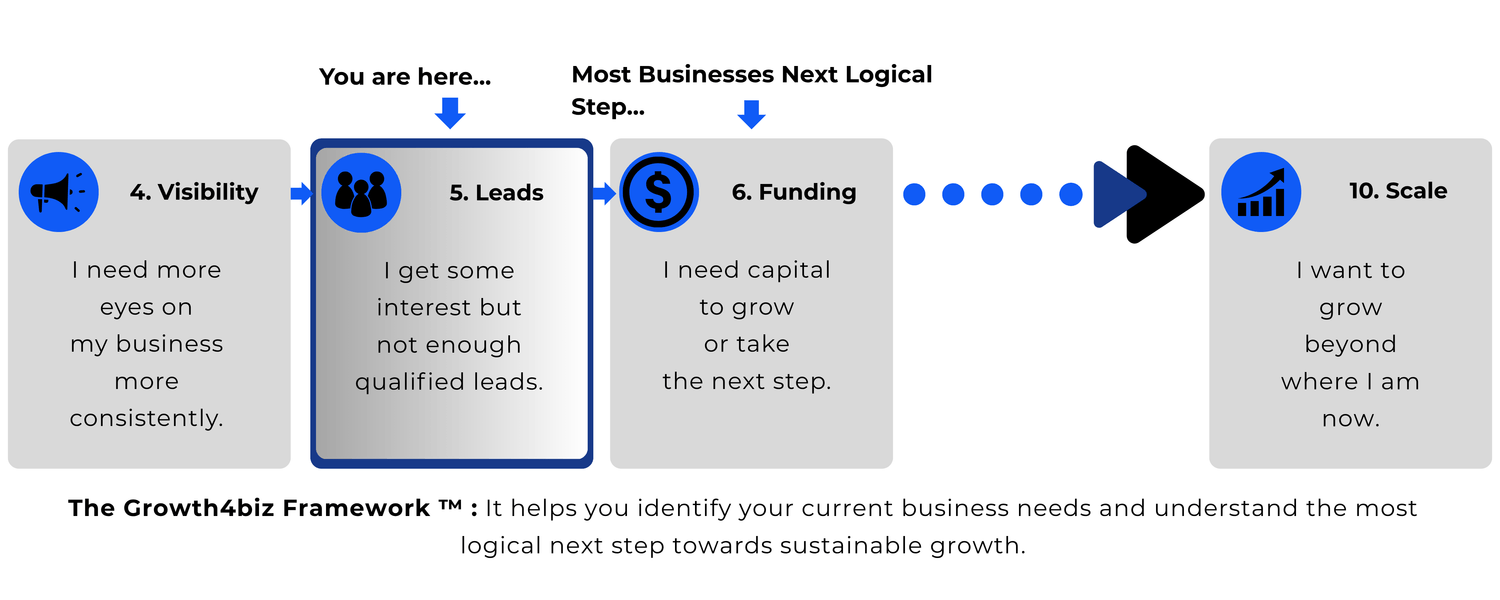

Primary Pillar — Infrastructure
What Connects, Collects, Supports, Organizes, Monitor, Sustains and Inspires Activity
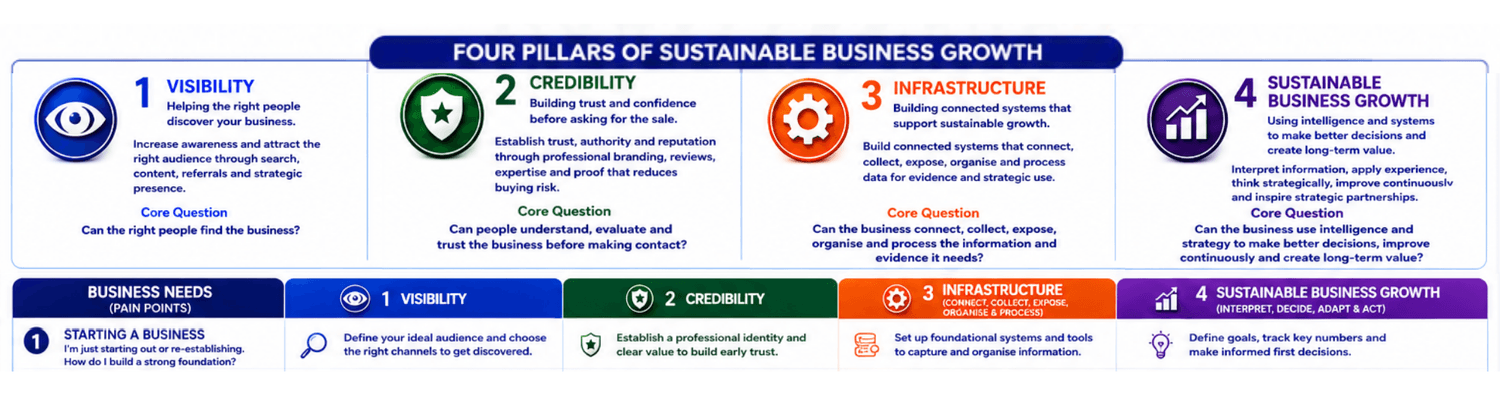
Lead generation connects visibility and credibility to the next stage of the customer journey. The next stages of the customer journey is infrastructure which helps the systems & processes of lead generation become repeatable.
Supporting Pillars: Visibility • Credibility • Growth
Businesses typically encounter the lead-generation challenge after they have begun establishing visibility and credibility.
People may now be able to discover the business.
The business may have a website, social media presence, Google Business Profile, content or other visibility assets.
It may also have reviews, testimonials, experience and other credibility signals.
But another question appears:
How do we turn attention into genuine business opportunities?
This is where lead generation becomes important.
Lead generation connects visibility and credibility to the next stage of the customer journey.
Visibility helps people discover the business.
Credibility helps them evaluate whether the business is worth considering.
Lead generation creates a pathway for interested people to take the next step.
Infrastructure helps that process become repeatable.
And when people remain involved in monitoring, responding, qualifying and improving the system, those activities can contribute to sustainable business growth.
The progression can therefore be understood as:
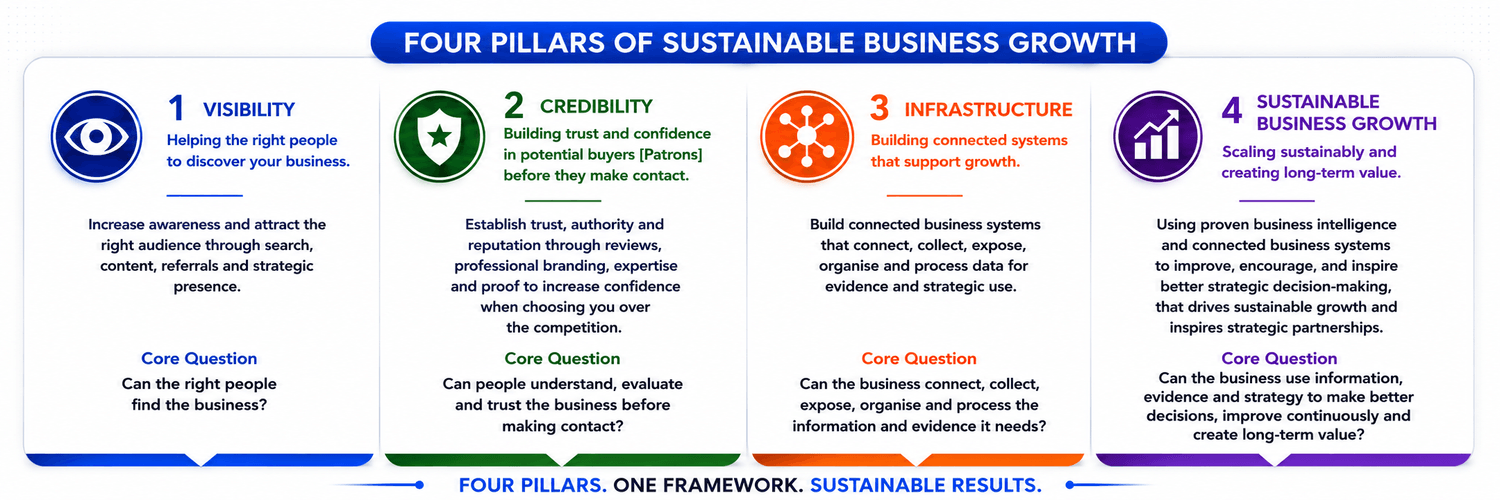
Visibility → Credibility → Infrastructure → Sustainable Growth
Lead generation sits at the point where a business begins turning attention into identifiable opportunities.
What Is Lead Generation?
Lead generation is the process of attracting potential customers and creating opportunities for them to enter into a business relationship or sales process.
A lead is a person or organisation that has demonstrated some level of interest in what a business offers.
That interest might be demonstrated by:
Completing an enquiry form.
Requesting a quotation.
Booking a consultation.
Calling the business.
Sending a message.
Downloading a resource.
Registering for an event.
Subscribing to useful information.
Requesting more information.
The exact definition of a lead can vary between businesses.
A lead for a property company may be someone requesting information about a property.
A lead for an accountant may be a business owner requesting a consultation.
A lead for a construction company may be someone requesting a project quotation.
A lead for an online education business may be someone registering for a webinar or joining an email list.
The common element is that the person has moved beyond simply being an anonymous member of an audience.
They have taken an identifiable action that creates an opportunity for the business to continue the relationship.
Related Read
Lead Generation Is Not the Same as Marketing
Marketing and lead generation are closely connected, but they are not the same thing.
Marketing is the broader process of communicating with a market, building awareness, positioning a business and attracting attention.
Lead generation focuses more specifically on creating identifiable opportunities from that attention.
For example, a business may publish an educational video.
That is marketing.
If someone watches the video and then completes a consultation form, that person may become a lead.
The marketing activity created the opportunity for attention.
The lead-generation process created a pathway for the interested person to identify themselves.
This distinction becomes important because a business can have significant marketing activity without generating many leads.
It can also generate leads through relatively simple marketing activity if the pathway is well designed.
Lead Generation Is Not the Same as Sales
Lead generation creates opportunities.
Sales converts qualified opportunities into customers.
These are connected but different activities.
Consider a building company.
Its marketing may attract a homeowner searching for renovation services.
The lead-generation process may encourage that homeowner to request a consultation.
The sales process then determines:
What the homeowner needs.
Whether the project is suitable.
Whether the budget is realistic.
Whether the company can deliver the project.
What solution should be proposed.
Whether the customer is ready to proceed.
The lead does not become a customer simply because the lead exists.
This is why businesses should not judge lead generation entirely by the number of leads produced.
The quality of those opportunities matters.
The Evolution of Lead Generation
Lead generation did not begin with social media, websites or online forms.
Businesses have always needed ways to identify people who might buy from them.
What has changed is how those opportunities are created, captured, measured and managed.
Rather than focusing on exact historical dates, it is more useful for business owners to understand the major stages in this evolution.
The Relationship and Referral Era
For many businesses, lead generation historically depended heavily on relationships.
A business owner met someone.
A customer recommended the business.
A supplier introduced a potential customer.
A person saw the business operating in their community.
A conversation created an opportunity.
The process was highly personal.
Trust was often established through reputation and relationships.
This approach still works today.
In fact, referrals remain valuable for many businesses.
But the limitation is scale.
The business may only reach as many people as the owner and existing network can reasonably interact with.
The Outbound and Mass-Media Era
As markets expanded, businesses developed ways to reach larger audiences.
Examples included:
Cold calling.
Direct mail.
Newspaper advertising.
Radio.
Television.
Flyers.
Events.
Trade shows.
Printed brochures.
The business increasingly moved from waiting for referrals to actively pursuing attention.
This created a new challenge.
Businesses could reach more people, but reaching people did not necessarily mean knowing who was interested.
A newspaper advertisement could reach thousands of people.
But the business might not know who actually cared about the offer.
This encouraged businesses to develop stronger response mechanisms.
Phone numbers.
Coupons.
Enquiry forms.
Promotional offers.
Call-back requests.
The basic principle was beginning to change:
Do not simply create attention. Create a measurable response.
The Direct-Response Era
Lead generation became increasingly connected to measurable actions.
Instead of asking only:
"How many people saw our advertisement?"
Businesses could begin asking:
"How many people responded?"
This introduced concepts such as:
Response rates.
Enquiries.
Appointments.
Offers.
Campaign tracking.
Customer acquisition costs.
The business could begin connecting marketing activity to actual opportunities.
This was an important development because it moved lead generation closer to a measurable business process.
The Digital Era
The internet changed how businesses could attract and capture potential customers.
Websites became digital business assets.
Email became a direct communication channel.
Search engines allowed customers to actively search for solutions.
Online forms made enquiries easier to capture.
Businesses could publish content that remained available long after it was created.
Instead of relying entirely on physical advertising, a business could begin building digital assets that continued attracting attention.
The customer could:
Search → Visit → Learn → Enquire
This created new possibilities for lead generation.
The Social and Content Era
As social platforms became major distribution channels, businesses gained new ways to publish content and interact with audiences.
Businesses could create:
Videos.
Educational posts.
Live streams.
Tutorials.
Articles.
Podcasts.
Demonstrations.
Case studies.
Community discussions.
The relationship between marketing and lead generation became more interactive.
A person could discover a business through content, engage with it, ask questions and eventually become a lead.
The business was no longer limited to broadcasting a message.
It could participate in an ongoing conversation.
The Automated and System-Driven Era
The next major development is not simply another marketing channel.
It is the ability to connect multiple activities into systems.
A business can now combine:
Long-form content.
Social distribution.
Search visibility.
Landing pages.
Forms.
Email.
CRM systems.
Automation.
Scheduling.
Analytics.
Follow-up processes.
Human support.
The important change is that the business no longer has to manually repeat every activity every time.
Content can be created once.
Systems can distribute it.
Interested people can take action.
Information can be captured.
Automated processes can handle appropriate repetitive tasks.
People can monitor the system and respond where human judgement is required.
This is where lead generation starts becoming infrastructure rather than simply activity or a single tool.
From Manual Lead Generation to System-Driven Lead Generation
Imagine a business owner named Jack.
Jack works a full-time job.
He has a family.
Some weeks he works overtime.
But he also has a side business that he wants to grow.
The problem is that Jack has discovered something that could help his business:
People need to see him go LIVE and hear what he knows before they are likely to trust him enough to enquire.
So Jack decides to create educational video content.
But there is a problem.
He cannot realistically go live for an hour every day.
He cannot spend every evening producing new content.
He cannot constantly be online waiting for someone to ask a question.
If lead generation depends entirely on Jack being physically present, his limited time becomes the limit of the system.
So Jack changes the way he approaches the problem.
He records a substantial piece of content.
Perhaps it is a long educational presentation.
Perhaps it is a previous live session.
Perhaps it is a webinar or detailed training session.
That content becomes a reusable asset.
Jack's Growth4biz Framework™ Approach
Visibility
The content creates visibility.
People can discover the information through the platforms where it is distributed.
Jack no longer has to personally deliver the same presentation every time someone needs to see it.
The content continues doing part of the communication work.
But visibility alone is not enough.
Jack now needs people to believe that the person behind the content is worth listening to.
Credibility
Jack therefore builds credibility around the content.
His social account contains previous content.
People can see that he has been publishing consistently.
There may be an existing audience.
There may be comments, engagement, reviews, examples of his work or other evidence.
A person who encounters Jack's content does not see one isolated video.
They see a broader body of evidence.
The credibility of the platform or account becomes part of the customer's evaluation process.
Again, credibility is not simply a follower count.
Five thousand followers do not automatically make a business trustworthy.
But an established presence, consistent content and genuine evidence can provide more context than an account with no history or supporting information.
Infrastructure
Jack then needs infrastructure.
He uses appropriate technology to help distribute or rebroadcast his content across relevant platforms.
A tool such as OneStream can be an example of this type of infrastructure.
Instead of Jack having to physically appear on every platform every time, technology can help distribute content according to the system he has established.
Other infrastructure may include:
Internet connectivity.
Content storage.
Landing pages.
Forms.
Email systems.
CRM systems.
Automation.
Scheduling.
Analytics.
The technology is not the strategy.
It supports the strategy.
Sustainable Growth
Now the system has another important requirement.
Jack cannot simply disappear.
People may comment.
They may ask questions.
They may want more information.
They may need clarification.
They may become ready to enquire.
This is where the human element becomes important.
Jack, or someone supporting the business, can monitor the system and respond to people.
They can answer questions.
They can identify genuine opportunities.
They can follow up.
They can improve the content.
They can notice recurring objections.
They can refine the offer.
They can improve the process.
The technology creates leverage.
The human element creates responsiveness and judgement.
Together, these components create the possibility of sustainable growth.
The model can therefore be understood as:
Visibility → Credibility → Infrastructure → Sustainable Growth
Human involvement is not a fifth component.
It is part of what makes the growth sustainable.
Automation does not mean removing people from lead generation.
It means removing unnecessary repetition so people can focus on the interactions that require human judgement.
Jack has not discovered a way to generate leads without doing any work.
He has changed where the work happens.
Instead of personally repeating the same activity every day, he creates an asset once and builds a system around it.
That is the difference between manually generating leads and building a lead-generation system.
Why This Matters
Imagine building a side business that depends entirely on you being available every evening.
You have to create the content.
You have to publish it.
You have to go live.
You have to respond to every comment.
You have to capture every enquiry.
You have to remember every follow-up.
Eventually, your business growth becomes limited by your personal availability.
Now imagine that the same business has a system where:
Content continues creating visibility.
Credibility continues developing around the business.
Technology distributes and captures activity.
People monitor and manage important interactions.
The business has not eliminated work.
It has made the work more repeatable and scalable.
That is a much more useful objective.
Lead Generation Is Strategic, Not Just Activity
It is easy to look at lead generation as a list of activities.
Post on Facebook.
Run an advertisement.
Create a video.
Send an email.
Attend an event.
Publish a blog.
But activities do not automatically create a system.
A system connects activities together.
For example:
Content → Attention → Offer → Contact → Follow-Up → Qualification → Sales Conversation
Each stage has a purpose.
If one stage is missing, the system can weaken.
A business may have excellent content but no clear next step.
It may have a strong offer but no visibility.
It may generate enquiries but fail to follow up.
It may have plenty of leads but no qualification process.
This is why lead generation needs to be considered as a complete business process.
Where Do Leads Come From?
Leads can come from many sources.
Organic Search
Customers search for problems, services and businesses.
Search visibility can bring people to a website or business profile.
Google Business Profile
For eligible businesses with a genuine local search opportunity, Google Business Profile can help customers discover and evaluate the business.
Related Read
Google Business Profile Optimisation Guide: How Small Businesses Can Get More From Google Search
Social Media
Social platforms can distribute content and create opportunities for conversations.
Paid Advertising
Paid advertising can place a business in front of targeted audiences.
Referrals
Existing customers, partners and professional networks can introduce new opportunities.
Content Marketing
Articles, videos, guides, webinars and educational resources can attract people who are actively looking for information.
Lead Magnets
A business may offer a useful resource in exchange for contact information.
Examples include:
Checklists.
Guides.
Templates.
Worksheets.
Calculators.
Educational resources.
Related Read
What Is a Lead Magnet? A Practical Guide for Businesses
Lead magnets are therefore one method of lead generation.
They are not the definition of lead generation itself.
Not Every Lead Should Become a Customer
This is one of the most important principles in lead generation.
A business should not automatically try to convert every person who becomes a lead.
Some people are not a good fit.
Some do not have the problem the business solves.
Some are researching.
Some are not ready.
Some have unrealistic expectations.
Some may not have the budget.
Some may need a different solution.
This does not necessarily make them bad leads.
It simply means that lead generation and customer acquisition are not exactly the same thing.
A lead can be valuable even when it does not become a customer immediately.
It may become a customer later.
It may refer someone else.
It may provide useful feedback.
Or....
It may simply help the business understand its market better.
Qualification is not rejection.
It is a strategic way of determining where the business should invest its attention.
A lead-generation system should therefore be designed around relevant opportunities, not simply the highest possible number of contacts.
Lead Quality Versus Lead Quantity
Businesses often celebrate large numbers.
1,000 leads sounds better than 100 leads.
But what if the 1,000 leads are poorly matched to the business?
And what if the 100 leads are highly relevant?
The second group may be far more valuable.
Lead quality can involve factors such as:
Customer fit.
Problem fit.
Budget.
Timing.
Geographic relevance.
Decision-making authority.
Level of interest.
Ability to purchase.
Need for the solution.
The right measures depend on the business.
A business should therefore ask:
"Are we generating more opportunities?"
But also:
"Are we generating better opportunities?"
Lead Generation and Human Follow-Up
Automation can make lead generation more efficient.
But automation should not be confused with relationship building.
A system can:
Send an email.
Schedule content.
Capture information.
Trigger a notification.
Assign a lead.
Record activity.
Distribute content.
But a person may still need to:
Understand the customer's situation.
Answer a complicated question.
Handle an objection.
Build trust.
Qualify an opportunity.
Recommend an appropriate solution.
Have the sales conversation.
This is why sustainable lead generation combines technology with human judgement.
The objective is not to replace people.
The objective is to allow people to spend more time where people create the most value.
Lead Generation and the Economics of Growth
Lead generation also has an economic dimension.
A business can generate thousands of leads and still lose money.
For example:
If a business spends R10,000 on advertising and generates 100 leads, the average cost per lead is R100.
But that number alone does not tell the business whether the campaign worked.
What matters is what happens next.
How many leads were qualified?
How many became sales conversations?
How many became customers?
How much revenue did those customers generate?
The business may therefore need to consider measures such as:
Cost per click.
Cost per lead.
Lead-to-opportunity rate.
Opportunity-to-customer rate.
Customer acquisition cost.
Customer value.
Revenue generated.
The exact metrics depend on the business model.
The important principle is:
Lead generation should ultimately be connected to business outcomes, not treated as a numbers game.
Lead Generation for Different Business Models
Lead generation does not look identical across businesses.
Local Service Business
A plumber may generate leads through:
Google search.
Google Business Profile.
Referrals.
Local content.
Paid advertising.
Phone enquiries.
The customer may need a solution quickly.
Speed of response can therefore be important.
Professional Services
An accountant may use:
Educational content.
Search visibility.
Referrals.
Consultations.
Webinars.
Lead magnets.
The customer may need more time to evaluate expertise and credibility.
E-Commerce
An online retailer may focus more heavily on:
Product discovery.
Paid advertising.
Organic search.
Email.
Retargeting.
Promotions.
The lead may take a different form from a traditional service enquiry.
Online Education
An education business may use:
Video.
Webinars.
Content.
Email.
Lead magnets.
Social media.
Paid advertising.
The customer may need to consume significant information before purchasing.
The lesson is simple:
Lead generation should reflect the way customers actually make decisions in that business.
Lead Generation Is a System, Not a Single Tool
There is no single piece of software that automatically creates a complete lead-generation system.
A tool can perform a function.
A system connects functions together.
For example:
Content, search, social media and advertising create opportunities for discovery.
↓
Reviews, experience, evidence, content and professional presentation help customers evaluate the business.
↓
Websites, forms, email, CRM systems, automation and distribution technology support the process.
↓
People monitor, respond, qualify, improve and maintain the system so that it continues creating business opportunities.
This is the distinction between buying software and building infrastructure.
The software is only one component.
The business still needs:
A clear audience.
A useful offer.
Relevant content.
A credible presence.
A process for capturing opportunities.
A follow-up process.
People who can manage important interactions.
A way to measure results.
The Modern Lead Generation Mindset
Older approaches to lead generation often required the business owner to repeatedly perform the same activities.
Make the call.
Attend the event.
Deliver the presentation.
Send the letter.
Place the advertisement.
Modern systems can create leverage.
A business can create an asset once and distribute it repeatedly.
A video can become multiple pieces of content.
A webinar can continue attracting registrations.
An article can attract search traffic.
A lead magnet can capture information.
An email sequence can deliver useful information automatically.
A CRM can record and organise interactions.
A distribution platform can help content reach multiple audiences.
The important question therefore changes.
Instead of asking:
"How do I generate more leads today?"
A more strategic question is:
"How do I build a lead-generation system that can consistently create and manage opportunities?"
That is a fundamentally different mindset.
Digital Protection and Long-Term Considerations
Modern lead generation increasingly depends on digital platforms and software.
That creates both opportunity and dependency.
A business may rely on:
Social media platforms.
Advertising platforms.
Email systems.
CRM software.
Content distribution tools.
Website platforms.
Search engines.
These tools can be valuable.
But businesses should understand which assets they control and which they do not.
A useful Growth4biz principle is:
Build on assets you control. Use platforms for distribution.
The business should ideally maintain control over important assets such as:
Its domain.
Its website.
Its business email.
Customer information.
Brand assets.
Content.
Internal processes.
Customer records.
Third-party platforms can then be used to distribute that content and create opportunities.
This approach reduces unnecessary dependence on a single platform.
It also makes the lead-generation system easier to adapt when technology changes.
Benefits of a Strong Lead Generation System
A well-designed lead-generation system can provide several benefits:
More consistent opportunities
Greater visibility
Better use of marketing activity
Improved lead quality
More measurable customer acquisition
Less dependence on the owner's daily availability
Better follow-up
Stronger customer journeys
Greater scalability
A stronger foundation for sustainable growth
More Consistent Opportunities:
A system can reduce the extreme highs and lows that occur when lead generation depends entirely on occasional activity.
Better Use of Content:
A well-designed system can allow useful content to continue generating opportunities after it has been created.
Improved Lead Quality:
Clear positioning and relevant offers can attract people who are more closely aligned with the business.
Better Follow-Up:
Systems can help ensure that genuine opportunities are not forgotten.
Greater Scalability:
When repetitive activities are supported by systems, the business can potentially handle greater activity without increasing manual effort at the same rate.
Less Owner Dependency:
The business becomes less dependent on the owner personally performing every visibility and capture activity.
Stronger Sustainable Growth:
When visibility, credibility, infrastructure and human involvement work together, lead generation can become part of a broader sustainable growth system.
Common Lead Generation Mistakes
Thinking More Leads Always Means More Growth
Businesses may focus entirely on lead volume.
Why it happens: Numbers are easy to see and celebrate.
Why it causes problems: Poor-quality leads can consume time without producing meaningful opportunities.
How to avoid it: Measure lead quality and business outcomes as well as volume.
Treating Marketing as Lead Generation
A business may publish lots of content without creating clear pathways for interested people to take action.
Why it happens: Content feels productive.
Why it causes problems: Attention does not automatically become an identifiable opportunity.
How to avoid it: Give relevant marketing activities an appropriate next step.
Treating Lead Generation as Sales
Some businesses immediately try to sell to everyone who shows interest.
Why it causes problems: People may still be researching or may not be a suitable fit.
How to avoid it: Build a process that allows people to move through appropriate stages of evaluation.
Relying Entirely on the Business Owner
The owner personally creates every post, answers every enquiry and performs every follow-up.
Why it causes problems: Growth becomes limited by the owner's time.
How to avoid it: Document processes and introduce appropriate systems and automation.
Automating Everything
Automation can become an obsession.
Why it causes problems: Customers may feel ignored or receive irrelevant responses.
How to avoid it: Automate repetition while keeping human involvement where judgement, trust and relationships matter.
Using Technology Without a Strategy
A business may buy software because it promises automation.
Why it causes problems: Technology cannot compensate for an unclear audience, weak offer or poor customer experience.
How to avoid it: Define the business process before selecting technology.
Ignoring Credibility
A business may invest heavily in visibility without giving people enough evidence to trust it.
Why it causes problems: More attention does not automatically create confidence.
How to avoid it: Build credible content, reviews, evidence and customer experiences alongside visibility.
Generating Leads the Business Cannot Handle
A successful campaign can create more enquiries than the business can respond to.
Why it causes problems: Slow responses and poor follow-up can damage customer experience.
How to avoid it: Ensure infrastructure and human capacity can support the expected volume.
Measuring Only Traffic
A website can receive substantial traffic without generating meaningful business.
Why it causes problems: Traffic is not the same as opportunity.
How to avoid it: Measure the journey from attention through enquiry and customer outcome.
Practical Tips for Building Better Lead Generation
Define your ideal customer.
Understand the problem that customer is trying to solve.
Clarify your positioning.
Create useful reasons for the right people to engage.
Build visibility through appropriate channels.
Strengthen credibility before expecting people to buy.
Create clear pathways for interested people to take the next step.
Capture relevant contact information where appropriate.
Follow up consistently.
Qualify opportunities rather than treating every lead identically.
Use automation for repetitive tasks.
Keep humans involved where judgement and relationships matter.
Connect lead generation to your website and broader digital infrastructure.
Track meaningful business outcomes.
Measure lead quality, not just lead quantity.
Build systems that reduce unnecessary owner dependency.
Protect the digital assets the business controls.
Use third-party platforms primarily for distribution and discovery.
Review the system regularly.
Improve the underlying business when visibility exposes weaknesses.
The goal is not to automate everything.
The goal is to build a system that makes good lead generation more consistent, measurable and sustainable.
Frequently Asked Questions:
Lead generation is the process of attracting potential customers and creating identifiable opportunities for them to enter into a business relationship or sales process.
Examples include someone completing an enquiry form, requesting a quotation, booking a consultation, calling a business, downloading a useful resource or registering for an event.
Marketing is the broader process of communicating with a market and attracting attention. Lead generation focuses specifically on turning relevant attention into identifiable business opportunities.
Lead generation creates opportunities. Sales involves evaluating those opportunities, presenting solutions and converting suitable prospects into customers.
No. Some leads are not suitable, some are not ready and some may never purchase. The objective is to identify and manage relevant opportunities rather than force every lead into a sale.
No. Local businesses, professional services, contractors, retailers, manufacturers and many other businesses can use lead-generation strategies.
Leads can come from search engines, websites, Google Business Profiles, social media, referrals, content marketing, email, paid advertising, networking, events and other channels.
A lead magnet is a useful resource offered to a potential customer in exchange for contact information or another appropriate action.
Related Read
Is lead generation the same as getting more traffic?
No. Traffic represents attention or visitors. Lead generation creates identifiable opportunities from relevant attention.
Parts of lead generation can be automated, including content distribution, forms, notifications, email sequences, CRM actions and other repetitive processes.
However, effective sustainable lead generation usually still requires human involvement for questions, qualification, relationships, judgement and improvement.
A lead-generation system is a connected process that attracts attention, establishes credibility, creates opportunities, captures information, supports follow-up and helps move suitable prospects toward a business outcome.
Look beyond lead volume. Consider lead quality, enquiries, qualified opportunities, sales conversations, customers acquired, acquisition costs and revenue.
There is no single strategy that works for every business. The right approach depends on the target customer, business model, market, offer, customer journey, resources and available infrastructure.
Automation can be valuable when it reduces repetitive work and improves consistency. It should support a clear strategy rather than replace the need for human judgement.
Lead generation can contribute to sustainable growth when it forms part of a broader system involving visibility, credibility, infrastructure, appropriate human support and effective business delivery.
The business may experience slow responses, poor follow-up and weaker customer experiences. Lead-generation activity should therefore be matched to the business's capacity and infrastructure.
Final Thoughts
Lead generation has changed significantly.
Businesses once relied heavily on personal relationships, referrals, cold calling, print advertising and physical interactions.
Those methods have not disappeared.
But businesses now have access to digital channels and systems that can create opportunities at a scale that was previously difficult to achieve.
The most important evolution, however, is not simply the move from offline to online.
It is the move from repeated manual activity toward connected business systems.
A business can create content once and distribute it repeatedly.
It can build credibility around an established digital presence.
It can use infrastructure to capture and organise opportunities.
And....
It can keep people involved where human judgement, responsiveness and relationships matter.
This creates a powerful distinction.
Automation is not the goal.
Sustainable growth is the goal.
Automation, technology and systems are tools that can help the business reach that goal.
The Growth4biz perspective is therefore not:
"How can we get as many leads as possible?"
It is:
"How can we build a lead-generation system that consistently creates relevant opportunities and supports the business as it grows?"
That question changes the way a business thinks about marketing, technology and growth.
Visibility creates the opportunity for discovery.
Credibility helps people evaluate the business.
Infrastructure makes the process more repeatable.
Human involvement helps ensure that the resulting growth remains sustainable.
Together:
Visibility → Credibility → Infrastructure → Sustainable Growth
And this is where lead generation becomes more than a marketing activity.
It becomes part of the infrastructure of the business itself.
The businesses that build this capability deliberately are better positioned to move beyond unpredictable bursts of activity and toward a more consistent flow of opportunities.
The next question is no longer simply:
"What is a lead?"
It becomes:
"What happens after someone becomes a lead?"
That is where qualification, nurturing, follow-up and sales become increasingly important.
And that is the next stage of the Growth4biz Business Growth Journey.
Continue Your Growth Journey
Related Articles
What Is a Lead Magnet? A Practical Guide for Small Businesses
Google Business Profile Optimisation Guide: How Small Businesses Can Get More From Google Search
Google Business Profile vs Website: Which One Does Your Business Need?
How to Build Trust Online: A Practical Guide for Small Businesses
How to Create a Professional Business Brand: A Practical Guide for Small Businesses
Coming Soon
Lead Qualification: How to Identify the Leads Worth Pursuing
Lead Nurturing: How to Build Relationships Before the Sale
Lead Scoring: How to Prioritise Sales Opportunities
Cost Per Lead vs Customer Acquisition Cost
How to Build a Lead Follow-Up System
Lead Generation for Service-Area Businesses
Automated Lead Generation Systems for Businesses
Related Downloads
Lead Generation System Checklist (Coming Soon)
Lead Generation Audit Checklist (Coming Soon)
Lead Generation Planning Guide (Coming Soon)
Related Checklists
Lead Generation Readiness Checklist (Coming Soon)
Lead Generation System Audit Checklist (Coming Soon)
Lead Quality Assessment Checklist (Coming Soon)
Related Worksheets
Lead Generation Planning Worksheet (Coming Soon)
Lead Source Mapping Worksheet (Coming Soon)
Lead Generation System Planner (Coming Soon)
Business Need
Lead Generation
Primary Pillars
Infrastructure
Supporting
Visibility
Credibility
Sustainable Growth
Book a Consultation
Generating leads is only one part of building a growing business.
The bigger challenge is creating a system that consistently attracts the right people, establishes credibility, captures opportunities, follows up effectively and supports the business as demand increases.
Growth4biz Media can help businesses build that system — from visibility and content strategy through to digital infrastructure, automation, lead capture and the processes that support sustainable growth.
If your business is generating inconsistent enquiries, relying too heavily on the owner's time or struggling to turn attention into genuine opportunities, a consultation can help identify where the lead-generation system can be strengthened.
Book a consultation and let's build a lead-generation system that supports the sustainable growth of the business you are building.
SHARE




ABOUT
Growth4biz Media is a Digital Business Infrastructure Agency helping businesses establish, strengthen and evolve the digital capabilities that support how they operate, communicate, connect with people and grow.
We do more than keep websites alive or help people monetise their intellectual property or expertise. We are helping businesses keep their digital capabilities relevant and useful as their operating environments change.
Copyright 2026 • Growth4biz Media (Pty) Ltd.