Who Is Collen Silaule? Building a Practical Approach to Business, Digital Infrastructure and Sustainable Growth
Introduction
For many entrepreneurs, the challenge is not simply starting a business.
It is building a business that can become visible, credible, organised and capable of handling growth.
A business may have a good idea but little visibility.
It may have customers but weak systems.
It may have a website but very little documented knowledge behind it.
It may generate activity without developing the capacity required to handle that activity.
And as the business grows,
The owner can increasingly find themselves becoming the system that keeps everything together.
This is the environment in which Collen Silaule has developed his approach to entrepreneurship, digital business infrastructure and sustainable business growth.
Rather than viewing technology simply as a collection of tools for marketing or automation, Collen's approach increasingly focuses on something more fundamental:
How can a business organise what it knows, build the infrastructure around that knowledge and use information to make better decisions?
This question sits at the centre of the work he is developing through Growth4biz Media and the Growth4biz Framework™.
His work brings together several areas that are often treated separately:
Business visibility.
Business credibility.
Digital infrastructure.
Sustainable business growth.
Documentation and knowledge management.
Systems and processes.
Data and decision-making.
Strategic partnerships.
Community engagement.
Business capability development.
The underlying idea is practical.
A business should not simply become busier.
It should become more capable.
That distinction between activity and capacity is an important part of Collen's thinking about business growth.
Understanding that approach requires looking at the experiences that shaped the way Collen thinks about business, technology, systems and growth.
Who Is Collen Silaule?
Collen Silaule is a South African entrepreneur and the founder of Growth4biz Media, a business focused on digital business infrastructure and the systems that help businesses establish, operate and grow professionally online.
His approach has been shaped by experience across technical work, business development, digital technology and entrepreneurship.
Rather than positioning technology as the business itself, Collen approaches technology as an enabler of business capability.
This means asking practical questions:
What problem is the business trying to solve?
What does the business already know?
What needs to be documented?
What needs to become a process?
What information needs to be captured?
What can technology improve?
Where is human judgement still required?
These questions did not emerge from digital technology alone. They were shaped by the way Collen had already learned to think about systems, problems and real-world performance through his earlier technical work.
To understand where this way of thinking came from, it helps to go back to the beginning of Collen's professional journey — before digital business became the focus of his work.
From Technical Work to Entrepreneurship
Collen's entrepreneurial journey did not begin with digital technology.
His earlier professional experience was rooted in technical work and mechanical expertise.
He trained and worked in the earth-moving equipment environment before moving into technical inspection and product-support related roles.
That background provided exposure to an important reality of business:
Systems matter.
Equipment needs processes.
Problems need diagnosis.
Information needs to be interpreted.
Standards need to be followed.
Performance needs to be evaluated.
And
Solutions need to work in the real world rather than simply look good on paper.
These principles would later become relevant to Collen's thinking about digital businesses. The environment would eventually change from physical equipment to digital infrastructure, but the underlying way of thinking about systems would remain.
The next stage of the journey therefore was not a complete departure from what came before. It was a change in the environment in which those same systems-oriented ideas were being applied.
The Move Into Digital Business
As Collen moved into the digital business environment, he entered a different kind of technical world.
Instead of machines, there were websites.
Instead of physical equipment, there were domains, hosting, email systems and digital platforms.
Instead of mechanical processes, there were digital processes.
But something familiar remained.
Systems.
A website had pages.
A business had information.
A customer had a journey.
An enquiry had a process.
A digital platform had functions.
Data moved from one place to another.
And
Effectiveness depended on how those parts connected.
This gradually changed the way Collen looked at websites.
He began questioning whether the conventional way of thinking about and selling websites was actually undermining what a website could do for a business.
A website was often treated as something a business needed to "have".
But Collen began looking at it differently.
He started asking a more fundamental question:
What is the function of a website?
That became an important distinction.
A website could certainly communicate information.
It could present services.
It could help a business become visible.
But those were functions the website could perform.
They were not the fundamental function Collen was beginning to identify.
The deeper value was in what the website could help the business become capable of doing.
Building a professional website requires a business to make decisions about what it is, what it offers, who it serves, what it knows, how it communicates and how it wants to operate digitally.
Information has to be gathered.
Knowledge has to be organised.
Services have to be defined.
Processes have to be considered.
Customer journeys have to be understood.
The business begins making parts of itself explicit.
This creates an important transition:
What exists informally within the business can begin becoming documented and structured through the digital environment.
The website therefore becomes more than a destination for information.
It can become part of the process through which business knowledge is captured, organised and made usable.
And once information begins becoming structured, other possibilities emerge.
Documentation can support processes.
Processes can connect to systems.
Systems can collect information.
Information can become data.
Data can be interpreted.
Interpretation can support decisions.
Decisions can influence what the business builds next.
This changed the way Collen thought about digital infrastructure.
The question was no longer simply:
"What digital tools does this business need?"
It became:
"What capability does this business need to develop, and what infrastructure can support that capability?"
That distinction became increasingly important.
A website could be connected to a domain.
A domain could support the business's digital identity.
Business communication could connect to customer interactions.
Customer interactions could generate information.
Information could be collected and organised through systems.
Those systems could make information available for interpretation.
And the resulting
Knowledge could help the business understand what is happening and what needs to happen next.
This systems-oriented perspective became increasingly important to Collen's approach.
Technology was changing rapidly.
The tools would continue to change.
Websites would change.
Platforms would change.
Software would change.
Artificial intelligence would change.
But the underlying business questions would remain.
What does the business know?
What does the business need to know?
What should be documented?
What needs to be connected?
What information should be collected?
What can the business learn from that information?
What capability needs to be developed?
Those questions would eventually lead Collen beyond websites and into a broader way of thinking about digital infrastructure, business systems, knowledge and artificial intelligence.
But before those ideas could extend into systems, knowledge and artificial intelligence, one particular digital asset became central to Collen's thinking:
The business website.
The more he considered what a website required a business to define and document, the more he began questioning whether a website should be understood simply as something a business needs to have.
What Is the Function of a Website?
Collen's thinking about websites eventually led to a more fundamental question.
Not:
What does a website do?
Not:
How does a website look?
Not:
How does a website help with marketing?
But:
What is the function of a website?
The answer is simple:
The function of a website is to build business capability.
That is the starting point.
A website can certainly present information.
It can communicate services.
It can support visibility.
It can generate enquiries.
It can provide credibility assets.
It can connect customers with a business.
But those are applications of the website.
The deeper function is business capability.
This distinction matters because it changes how the website itself is approached.
If a website is treated simply as something a business needs to "have", the project can become a once-off transaction.
A business owner approaches an agency and says:
"I need a website."
The agency builds the website.
The business pays the invoice.
The website goes live.
The transaction is completed.
The business now has a website.
But very little may have changed in the underlying capability of the business.
Collen's approach asks a different question.
What does building this website cause the business to understand, define, document, connect and develop?
That question changes the purpose of the work.
And once the purpose of the website is viewed in terms of building business capability, another question naturally follows:
What happens to all the knowledge a business has to uncover in order to build that capability?
Answering that question leads directly to documentation.
Why Building a Website Can Lead to Documentation
A proper website requires a business to reveal what it actually is.
The business has to explain:
What it does.
Who it serves.
What problems it solves.
What services it provides.
What makes it different.
How customers engage with it.
What information customers need.
What the business knows.
What the business wants to communicate.
This means that a properly considered website can push a business toward documenting knowledge that may previously have existed mainly in the owner's head.
That documentation is valuable beyond the website.
Once information has been captured, it can become:
Articles.
Knowledge assets.
Service documentation.
Procedures.
Frameworks.
Customer information.
Internal processes.
Training material.
Structured business knowledge.
The website can therefore become one of the first places where a business begins converting informal knowledge into documented knowledge.
But....
Documentation is not valuable only because it gives the business more information to publish. Its deeper value is that documented knowledge can become the foundation for processes, systems and eventually more advanced forms of technology.
Why Documentation Matters: From Websites to Systems to AI
One of Collen's increasingly important views on business infrastructure is that documentation is the bridge between what a business knows and what a business can eventually systemise, automate and enhance with technology.
There is a growing emphasis among entrepreneurs on the importance of building processes and systems.
The reason is straightforward.
As a business grows, the owner cannot continue relying entirely on memory, personal involvement and informal ways of doing things.
Processes make work repeatable.
Systems connect those processes.
Documentation makes them understandable and transferable.
The progression can therefore look something like:
Business Knowledge → Documentation → Website → Structured Knowledge → Systems → Automation → AI
Each stage can build upon information captured at an earlier stage.
The objective is not to automate everything immediately.
The objective is to create the underlying structure that makes future technology more useful.
For example, a business may initially document how it provides a particular service.
That information can become a website page.
It can later become part of an internal procedure.
The procedure can become part of a workflow.
The workflow can eventually connect to software.
And once the knowledge, processes and rules are sufficiently structured,
AI may be able to interact with that information or assist with parts of the process.
This creates an important principle:
The better a business understands and documents what it knows and how it operates, the more opportunities it creates for technology to add capability later.
AI does not remove the need for business knowledge.
In many cases, it increases the value of having that knowledge properly documented.
This way of thinking about knowledge, systems and technology eventually raises a broader question:
What would it look like to build a business around helping other businesses develop this kind of capability?
That question provides an important part of the context for Growth4biz Media.
Growth4biz Media
Growth4biz Media was established as a platform through which Collen could help businesses develop a stronger digital foundation.
The focus is not simply on helping a business "get online."
The broader objective is to help businesses establish digital assets and systems that can support the way they operate and grow.
This includes areas such as:
Professional websites.
Digital business infrastructure.
Business communication systems.
Hosting and domains.
Digital branding.
Search visibility.
Lead capture.
Analytics.
Automation.
Customer journeys.
Knowledge development.
Ongoing digital support.
The emphasis is on building infrastructure that can become increasingly useful as the business develops.
This reflects a broader philosophy:
Digital technology should support the business rather than become a substitute for building the business.
But applying this philosophy to different businesses also revealed that businesses do not all face the same challenge.
One business may need to become more visible.
Another may need to establish greater credibility.
Another may have enough activity but lack the infrastructure to manage it.
And
Another may need to become better at interpreting information, learning from experience and developing its capacity for growth.
This created the need for a broader way of understanding these different business conditions.
The Growth4biz Framework™
One of the central developments in Collen's work is the Growth4biz Framework™.
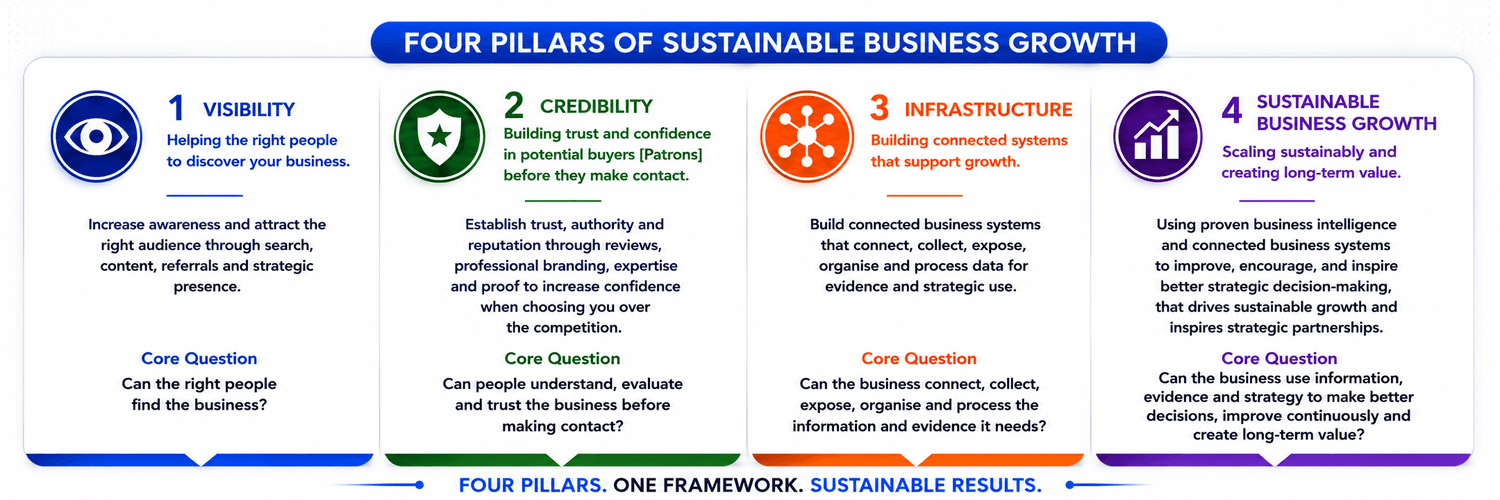
The framework is built around four pillars:
Visibility.
Credibility.
Infrastructure.
Sustainable Business Growth.
But the four pillars are not simply four categories of services.
They represent four different perspectives and capabilities within a business.
The distinction is important because each pillar looks at a different part of the relationship between the business, its audience, its infrastructure and its ability to grow.
The first question is therefore about what the business deliberately puts into the world:
How does the business make itself visible?
Visibility: What the Business Deliberately Presents
Visibility begins from the business's perspective.
The business makes deliberate decisions about what it wants to present, communicate and make visible.
This includes decisions about:
Business identity.
Positioning.
Chosen messages.
Services.
Areas of operation.
Content.
Channels.
Public presence.
Partnerships and community presence.
The business decides:
What are we presenting?
What do we want to be known for?
Where do we want to be visible?
How are we going to present ourselves?
Visibility may be created through:
Websites.
Search.
Google Business Profile.
Social media.
Content.
Advertising.
Networking.
Community engagement.
Referrals.
Strategic partnerships.
But the important distinction is that visibility is not defined primarily by the people who may eventually see the business.
It begins with the business deciding what it is presenting.
The business creates the signals.
It chooses the message.
It chooses where and how those signals are made visible.
Visibility is therefore an intentional business activity.
But deliberate presentation is only the beginning.
A business can decide what it wants to communicate and where it wants to be seen, but it cannot decide exactly how every person will interpret what they encounter.
Once the business becomes visible, the audience begins evaluating what it sees.
That leads to the second pillar:
Credibility: What the Audience Understands and Trusts
Credibility begins from a different perspective.
It is the audience's perspective.
The business can decide what it presents.
It cannot decide exactly what every person will believe about it.
The audience evaluates what the business presents.
They may ask:
Does this make sense?
Can I understand what this business does?
Does the business appear capable?
Is there evidence?
Can I trust what I am seeing?
Does the experience support what the business is saying?
Credibility therefore develops through the audience's interpretation and evaluation of the business.
The business can influence that process through:
Professional presentation.
Consistent communication.
Customer reviews.
Testimonials.
Demonstrated experience.
Evidence.
Qualifications.
Case studies.
Clear information.
Reliable customer experiences.
Consistent delivery.
But credibility is not something the business can simply declare.
A business can say:
"We are trustworthy."
But the audience decides whether it believes that.
A business can say:
"We provide professional service."
But the audience evaluates whether its experience supports that claim.
This creates an important distinction:
Visibility is what the business deliberately presents.
Credibility is what the audience is able to understand, evaluate and trust.
The two are connected, but they are not the same thing.
But there is another part of the relationship that neither visibility nor credibility can solve on its own.
The business needs to be capable of supporting the expectations it creates.
It needs somewhere to capture information, connect activities, organise knowledge and manage the interactions that follow.
This brings the framework to its third pillar:
Infrastructure: Connecting, Collecting and Organising Information
Infrastructure connects the business's activities and the information those activities produce.
It is the mechanism through which information can be:
Collected.
Connected.
Exposed.
Organised.
Processed.
Stored.
Made accessible.
Prepared for interpretation.
Infrastructure can include:
Websites.
CRM systems.
Business communication systems.
Analytics.
Databases.
Documentation.
Knowledge management.
Lead capture systems.
Workflow systems.
Automation.
Reporting systems.
This means infrastructure sits between business activity and business understanding.
Visibility creates information about what the business is presenting and where that presentation is occurring.
Credibility creates information through audience responses, feedback, reviews, interactions and evidence.
Infrastructure helps collect and organise these forms of information so they can become useful to the business.
The purpose is not simply to collect more data.
It is to make information usable.
That is why Collen sees analytics as part of infrastructure rather than simply as a marketing tool.
Analytics can capture what is happening.
Systems can organise what is happening.
Documentation can explain what the business knows.
Together, these create information that the business can eventually interpret.
But collecting and organising information is not the final objective.
Information only becomes strategically valuable when the business can interpret it and use it to decide what to do next.
That is where the fourth pillar becomes important.
Sustainable Business Growth: Interpret, Decide, Adapt and Act
The fourth pillar is where information becomes useful for business development.
The business needs to interpret what its systems are showing it.
It needs to decide what matters.
It needs to adapt.
And it needs to act.
This includes:
Interpreting information.
Applying experience.
Making decisions.
Tracking progress.
Improving continuously.
Increasing capacity.
Developing strategy.
Identifying opportunities.
Inspiring strategic partnerships.
This is where the distinction between data and decision-making becomes important.
Infrastructure can collect and organise information.
But the business still has to determine what that information means and what should happen next.
That requires judgement.
It requires context.
It requires experience.
It requires strategy.
And sometimes
It requires collaboration with people outside the business.
Sustainable business growth is therefore not simply the result of having more information.
It is the result of becoming better at using information and experience to make decisions and take action.
At this point, the four pillars can be seen as parts of one broader system rather than four isolated ideas.
Visibility concerns what the business deliberately presents.
Credibility concerns how that presentation is understood and evaluated.
Infrastructure provides the systems through which information can be captured and organised.
Sustainable business growth is where the business interprets that information, makes decisions and acts on what it learns.
The relationship between these pillars is therefore more important than any individual pillar in isolation.
The Four Pillars Are Interconnected
The Growth4biz Framework™ is not intended to be understood as four rigid steps that every business follows in exactly the same order.
The pillars are interconnected capabilities.
The relationship can be understood as:
Visibility → Credibility → Infrastructure → Interpretation → Decision → Action → Sustainable Growth
But these relationships can operate in multiple directions.
A business may discover through its infrastructure that its visibility is attracting the wrong audience.
It may then change what it presents.
A business may receive credibility feedback that reveals a weakness in its customer experience.
It may then improve its infrastructure.
A business may interpret operational information and identify a new partnership opportunity.
It may then use visibility to become known within that new environment.
The framework therefore provides a way of understanding what is happening within the business and identifying where action may be required.
And this brings the framework back to one of the central questions in Collen's thinking:
What happens when business activity increases faster than business capability?
A business can become more visible, generate more enquiries and collect more information without necessarily becoming more capable of handling what that activity creates.
This is where the distinction between activity and capacity becomes important.
From Activity to Capacity
This distinction between activity and capacity has become an important part of Collen's thinking.
A growing business can generate more:
Leads.
Customers.
Sales.
Enquiries.
Transactions.
Marketing activity.
But if the underlying business does not develop its ability to handle those things, growth can create problems.
For example:
A business may successfully increase enquiries through marketing.
But if nobody responds quickly enough, the additional visibility has not created sustainable growth.
The business has increased activity without increasing capacity.
Scaling is different.
Scaling increases the capacity of the business to handle greater demand.
That may require:
Better processes.
Additional staff.
Automation.
Documentation.
Improved systems.
Better management.
Additional funding.
Strategic partnerships.
This is why Collen views sustainable growth as more than simply increasing revenue or activity.
The deeper question becomes:
Has the business become more capable of handling what its growth creates?
Answering that question requires the business to know what is actually happening inside it.
That requires information.
And information becomes increasingly valuable when it can be connected to the processes, knowledge and experience of the business.
From Documentation to Business Intelligence
This also connects with Collen's broader view of systems and data.
When processes become digital, the business can begin generating information about what is happening.
Systems can capture things such as:
Customer enquiries.
Website interactions.
Sales activity.
Service delivery.
Customer behaviour.
Operational activity.
Performance information.
That information can then be organised and interpreted.
The business can begin asking:
What is happening?
Why is it happening?
What have we learned?
What should we change?
What opportunity does this information reveal?
This is where documentation, systems and data begin connecting with sustainable business growth.
The business is no longer relying solely on intuition.
It can increasingly use documented knowledge, accumulated experience and information generated through its systems to support better decisions.
Once business knowledge and information become structured enough to support decisions, another possibility emerges.
Technology can begin interacting with that knowledge in more sophisticated ways.
This is where Collen's thinking about artificial intelligence begins to connect with the longer-term direction of Growth4biz.
The Long-Term Vision: The Growth4biz AI Business Navigator
Collen's long-term thinking is that structured business knowledge can eventually support the development of more sophisticated digital products and AI systems.
For example, a business may eventually be able to create an AI representation of a particular area of its knowledge, methodology or framework.
This does not mean creating an artificial version of the entire business overnight.
It can begin with:
One clearly defined body of knowledge.
One process.
One framework.
One customer journey.
One specialised area of expertise.
Once that knowledge is documented and structured, it becomes easier to connect technology to it.
This thinking contributes to the longer-term development of the Growth4biz AI Business Navigator.
The concept is based on the idea that structured business knowledge can become a foundation for intelligent tools that help businesses understand their current position, identify opportunities and make better decisions.
The important point is that the AI system is not the starting point.
The documented business knowledge is the starting point.
The website can therefore become more than a place where customers find information.
It can become one of the first places where a business begins making its knowledge visible, structured and usable.
And that creates possibilities that extend far beyond the website itself.
But the possibility of using AI and automation raises another important question:
What should technology actually do within a business?
For Collen, the answer is not to automate everything simply because automation is possible.
The purpose is to increase capability while preserving the areas where human judgement, relationships and responsibility remain essential.
Building Systems Without Losing the Human Element
Collen's approach to systems is not based on the idea that every part of a business should eventually be automated.
Technology has limits.
Some activities require:
Judgement.
Relationships.
Creativity.
Leadership.
Empathy.
Negotiation.
Context.
Human responsibility.
The purpose of systems and automation is therefore not necessarily to remove people.
It is to reduce unnecessary repetition and create greater capacity for the activities where people add the most value.
A well-designed system can allow a business owner to spend less time repeatedly performing administrative tasks and more time making decisions, serving customers, developing relationships and improving the business.
The objective is not:
Technology instead of people.
It is:
Technology supporting people.
If technology is ultimately intended to support people and increase business capability, then digital infrastructure is only one part of the equation.
Businesses still need to engage with the real world.
They need customers to encounter them, understand them and interact with them.
That brings the discussion back to visibility — but now from a broader perspective than search engines and digital platforms alone.
Visibility Through Action
Collen's understanding of visibility also extends beyond online marketing.
A business cannot always expect people to discover it simply because it has created a website or social media account.
Visibility often requires deliberate action.
This includes going beyond the four walls of the business.
It can involve:
Community engagement.
Networking.
Public events.
Educational sessions.
Partnerships.
Speaking.
Demonstrating expertise.
Helping people solve real problems.
This has become particularly relevant to Collen's own work.
His involvement in community initiatives such as the Grace Notes Community Transformation Day, together with the Grace Notes Open-air Sessions he has been conducting, reflects a practical application of the principle.
The idea is simple:
If you want to become known, you have to make an intentional effort to become known.
Visibility requires exposure.
Exposure requires action.
And action creates opportunities for people to encounter the person, business or solution behind the brand.
But becoming visible through action is not only about attracting attention.
It is also about creating opportunities to understand people, demonstrate capability and build relationships.
This is where visibility begins to overlap with community engagement.
Community Engagement as a Business Principle
Community engagement is therefore not viewed simply as promotional activity.
It can be an opportunity to:
Understand real problems.
Communicate solutions.
Demonstrate capability.
Build relationships.
Create awareness.
Learn from people.
Identify opportunities.
Develop partnerships.
There is an important difference between telling people that a business can help them and actually going into environments where people can experience the business's approach to helping.
This makes community engagement a practical extension of visibility.
The business becomes visible through action rather than simply through advertising.
And when those relationships develop, visibility can create something more valuable than attention alone.
It can create relationships with people and organisations that may become collaborators, referral sources, supporters or strategic partners.
Partnerships and Strategic Relationships
Visibility can also create another opportunity:
Partnerships.
A business that is known for what it does can become easier for other organisations, businesses and community groups to identify as a potential partner.
Partnerships do not always begin with money.
They may begin with:
Shared resources.
Shared audiences.
Collaboration.
Community projects.
Referrals.
Knowledge exchange.
Joint initiatives.
Strategic relationships.
In some cases, a partnership can become an alternative route to opportunity before traditional funding becomes available.
This is particularly important for growing businesses.
A business that demonstrates what it does, communicates clearly and becomes known within its community can create relationships that would otherwise never have existed.
Collen's approach therefore treats visibility as more than a search-engine concept.
It is also about becoming findable by people who may create opportunities.
Some of those opportunities may come through customers or partnerships.
Others may come through organisations that are prepared to provide resources for businesses with credible opportunities and sufficient capacity to use those resources.
This raises another question in the Growth4biz approach:
What makes a business capable of using funding effectively?
Becoming Fundable
Another area where the Growth4biz Framework™ becomes particularly relevant is funding readiness.
Funding should not necessarily be viewed as the starting point of growth.
It can be viewed as an opportunity that becomes more useful when the business has developed sufficient capability to use it effectively.
A funder may want to understand whether the business:
Has a legitimate market.
Can demonstrate demand.
Has credible leadership.
Has appropriate systems.
Understands its financial position.
Can explain how funding will be used.
Has the operational capacity to implement its plans.
Can demonstrate progress.
Can provide relevant information and evidence.
This is where the four pillars become relevant.
Visibility concerns what the business deliberately presents and makes visible about itself.
Credibility concerns how that presentation and the available evidence are understood and evaluated by the audience.
Infrastructure provides systems for collecting, connecting, organising and processing relevant information.
Sustainable Business Growth is where the business interprets that information, makes decisions, adapts and acts.
The framework does not claim that meeting these conditions automatically guarantees funding.
Rather, it provides a way to think about the capability a business may need to demonstrate before external capital can be used effectively.
Funding can provide additional resources.
But resources alone do not create capability.
The business needs the capacity to use those resources well.
That distinction between resources and capability is important.
Funding can give a business access to more resources, but those resources only create sustainable value when the business can convert them into greater capacity.
This brings the discussion back to one of the central ideas in Collen's approach:
Funding and Capacity
This connects directly to Collen's distinction between activity and capacity.
A business may receive funding and use it to:
Hire employees.
Purchase equipment.
Increase marketing.
Develop technology.
Expand operations.
Enter new markets.
The funding increases the resources available to the business.
But the business must then convert those resources into increased capacity.
That may require new systems, people, processes and management capability.
In this sense:
Funding can provide resources.
Infrastructure helps organise those resources.
Sustainable business growth determines how effectively the business interprets information, makes decisions and applies those resources.
The outcome should be greater capacity.
That capacity then gives the business the ability to handle a larger level of activity.
But increased capacity also creates another requirement.
As the business becomes larger and more active, it generates more information.
The business therefore needs to understand not only how to create capacity, but also how to use the information generated by that capacity.
Information as a Growth Asset
Once business knowledge has been captured and structured, another possibility emerges.
The information can begin to create value beyond simply being stored.
This is where information becomes a growth asset.
Businesses generate information constantly.
Customer enquiries.
Sales activity.
Website interactions.
Service delivery.
Customer behaviour.
Operational activity.
Financial information.
Performance information.
The important question is not simply whether the business is collecting information.
The question is:
What can the business understand from it?
Structured information can help the business identify patterns, compare performance and recognise changes that may otherwise be difficult to see.
The business can begin asking:
What is happening?
What is changing?
What are we learning?
What requires attention?
What opportunity does this information reveal?
This is where information begins connecting with decision-making.
The business interprets what it is seeing.
It applies context and experience.
It considers the possible consequences.
It decides what to do.
And the decision creates another cycle of experience and information.
This creates a continuous growth loop:
Information → Interpretation → Decision → Action → Experience → Improvement
Over time, that cycle can help the business become more capable.
For example:
A business may discover through its enquiry data that customers repeatedly ask about a service that is poorly explained on the website.
The information reveals the pattern.
The business interprets the problem.
It decides to improve the service information.
The change creates a new customer response.
That response generates more information.
The business can then evaluate whether the change improved the situation.
The same principle can apply to:
Sales performance.
Customer service.
Marketing activity.
Operational efficiency.
Product development.
Resource allocation.
Staff performance.
Customer retention.
Information therefore becomes useful when it can influence what the business does next.
This is also where the Growth4biz Framework™ connects with Collen's thinking.
The Infrastructure pillar helps create systems that collect, connect and organise information.
The business can then interpret that information.
The Growth pillar is where those interpretations can contribute to decisions about what the business is building toward.
The objective is not to collect data simply because data exists.
The objective is to develop the ability to learn from what the business is experiencing and make better decisions because of it.
This creates a broader progression:
Knowledge → Structure → Information → Interpretation → Decision → Action → Improvement → Capability
Information becomes a growth asset when it helps the business understand itself better and act more deliberately.
That is the point at which information stops being merely something the business possesses and becomes something the business can use.
And when a business understands itself better, it can also recognise where it has capabilities it can offer and where it has capabilities it does not have.
That recognition can create another pathway to growth:
Partnership.
The Importance of Strategic Partnerships
Strategic partnerships can emerge from this same process.
A business may interpret its information and discover:
A new market opportunity.
A capability gap.
A potential collaboration.
A customer need it cannot solve alone.
A complementary service.
A community opportunity.
A technology opportunity.
The answer does not always have to be building everything internally.
Sometimes the strategic answer is partnership.
This is why Collen's definition of sustainable business growth includes the idea of inspiring strategic partnerships.
Growth does not always mean doing more alone.
Sometimes growth means becoming capable of working with the right people and organisations.
Partnerships therefore reinforce another part of Collen's broader philosophy: sustainable growth does not come from one capability operating in isolation.
People, processes, information, technology and relationships all interact.
That raises a broader question about the role technology should play within that system.
A Practical Philosophy of Technology
Collen's approach to technology can be summarised in a few principles.
The Function of a Website Is to Build Business Capability
This is the foundational principle.
The website should not be viewed merely as a digital brochure or a once-off deliverable.
Its deeper function is to contribute to the capability of the business.
Technology Should Solve a Business Problem
Technology should have a purpose.
A business should not adopt software simply because it is fashionable.
The question should be:
What problem will this solve?
Build What You Can Control
Businesses should understand the difference between assets they control and platforms they use.
A website and domain provide a stronger level of control than relying entirely on a social media platform.
Platforms can provide distribution.
Business-owned assets provide greater control.
Document Before You Automate
Automation works better when the underlying process is understood.
If nobody knows how a process works, automating it may simply make confusion happen faster.
Documentation creates clarity.
Use Infrastructure to Make Information Usable
Systems should not simply collect information.
They should connect, organise and process it so that the business can eventually interpret it.
Use Data to Improve Decisions
Information becomes valuable when it can be interpreted and applied.
Use AI to Extend Capability
AI should not replace business thinking.
It should be used where it can help the business interpret information, support processes, improve efficiency or create new capabilities.
These principles connect technology directly to business growth.
Taken together, these principles also explain why Collen's approach differs from a conventional technology-first approach.
Rather than beginning with the question of which tool a business should buy, the starting point is the business itself.
What Makes This Approach Different?
Many digital-business approaches begin with a tool.
Website.
CRM.
Automation.
AI.
Advertising.
Collen's approach begins with the business.
The questions become:
What does the business know?
What does it need?
What problem is it trying to solve?
What should be documented?
What should become a process?
What information should be captured?
What capability needs to be developed?
Only then does technology become relevant.
This creates a different relationship with digital infrastructure.
Technology is not the destination.
It is part of the infrastructure that allows the business to become more capable.
If technology is not the destination, then the question becomes what the technology is actually being built around.
For Collen, an important answer is the knowledge of the business itself.
That leads us to the idea of the Business Knowledge System.
The Business Knowledge System
This philosophy has also influenced the way Collen thinks about business knowledge.
A business does not only have physical assets, financial assets or digital assets.
It also has knowledge.
That knowledge may include:
How the business operates.
What services it provides.
How customers are handled.
How decisions are made.
What processes are followed.
What employees have learned.
What problems have already been solved.
What the business has discovered through experience.
The problem is that much of this knowledge can remain scattered.
It may exist in:
People's memories.
Emails.
Documents.
Spreadsheets.
Websites.
Conversations.
Customer records.
Internal procedures.
When knowledge remains scattered, it becomes difficult to access, transfer, maintain and improve.
This is where the idea of a Business Knowledge System becomes important.
The objective is not necessarily to create another piece of software.
It is to create a structured way of capturing and organising what the business knows.
That can include:
Knowledge assets.
Articles.
Frameworks.
Processes.
Standard Operating Procedures.
Business information.
Customer journeys.
Service documentation.
Internal knowledge.
The structure gives the business a clearer view of its own knowledge.
Instead of knowledge existing primarily in individual people's heads, important knowledge can become documented and organised within the business.
This creates a progression:
Individual Knowledge → Documentation → Structured Business Knowledge
The benefit is not simply having more documents.
Structured knowledge can be easier to:
Find.
Understand.
Transfer.
Maintain.
Improve.
Connect to business processes.
It can support employees who need to understand how the business works.
It can provide a reference point when processes change.
It can help preserve knowledge when people leave the organisation.
And it can create a foundation for systems that need access to reliable business information.
This is why Collen sees documentation as more than administrative work.
Documentation can become part of the infrastructure through which a business preserves and develops what it knows.
The Business Knowledge System is therefore not defined by a particular application or platform.
It is a way of thinking about the organisation of business knowledge.
Capture what the business knows.
Structure it.
Keep it accessible.
Make it possible to build upon.
But simply capturing knowledge is not enough if that knowledge remains dependent on the person who originally holds it.
For a business to become more scalable, important knowledge needs to move beyond individual memory and become part of the organisation itself.
From Individual Knowledge to Organisational Knowledge
A business can be highly dependent on one person.
That person knows:
How things work.
Why decisions are made.
How customers are handled.
How services are delivered.
Where information is stored.
What needs to happen next.
This can work for a small business.
But it creates a serious limitation.
If the knowledge cannot be transferred, the business becomes dependent on the individual.
Documentation begins changing that.
Knowledge can move from:
Person → Document → Process → System → Organisation
This makes the business less dependent on individual memory.
It also makes growth easier to manage.
New employees can learn.
Processes can be improved.
Systems can be connected.
Information can be analysed.
And technology can eventually interact with structured knowledge.
But organisational knowledge is not something that should simply be preserved.
It should also evolve.
Processes change.
Customer expectations change.
Markets change.
Technology changes.
The business therefore needs a mechanism for learning from what it knows and continuously improving it.
The Role of Continuous Improvement
Collen's view of sustainable business growth also places emphasis on continuous improvement.
A business does not become sustainable because it finds one perfect system.
Markets change.
Customers change.
Technology changes.
People change.
Business conditions change.
The business therefore needs the ability to learn.
That means asking:
What worked?
What did not work?
What information did we collect?
What did customers tell us?
What can we improve?
What should we stop doing?
What should we do differently?
Continuous improvement turns experience into capability.
And capability is what allows growth to become more sustainable.
This brings the different parts of Collen's approach back to the same central question:
Can the business become more capable as it grows?
Continuous improvement is valuable because it allows the business to learn from experience and strengthen the systems, knowledge and decisions that support its future activity.
A Business That Can Handle Growth
Ultimately, Collen's approach is not about creating businesses that simply appear successful.
It is about helping businesses develop the capability to handle success.
A business that becomes visible but cannot respond to enquiries has a capacity problem.
A business that attracts customers but cannot deliver consistently has an infrastructure problem.
A business that has systems but does not learn from the information they produce has a decision-making problem.
A business that learns, improves, develops relationships and increases its capacity becomes better positioned for sustainable growth.
This is why the Growth4biz Framework™ connects:
Visibility → Credibility → Infrastructure → Sustainable Business Growth
Not as a rigid sequence.
But as interconnected capabilities.
Those interconnected capabilities provide the context for understanding what Collen is building through Growth4biz Media.
The objective is not simply to strengthen one part of a business.
It is to help businesses develop the combination of visibility, credibility, infrastructure, knowledge and decision-making capability required to handle what comes next.
The Business Collen Is Building
Today, Collen's work through Growth4biz Media is increasingly focused on the intersection between:
Business.
Digital infrastructure.
Knowledge.
Systems.
Data.
AI.
Community.
Strategic partnerships.
Sustainable growth.
The objective is not simply to provide businesses with another digital service.
It is to help businesses build a stronger foundation from which they can operate and grow.
That includes helping businesses establish professional digital assets.
It also includes helping them think more deliberately about the systems and knowledge behind those assets.
The longer-term direction extends toward building intelligent business tools around structured knowledge and the Growth4biz Framework™.
That direction is reflected in the principles that increasingly define Collen's approach.
They provide a practical way of summarising what he believes businesses should build, how technology should be used and what sustainable growth should ultimately achieve.
What Collen Silaule Stands For?
At the centre of Collen's approach are several principles.
Build Before You Automate
Understand the business before attempting to automate it.
Document What You Know
Knowledge becomes more valuable when it can be accessed, transferred and improved.
Build Assets You Can Control
Use platforms for distribution while continuing to build business-owned digital assets.
The Function of a Website Is to Build Business Capability
A website should contribute to the capability of the business rather than exist merely as a digital brochure.
Visibility Is Deliberate
The business decides what it wants to present, communicate and make visible.
Credibility Belongs to the Audience
The business can present evidence and create expectations.
The audience evaluates whether those expectations are justified.
Infrastructure Makes Information Usable
Systems should connect, collect, expose, organise and process information so the business can use it.
Data Should Support Better Decisions
Information becomes valuable when it can be interpreted and applied.
Growth Must Create Capacity
Increasing activity without increasing capability can create problems.
Technology Should Increase Human Capability
The goal is not to remove people from business.
The goal is to help people spend their time where they create the most value.
Growth Does Not Always Mean Doing Everything Alone
Strategic partnerships can create capabilities and opportunities that would be difficult to build independently.
These principles point toward a broader direction.
They are not only a description of how Collen approaches businesses today.
They also provide a foundation for what he is trying to build next.
Looking Ahead
The next stage of Collen's work is not simply about building more websites or adding more technology.
It is about exploring what becomes possible when business knowledge, digital infrastructure, data and AI are connected more deliberately.
The Growth4biz Framework™ provides the strategic model.
The Growth4biz Business Knowledge System provides the knowledge structure.
Digital infrastructure provides the systems.
Data provides information.
AI can eventually provide additional capability.
And community engagement and strategic partnerships provide opportunities to apply those capabilities in the real world.
The objective is therefore not technology for technology's sake.
It is business capability.
That idea — business capability — provides the simplest way to understand the entire direction of Collen's work.
The story therefore comes back to the same question with which it began:
How can a business become more capable of handling what comes next?
Final Thoughts
Collen Silaule's approach to entrepreneurship has developed from a combination of technical experience, business experience and an increasing interest in the relationship between knowledge, systems, technology and growth.
At the centre of that approach is a simple idea:
A business should become more capable as it grows.
The business deliberately decides what it will present and make visible.
The audience then encounters, interprets and evaluates those signals.
Credibility develops through what the audience is able to understand, evaluate and trust.
Infrastructure connects the activity and information produced through the business, collecting, organising and processing it so that it becomes usable.
The business then interprets that information, makes decisions, adapts and acts.
Experience accumulates.
The business learns.
Capacity increases.
And opportunities for sustainable growth and strategic partnerships can emerge.
That is the distinction between simply becoming busier and becoming more capable.
It is also why Collen's thinking about websites extends beyond websites.
The function of a website is to build business capability.
A website can become a place where the business begins documenting what it knows.
Documentation can become structured knowledge.
Structured knowledge can become processes.
Processes can become systems.
Systems can generate information.
Information can support better decisions.
And eventually, technology and AI can build upon that foundation.
The long-term objective is not to replace the entrepreneur.
It is to give the entrepreneur and the business greater capability.
That is the direction behind Growth4biz Media and the Growth4biz Framework™:
Build capability.
Make the business visible.
Establish credibility.
Build infrastructure.
Interpret information.
Decide.
Adapt.
Act.
Increase capacity.
Create sustainable growth.
And, where the opportunity exists, build relationships and strategic partnerships that allow the business to go further than it could alone.
For Collen, sustainable growth is ultimately not about how much activity a business can create.
It is about how much capability the business can develop to handle what comes next.
That is the principle that connects Collen's experience, Growth4biz Media, the Growth4biz Framework™ and the longer-term vision for business knowledge, digital infrastructure and AI.
About Collen Silaule

Collen Silaule is a South African entrepreneur and the founder of Growth4biz Media.
His work explores the practical relationship between business capability, digital infrastructure, structured knowledge, systems, information and sustainable growth.
Drawing from experience across technical work, business development, digital technology and entrepreneurship, Collen takes a practical, systems-oriented approach to helping businesses become more capable of handling growth.
His work through Growth4biz Media and the Growth4biz Framework™ focuses on helping businesses build stronger foundations through visibility, credibility, infrastructure, knowledge and better decision-making.
Connect with Collen Silaule
Follow Collen Silaule for practical insights and ongoing conversations about business, digital infrastructure, systems, knowledge and sustainable growth.
YouTube: [ NCS Podcast ]
TikTok: [ Growth4biz Media ]
Continue Your Growth Journey
Related Articles
Sustainable Business Growth Guide
How to Create a Professional Business Brand
Google Business Profile vs Website: Which One Does Your Business Need?
Business Name vs Domain Name: What's the Difference and Why It Matters
Google Business Profile for Small Businesses
How to Build a Business Funders, Partners and Clients Want to Invest In
Funding Readiness Checklist
Business Need
Business Profile / Authority
This article explains Collen Silaule's relationship with the Growth4biz Framework™ and Groawth4biz Media itself rather than representing a single Business Need.
Primary Pillars
Visibility
Credibility
Infrastructure
Sustainable Business Growth
Book a Consultation
Building a professional business requires more than choosing the right technology.
It requires understanding what the business is, documenting what it knows, creating systems around what it does and developing the capability to handle growth.
Growth4biz Media helps businesses strengthen that foundation through digital business infrastructure, professional websites, systems, knowledge development and growth-focused digital solutions.
If your business is becoming more active but the systems behind it are struggling to keep up, the next step may not be simply to do more.
It may be to build greater capacity.
Book a consultation and let's explore what your business needs to become more capable, more connected and better prepared for sustainable growth.
SHARE



Copyright 2026 • Growth4biz Media (Pty) Ltd.